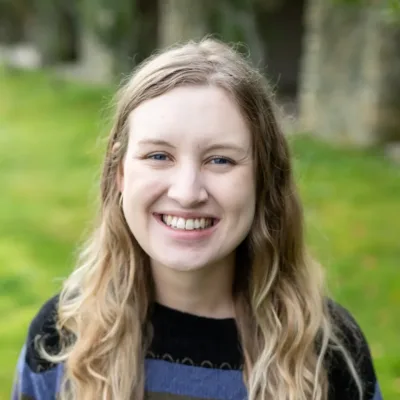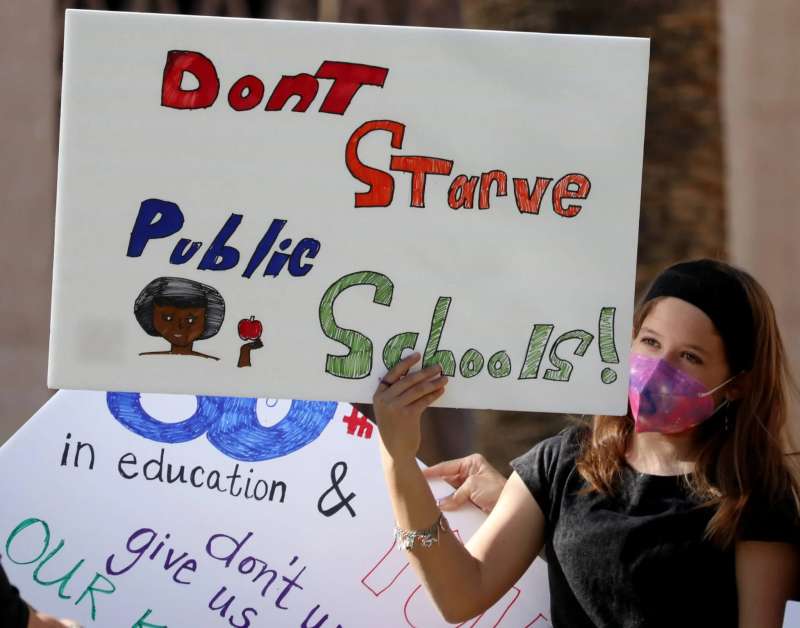
When Kristin Roberts, an English teacher at Carl Hayden Community High School, first heard about Proposition 320, she didn’t understand the alarm.
“Don’t we want more money in our classrooms?” she remembered thinking. She has watched colleagues leave for other states and districts over pay.
Once she read the measure, she got a better understanding of what it actually did.
Prop 320, referred to the Nov. 3 ballot by the Republican-controlled Arizona Legislature, would require districts with more than 7,500 students, or in counties with more than 500,000 residents, to spend at least 60% of their operation budgets on “direct instruction.” The Arizona Auditor General would decide what counts as “direct instruction.”
Districts statewide spent 52.1% on instruction in fiscal year 2025, according to the latest auditor general report, KTAR News reported.
Rep. Matt Gress, who sponsored the House version of the bill, said the goal is higher pay for teachers.
A teacher, a school counselor, and the head of the state’s school nurses organization said the measure would force cuts to the staff who support students, pile that work onto teachers, and possibly shrink teachers’ paychecks.
No new money
Prop 320 doesn’t add a dollar to school budgets. To reach 60%, districts below the spending mark would have to move money they already have.
“Without investing any more money into our schools, just micromanaging districts that are already strapped for cash, this will take away a lot of resources that I depend on as a teacher,” Roberts said.
Janine Menard, who has been a counselor in Arizona for nearly 25 years, said the math leads in one direction.
“You’re gonna have to have cuts, and the cuts are gonna come from school counselors, social workers, nurses, [and] special ed services,” she said.
Will Graham, president of the School Nurses Organization of Arizona, said his group formally opposes the measure. He pointed to Scottsdale Unified, which has listed spending that falls outside direct instruction: nurses, counselors, social workers, librarians, assistant principals, field trips, cafeteria staff, custodians, and school resource officers.
Graham said no district has told nurses they’ll be the ones cut if Prop 320 were to pass, but no single thing will close the gap to the 60% figure.
“Some of [these positions] are gonna have to be eliminated,” he said.
Who fills the gaps
Menard said she works with about 350 students, well above the 250-to-1 ratio the American School Counselor Association recommends. Arizona has the nation’s highest ratio at 570-to-1, according to the ASCA.
“We absolutely know we’re on the chopping block,” Menard said.
She said she’s working with one senior who is about three credits behind. They meet weekly, and she stays in contact with his parents.
“Together, myself, the parent, and the student, we form a little team,” she said.
Menard said her school has at least 50 off-track seniors in a typical year.
Fifty students across 25 years as a counselor means Menard has worked to help well over 1,000 students reach their graduation goals.
“Without the school counselor in there, I don’t know who else would do that. I don’t know who else would be part of that team other than the teacher,” she said.
Getting rid of counselors would be an increased workload for teachers, with no guaranteed pay increase.
“People can only do so much,” Menard said. “So if more pressure and more work is put on the teacher, then something else is going to fall to the wayside.”
Graham described the same shift for healthcare. A nurse may check on an elementary student with Type 1 diabetes anywhere from five to 15 times a day. Without a nurse, that monitoring could fall to the teacher.
“That’s five to 15 times a day that the teacher is now taking out of their lesson time to manage the student,” he said.
Some students’ federally mandated special education plans require nursing care, such as tube feeding or tracheostomy care. Districts must provide it, Graham said. But he expects it will not count toward the 60% for direct instruction.
“We are obligated by the federal government to expend these resources, but then the state is dinging us for expending them,” he said.
Roberts co-teaches a class with a special education teacher. She said a district presentation left her unsure which special education services would count as direct instruction, though she believes speech and occupational therapy would not.
A raise, or a pay cut?
Supporters of Prop 320 argue the measure would increase teacher pay. Their official ballot argument cites an auditor general finding that teachers would earn $7,500 more a year if money hadn’t shifted away from classrooms.
You can find official ballot arguments against Prop 320 here.
All three people in education doubt the arguments in favor. Nothing in the measure requires raises, and its enforcement tool runs through the Classroom Site Fund, money voters approved that helps pay teachers.
READ MORE: In Arizona’s tossup 6th District, Trump’s deportation surge is on the ballot
“Many districts use that fund to pay annual performance bonuses,” Graham said. “[Prop 320] actually has the potential to be a pay decrease.”
A district that misses the 60% target would lose 25% of its Classroom Site Fund allocation after one year. The cut grows to 50% after two years, 75% after three, and the full amount after four.
“I worry that [Prop 320] would end up costing me income,” Roberts said.
‘Direct instruction’ is undefined
The measure leaves the definition of direct instruction to the auditor general.
“From my understanding, the auditor general gets to decide what direct instruction is, and they could change their mind tomorrow,” Roberts said. “Which to me is just not something you want to vote on, something that can be changed right out from under you, especially [something] that impacts kids.”
Each person in education had the measure’s descriptive title read to them as it appears on the ballot:
“Requires certain school districts to spend at least 60% of their operational spending on direct instructional expenses as defined by the auditor general. Reduces certain state funding for noncompliant districts.”
All three said it does not tell voters enough.
Roberts called it misleading. “When people hear direct instruction, they don’t realize that it could have so many different definitions,” she said. “A lot of things that we count on, like math intervention [and] school counselors… I think a lot of people assume that counts as direct instruction, and it would never cross their mind that currently it doesn’t.”
“Absolutely not,” Menard said when asked if the title gives voters the full picture. “There’s nowhere in that description that explains at the expense of the 60%, all these other 40% things are going to get cut.”
Graham said voters who back it for teacher pay are “well-intentioned and quite frankly being tricked.”
A measure meant to shrink administration would cap administrative spending, he said. “It wasn’t written to shrink administration.”
Roberts also questioned the measure’s reach. It covers larger districts but not charter schools, even though both receive Classroom Site Fund money.
What they want instead
The educators said the fix is more money in, not a new rule for dividing it.
Roberts wants the Arizona Legislature to raise base per-student funding and let elected local school boards decide how to spend it.
“The people who come from the community know the needs of the community,” she said.
Menard sees Prop 320 as a jobs question that voters may miss.
“Prop 320 is basically, you’re killing jobs,” she said. “You’re taking people out of work.”