“Staying silent is how the stigma and the mystery and the lies stay so strong, and how we find ourselves here.” — Jennifer Sheets
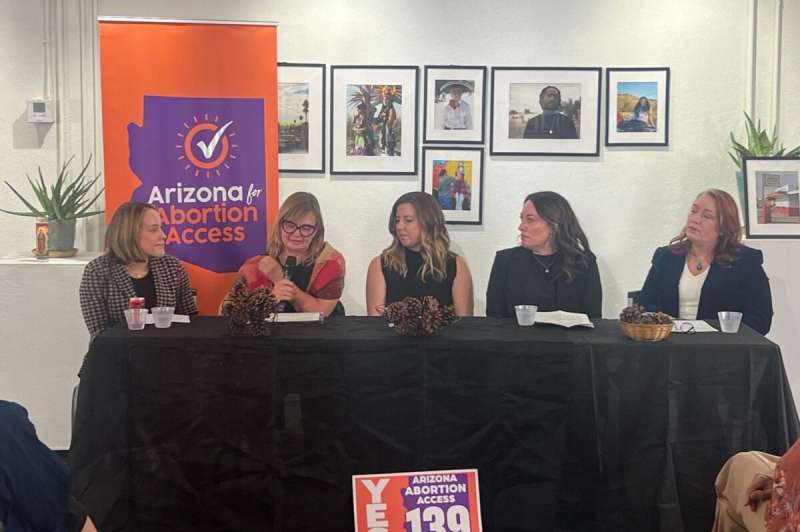
Five Arizona women spoke in favor of Prop 139 in south Phoenix on Oct. 10, just as early voting kicked off in the Grand Canyon State.
Proposition 139 is a citizen-led ballot measure that will allow Arizonans to vote on whether or not abortion should be constitutionally protected in the state. Right now, it’s statutorily protected up to 15 weeks into a pregnancy.
A YES vote on Prop 139 would constitutionally protect abortion before fetal viability, or when a fetus can survive outside the uterus (around 24 weeks). It would also prohibit penalties against health-care providers who offer abortion procedures and give them protections to do what is medically appropriate for their patients.
Despite abortion in Arizona being legal prior to 15 weeks of pregnancy, it isn’t uncommon for women to run into myriad health or personal issues after that cutoff, even when those women were hoping to bring the pregnancy to term.
Ashley Ortiz: Waiting to get sick enough so doctors could intervene
Ashley Ortiz, who has spoken in favor of Prop 139 in a commercial, talked to a few dozen people in south Phoenix about how Arizona’s current abortion law made what should’ve been a mindfully handled, dependable health-care procedure during her pregnancy into a nightmare for her family.
“I was at my routine 20-week anatomy scan when I went into preterm labor,” said Ortiz, who lives in Mesa. “The scan showed that my cervix had opened and [my baby’s] foot was already out of the cervix. At only 20 weeks, my baby was not yet viable, he would not survive, and my husband and I were devastated.”
READ MORE: This conservative is supporting Democrats and Prop 139 in 2024
Ortiz said that under normal circumstances, doctors would have given her medication and overseen her care as she delivered the nonviable fetus safely, but due to Arizona’s current abortion law she had to wait until the fetus’ heart stopped, or she developed a life-threatening infection that would allow physicians to intervene and safely remove the fetus during emergency care.
“My future fertility and my life were risked by this barbaric state law,” Ortiz said.
“Had Arizona politicians not decided that they knew better than doctors, this trauma would’ve been completely avoidable,” she said. “The women of Arizona deserve better. You all deserve better, and that’s why I’m voting yes on Prop 139, and I ask you to do so as well.”
Nicole Walker: Needed abortion after being raped as a child
Nicole Walker, a Flagstaff resident, shared her story about being raped by her 14-year-old babysitter.
“When I was 11, he impregnated me,” said Walker, now in her 50s. “In 1983, abortion was legal across the United States. I did not feel lucky to get an abortion. It felt like garbage. The babysitter did not have to go to the clinic. The babysitter was not shunned and shamed by our community.”
Walker said decades after the abortion, when Roe v. Wade was overturned by the far-right US Supreme Court, she felt the past come rushing back.
“I was so angry. I felt so disempowered. I felt like I’d been relegated to a second-tier citizen,” she said. “How could my daughter or her friends believe they have powerful voices [when] they have no voice about what to do with their own bodies?”
Walker said knowing that Arizona’s children and women may not be able to access the care they need motivated her to share her story in the New York Times.
She said she can’t predict what her life would have been like if she was forced to give birth when she was 11, but that she can be sure about a few things.
“I wouldn’t teach at Northern Arizona University. I wouldn’t be working on a book about climate change. I wouldn’t be married to my husband or have my two children,” Walker said. “I would be a prisoner subject to a body’s whims—and not my body’s whims, but the whims of a teenage boy who, as best I can tell, experienced no consequences.”
Kristin Gambardella: Tragic diagnosis sends her out of state to find care
Kristin Gambardella, a Tucson woman, was 17 weeks pregnant when doctors told her that her child had several medical anomalies, including one that would require in-utero surgery.
“Even if she survived the complex surgery and everything went well for her and for myself, the doctors told us that our baby would live a short life full of pain and surgeries and constant medical care,” Gambardella said.
Due to Arizona’s abortion limitations after 15 weeks, Gambardella wasn’t able to terminate her pregnancy and save her child from a painful life. She had to travel out of state.
“Instead of spending the last few days of my pregnancy giving my baby girl love and mourning our loss, we were tasked with all of the logistics of traveling out of state,” she said.
Gambardella said the night before her abortion, she had to sleep in a short-term rental in a city she didn’t know, trying to enjoy the last few moments with the child she wanted to have.
When she arrived at the clinic the next day, she said she was greeted by anti-abortion protesters who had no knowledge of her situation, but who were judging her for doing what was best for her and her family.
“With this personal experience with Arizona’s cruel laws, I know I can’t stay silent,” Gambardella said. “I do not want any family to go through what we went through. I find hope in working to protect abortion access in Arizona. First by voting yes, and then by passing Prop 139.”
Morgan Finkelstein: Twins
Phoenix woman Morgan Finkelstein went through a pregnancy and an abortion not long before the fall of Roe v. Wade.
“My husband and I were delighted to learn that I was pregnant three weeks after our wedding,” she said. “We were even more delighted to learn that we were expecting twins, and then we were excited to learn that it was a girl and a boy.”
Finkelstein said that’s where the excitement stopped. She and her husband learned that the male twin had a critical heart defect. The doctor said the condition was dangerous, and recommended that she receive a selective reduction.
Selective reduction is the removal of at least one fetus during a pregnancy. It is a type of abortion that isn’t performed by all providers.
She was 20 weeks into her pregnancy when doctors were able to find her a clinic in Los Angeles where she could receive the selective reduction.
“What happens with a selective reduction is you still have to carry that pregnancy,” Finkelstein said. “So for the remaining four months of my pregnancy, I carried my healthy twin daughter and my dead twin son.”
Finkelstein said her selective reduction trauma was compounded by having to travel to another state for the procedure.
“The words ‘choice’ and ‘decision’ are tough for me because this was necessary health care,” she said. “We call [Arizona] home and we always want it to be a better place, but Arizona really let me down and I can’t watch it let anyone else down.”
Jennifer Sheets: No regrets after abortion at 14
“At 14 years old, I found myself in an emotionally and mentally abusive relationship with a much older boy,” said Mesa woman Jennifer Sheets.
She said she was coerced into a sexual relationship with him, and he impregnated her in the next few months.
“My mother started noticing things. Changes in my behavior, changes in my body, and changes in my menstrual cycle, which was still very new,” Sheets said.
Sheets said they both broke down into tears when her mother asked her about the situation.
“In that moment, I believe that she made the best, bravest, and most loving decision possible and set out to find a place where I could have the pregnancy terminated,” she said.
Sheets had her abortion at 14, because the alternative was having a child as a child with no money or resources or even a high school diploma.
“I believe that having that abortion was the best decision for me and my family at the time. And 34 years later, I have zero regrets,” Sheets said.
She said she’s supporting voting yes on Prop 139 because the decision she made should be available to anyone and everyone. She said it’s a personal decision and often a medical necessity, and people who are anti-abortion often gloss over the second part.
“Even today I’m nervous that speaking publicly could have negative repercussions for me, but I’m certain that I cannot stay silent and do nothing when this choice is being ripped from the hands of the young women in my life and in this state,” Sheets said.