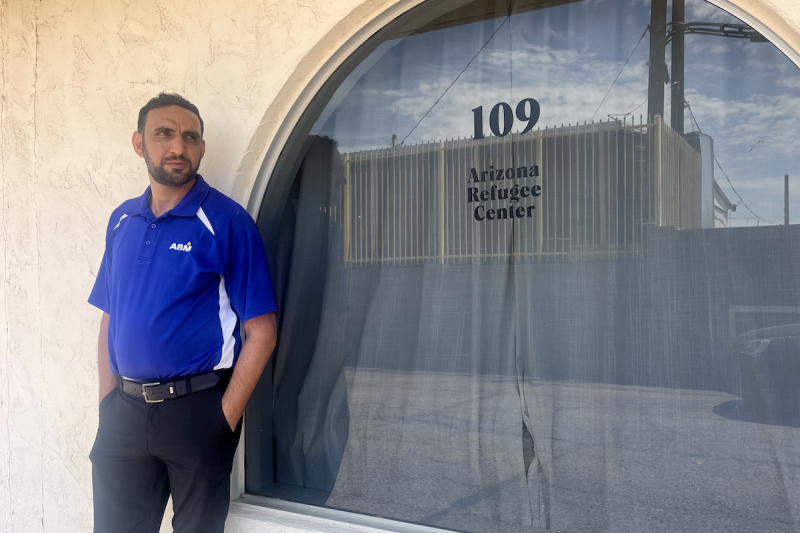
Mirwais Daudzai remembers his last few days in Afghanistan as chaotic, frightening, and uncertain. As a former police officer, he knew the Taliban would target him after the extremist group reclaimed power in August 2021.
The 32-year-old fled Kabul for the city of Mazar-i-Sharif, hid for days, then disguised himself, and headed to the international airport to leave the country for good. When he handed a Taliban official his passport, his heart was in his throat. Eventually, they let him through, and he left his six brothers, six sisters, his wife and child behind. There was no choice.
“If the Taliban had caught me, maybe they would have imprisoned me,” Daudzai said in Dari. “They would have humiliated me, would have torn me to pieces.”
Daudzai spent six months in Abu Dhabi before arriving in the US in April 2022 as a humanitarian parolee. He landed first in Washington DC, then moved to Phoenix after a friend encouraged him to relocate to the Valley.
He applied for asylum, which was granted, and in August 2023, applied for a green card, which would grant him permanent residency.
After he was granted asylum, Daudzai spent about $5,000 to get his wife to Pakistan for an interview at a US embassy there. She joined him in the US in 2024.
With limited English skills and a new life to build, he took whatever work he could find — cleaning hotels, driving for Uber, and now, assisting passengers at Phoenix Sky Harbor Airport.
But Daudzai fears his life could be upended again by the end of the year, when his work permit is set to expire, unless US Citizenship and Immigration Services (USCIS) works through a backlog of applications frozen under President Donald Trump.
A shooting in DC changed everything
In November 2025, Rahmanullah Lakanwal, an Afghan national, shot two National Guard members in Washington, DC., killing one. Hours later, USCIS announced it was halting the processing of immigration requests for Afghan nationals.
“Effective immediately, processing of all immigration requests relating to Afghan nationals is stopped indefinitely pending further review of security and vetting protocols,” USCIS said in a post on X.
Within days, the State Department then paused all visas for Afghan passport holders. A month later, Trump doubled down, expanding the freeze to immigration applications and status adjustments for Afghans and citizens of 18 other countries.
That left Daudzai in a precarious spot — his work permit is set to expire by the end of the year, and with it his driver’s license.
Work permits for asylum applicants used to last up to five years, but in December 2025, USCIS reduced it to a maximum of 18 months, also ending the grace period that let renewal applicants keep working while their case was being processed. Daudzai applied for renewal in 2025, but the newly implemented pause and rule changes left him without answers and with growing anxiety.
“If your driver’s license expires, you can’t even go to work. If you find a job, you can’t go there. God forbid you have an accident, then you get stuck,” Daudzai said. “You become a burden to others. Who would dare to drive with an expired driver’s license? We also understand that if you don’t have legal documents, no one will hire you. It’s so degrading.”
Without a work permit, Daudzai worries that he won’t be able to prove he’s eligible to work — and that he’ll lose his job by year’s end. That means rent, groceries, and other expenses could go unpaid, and he isn’t sure how he’ll afford life in Phoenix as costs continue to rise.
“My God, help me,” Daudzai said “This situation that you see here, this itself is now prison for me. Here, right now, really I’m inside the jail. Because no work for me, no green card – stress”
A different path, the same limbo
Daudzai isn’t alone. Mrs. Khan, who asked to be identified by her last name only out of fear, is in a similar boat, but her path to the US looked a little different.
A mother of two, Khan fled Afghanistan shortly after the Taliban takeover — first to Qatar, then Germany, and finally to the US in 2021. She and her husband came through the US evacuation with Chief of Mission (COM) approval, a program for Afghans who provided assistance to US forces. Things were smooth for a while, until Trump took office.
In November 2025, Khan walked into her green card interview, and at the time, interviewees could expect to receive a green card within weeks. Khan was working in laundry services, expecting legal status soon and, with it, the right to work without worrying about expirations.
But her application stalled after Trump’s broad pause, and as of this month, she’s still waiting on a final decision.
With an unclear legal status and an expired work permit, Khan spends her days caring for her two children, 8 and 11, while stuck in legal limbo. Her husband’s work permit isn’t set to expire until 2030, but the family’s overall status remains unclear — and Khan worries what that means under the Trump administration.
“It’s very hard for us. Nothing can be done. No work. The expenses are a lot, there are many problems,” Khan said. “Life here is difficult. If there is no money, if you don’t pay for a day, they will evict you. If you don’t pay the electricity, then fines come and it increases a lot. Everything, everything is a problem. Everything is a problem.”
Daudzai makes about $1,500 a month, all of which goes toward paying for rent and meals. His marketplace health insurance premium jumped from roughly $30 a month to more than $200, so he dropped his health coverage altogether. If a medical emergency struck, he isn’t sure what he’d do. His only insurance now, he said, is his faith in God.
“I, right now, am really so scared,” Daudzai said. “With hope I don’t become sick,” Daudzai said. “Sometimes I am sick, my wife is sick, we just go to Walgreens.”
He hopes to buy a vehicle so he can drive for Uber or Lyft on the side, but he can’t count on that future unless his work permit comes through.
“I’m very troubled. What should I do? Should I steal? Should I go and harm the people? I won’t do that, I won’t do that,” Daudzai said. “So, in the end, what should I do?”
What advocates are seeing on the ground
Julianna Larsen, co-founder of the Arizona Refugee Center, said the only work available to people with expired work permits is under the table, but fear of Immigration and Customs Enforcement (ICE) looms large as the Trump administration cracks down on undocumented workers.
“There’s such a crackdown, businesses won’t take a chance on any of that,” Larsen said. “They’re terrified to do that.”
In June, a federal judge in Rhode Island ruled the Trump administration’s blanket halt was unlawful, ordering USCIS to resume processing a backlog of roughly two million applications nationwide. The government has since appealed and asked the court to pause that ruling while the case proceeds — a request still pending as of mid-July.
In a statement to the Copper Courier, a USCIS spokesperson said the agency is “complying” with the court order, but offered no specifics on an estimated timeline for applications.
That uncertainty leaves Daudzai, Khan, and hundreds of other Arizona Afghans in the same situation, left to wait.
Robin Peterson, co-founder of the Arizona Refugee Center, said the organization has assisted hundreds of Afghans in similar positions. While they’ve seen signs that USCIS has begun working through the backlog, it isn’t moving fast enough to offer anyone certainty.
Larsen said it’s especially frustrating given that some of these Afghans assisted US forces — and are now caught in a bureaucratic system working against them.
“The thought that we as a nation cannot keep our promises globally, we made promises to our Afghans,” Larsen said. “We were in their country for 20 years, and most people that arrived here had promises made to them. It’s so concerning on a global scale, on a diplomatic scale.”
Despite the uncertainty, Khan tells her family back home in Afghanistan that things will improve — even though she’s unsure if that’s true.
“We tell our family that we will create a good life and our work permit will come, our green card will come, we will work, we will strive,” Khan said. “It’s very hard. It can’t be like this. The conditions here have become difficult.”
For now, Khan and Daudzai wait — watching the clock, with no solution in sight.