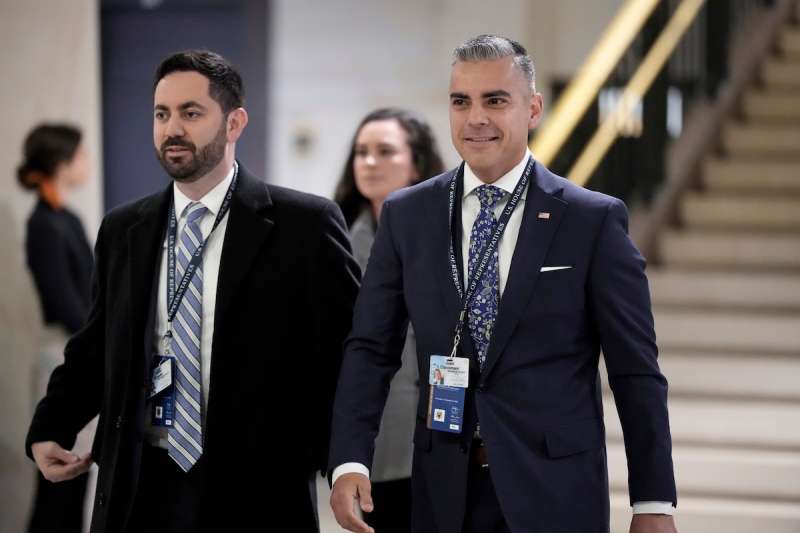
Arizona’s 6th Congressional District, covering Tucson, Eloy, Sierra Vista, and Casa Grande is a critical House seat that could help determine who controls Congress next year. Both parties are spending big in this high-stakes race. Incumbent US Rep. Juan Ciscomani (R-Tucson) is facing a challenge from US Marine and Navy veteran JoAnna Mendoza, a Democrat, in a race the Cook Political Report labels a “true toss-up.” Ciscomani won by less than three points in 2024 and 2022. President Donald Trump won the district by less than a point in 2024 and lost it by less than a point in 2020.
In a new reelection ad, Ciscomani pointed to his record to make the case that southern Arizona should send him back to the US House this November. It comes as Democrats are favored to take back House control as voters voice dissatisfaction with Trump and GOP policies that have led to increased costs. Ciscomani has voted with his party on many of those policies, including the Iran war and tariffs that have led to higher prices for Arizonans.
In the ad, Ciscomani appears to be differentiating himself from Trump and the GOP, pointing to his record as the “most collaborative and bipartisan lawmaker” and his own immigration background. The Republican came to the US from Mexico at age 11, and frequently points to his story as emblematic of the American Dream.
“As an immigrant, I’m grateful for the opportunity America has given me,” Ciscomani said in the ad. “I’ll always fight for working people to end Washington corruption, for more money in your pocket, delivering for police, seniors, and our veterans. Independent groups once again rank me Arizona’s most collaborative and bipartisan lawmaker, because I’m not a rubber stamp for anyone.”
Is the ad true?
In August, Bridge Grades, a congressional scorecard tracker, ranked Ciscomani as one of the most bipartisan lawmakers. The scorecard takes into account legislation introduced and co-sponsored, along with “discussing bipartisanship” and avoiding personal attacks. In an op-ed, Tim Steller, an opinion columnist, called the credentials “misleading.”
“When it has mattered most, Ciscomani has fallen in line with Trump, supporting his most consequential and damaging policies,” Steller wrote in September. “Even when other Republicans dared to break ranks on key issues, Ciscomani toed the Trump line.”
Despite the ranking, Ciscomani voted with Trump’s second administration 100% of the time, according to a scorecard by the Center for American Progress, a left-leaning think tank. That includes passing the One Big Beautiful Bill Act in July 2025, which cut SNAP food assistance and Medicaid by more than $1 trillion over a decade. The bill has already affected Arizona worse than any other state in the nation: more than 400,000 Arizonans lost SNAP food assistance, including 180,000 children. In Pima County, which includes part of the district, more than 77,000 people have had benefits cut.
Prior to the bill’s passage, Ciscomani expressed concerns over Medicaid cuts, penning a letter to Republican leadership sounding the alarm about what the cuts would mean for his district.
“Cuts to Medicaid also threaten the viability of hospitals, nursing homes, and safety-net providers nationwide,” Ciscomani and other House Republicans wrote in April 2025. “Many hospitals—particularly in rural and underserved areas—rely heavily on Medicaid funding, with some receiving over half their revenue from the program alone.”
Despite the letter, Ciscomani later voted for the bill’s passage. He pointed to a newly added measure in the bill—the Rural Health Transformation Program—arguing it would offset Medicaid cuts, but Arizona was later shortchanged by the federal government, receiving the sixth-lowest allocation.
Since the bill’s passage, one Tucson hospital has already closed its doors, and eight more are at risk. Once the new rules are implemented in 2027, more than 300,000 Arizonans could lose Medicaid—commonly known as the Arizona Health Care Cost Containment System, or AHCCCS, in Arizona.
His immigration record
While Ciscomani pointed to his own record as an immigrant, immigrants in his district have criticized him for remaining largely silent as Immigration and Customs Enforcement (ICE) ramps up arrests. Karla Toledo, a recipient of Deferred Action for Childhood Arrivals, or DACA, was detained by ICE and held for about a week. Toledo wrote an op-ed criticizing the congressman for his silence.
“You have stated openly that DACA recipients deserve a shot at the American Dream,” Toledo wrote. “I am asking you to help make that statement a reality by supporting a permanent pathway to legal status for Dreamers like me. We cannot wait any longer.”
The Republican used to have a more supportive tune towards Dreamers. In 2024, Ciscomani indicated support for DACA recipients, arguing they, too, were Americans.
“Our DACA and our dreamer students that have been here since they were 2 or 3 years old, they deserve a shot at the American dream,” Ciscomani said in a 2024 radio appearance. “I’ve taken some heat for that position but I’ll continue to stand on that because these kids don’t know anything else, any other country. They’re Americans.”
But under Trump’s second term, Ciscomani has voted to give ICE more than $113 billion through the One Big Beautiful Bill Act and Secure America Act. In June, Ciscomani skipped a roll-call vote on an amendment that would have shielded DACA recipients from detention or deportation, despite voting on every other roll-call measure, according to reporting from Migrant Insider.
Veterans
According to the US Census Bureau, the district is home to more than 76,000 veterans, whom Ciscomani said he delivered for in the ad. National Democrats have criticized Ciscomani for “being silent” after the Trump Administration unveiled plans in December 2025 to eliminate 35,000 healthcare positions at the Department of Veterans Affairs. Arizona’s US senators, Democrats Mark Kelly and Ruben Gallego, warned the cuts would mean longer wait times.
In September, Tom Davis, a retired US Army colonel who served 32 years, resigned from Ciscomani’s Veterans Advisory Council, writing in an op-ed that he urged Ciscomani “directly” to take action against cuts to veterans’ healthcare, but Ciscomani did “nothing.”
“Remaining on Congressman Ciscomani’s Veterans Advisory Council would imply that I continue to have confidence in his leadership,” Davis wrote. “I do not, and remaining would therefore compromise my own integrity.”
After resigning, Davis starred in a campaign ad for VoteVets, a progressive advocacy group, stating that Ciscomani lost both his trust and his vote.
Ciscomani will face Democratic challenger JoAnna Mendoza in the Nov. 3 election. Early voting is underway, and election officials encourage voters to return mail-in ballots by Oct. 27. After that, it’s recommended to drop them off at a drop-off location.