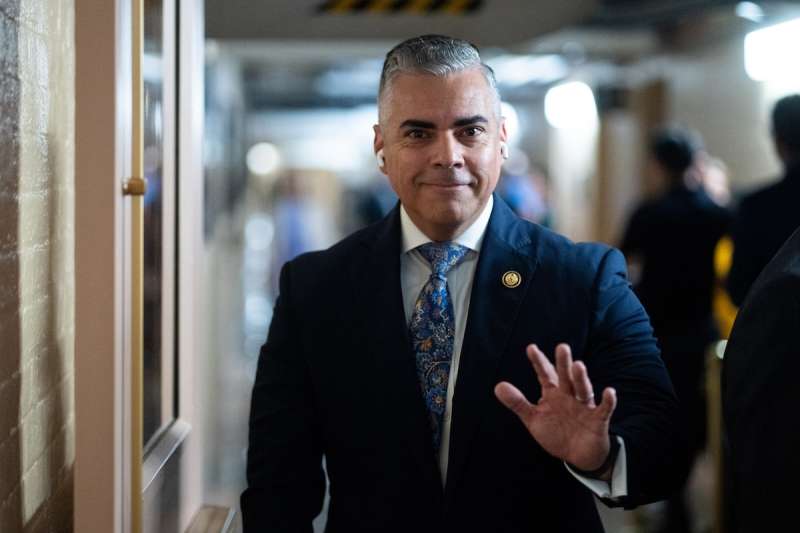
More than a year after President Donald Trump and congressional Republicans — including every Arizona Republican in Congress — passed the “One Big Beautiful Bill Act,” Tucson is still absorbing the damage. And it could cost US Rep. Juan Ciscomani his seat in November.
Last year, the Republican congressman signed onto the megabill, citing concerns about Medicaid cuts, before eventually voting with his party to implement the steepest cuts to social services, including SNAP food assistance and Medicaid, in the programs’ history.
Since the vote, Arizona has absorbed the consequences quickly: more than 400,000 Arizonans, including 180,000 children, have lost SNAP food assistance, hundreds of Casa Grande workers have lost their jobs after cuts to clean energy tax credits, and as many as 246,000 people in Arizona could lose Medicaid coverage.
“It cracks down on fraud and abuse in Medicaid through common-sense work requirements and better eligibility checks,” Ciscomani said after the bill’s passage, arguing that the bill will help the “most vulnerable.”
Arizona’s 6th Congressional District has been hit particularly hard since the bill’s passage. An Arizona Mirror analysis found that Southern Arizona hospitals are at risk of losing $110 million a year from Medicaid cuts, and one Tucson hospital has already closed its doors — Select Specialty Hospital, which shut down July 31 and laid off all 99 of its workers.
In Pima County, 77,000 SNAP recipients have been thrown off the program, all while food banks across the state struggle to fill the gaps. The cuts go beyond social services, too. The megabill axed Biden-era tax credits aimed at spurring the sale of electric vehicles, laying off hundreds of Casa Grande workers. Lucid Motors, an electric vehicle company in Casa Grande, said the end of those tax incentives was directly responsible for its decision to lay off more than 1,000 workers.
To offset Medicaid cuts, congressional Republicans included in the budget bill the creation of a $50 billion Rural Health Transformation Fund, which Ciscomani pointed to as a buffer against the coming shortfalls. In October, Ciscomani signed onto a letter calling for fair funding allocation “to states with Democrat governors.” However, Arizona was later shortchanged by the federal fund, receiving only $167 million for the fiscal year despite Gov. Hobbs requesting $200 million. Hobbs’ office later revised the state plan down by about $33 million, and Ciscomani told the Tucson Sentinel in January the allocation “falls short of my expectations.”
Ciscomani later joined Democratic lawmakers in urging the federal government allocate more to the state after Arizona received the six-lowest allocation.
Could it cost him?
Arizona’s 6th Congressional District — deemed a toss-up by the Cook Political Report—is one of the most sought after districts in the country. Ciscomani won reelection in 2024 by just 2.5 percentage points, and Trump won the district by less than a point, making the seat a prime target for Democrats to take back the House.
In August, GOP consultant Chuck Coughlin told the Arizona Mirror he predicts the district will flip blue because of Ciscomani’s vote and Arizona’s shifting demographics.
“Right now, I’m betting (CD6 is) going to flip,” Coughlin said to the Arizona Mirror. “(Ciscomani) is a good campaigner, I know that… He is not going to run a bad campaign, and this is where it will matter what kind of campaign (Mendoza) runs.”
Ciscomani’s Democratic challenger, Navy and Marine Corps veteran JoAnna Mendoza, has pointed to Ciscomani’s vote as a reason to oust him from his seat. For Mendoza, who served 20 years including deployments to Iraq and Afghanistan and grew up on SNAP, the vote is “very personal” to her.
A lifelong resident of the district, Mendoza told The New York Times that she used to wake up at 4 a.m. in the summer and wait at a gas station alongside her parents waiting for a bus to drive them to cotton fields where they would pick weeds to make money. Without a car, Mendoza would ride her bike to the grocery store and use food stamps to buy food for her family. Now raising a ten year old, Mendoza said she questions if the next generation will be able to afford the American dream as costs continue to rise and social services decrease.
“Voters want people who understand the struggles and share their concerns. Growing up on SNAP, it was for a really long time that I thought it was somehow a failure of my parents, that they weren’t working hard enough, but it wasn’t until years later that I realized that it’s a huge failure of the government,” Mendoza said. “For me and my family, that benefit was survival.”
For Mendoza, Ciscomani’s vote to cut SNAP showed how out of touch the congressman is with his constituents.
“When you’re elected to represent your community, that’s what you should be doing. Unfortunately, Ciscomani has not been doing that. He hasn’t been listening to his constituents,” Mendoza said. “He didn’t hold any town halls or listening sessions to hear what the impact of the bill would have on his constituents. It just gives the impression that [he] could really care less.”
Ciscomani’s office did not respond to a request for comment by the time of publication.