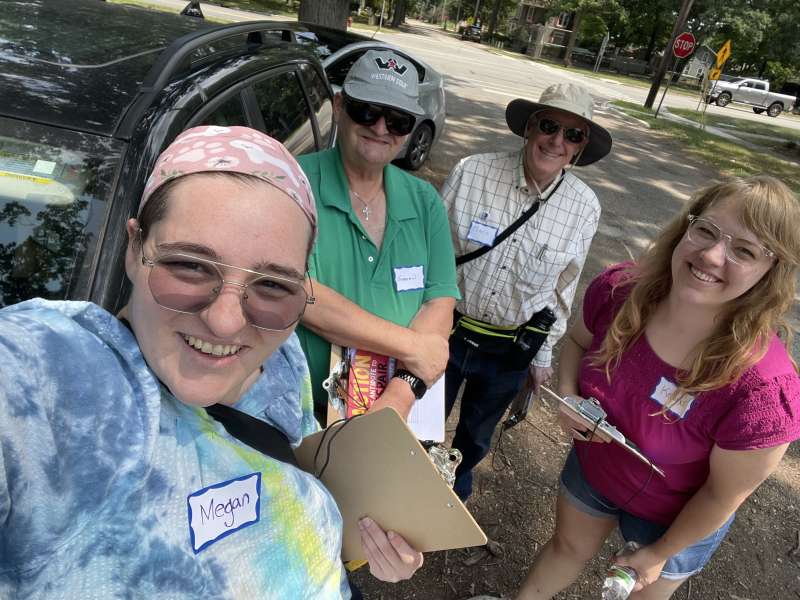
Earlier this month, volunteers with grassroots canvassing organization We the Fighters gathered in an Allegan, Michigan, park. A young man approached them, asking what they were doing. When they explained they were preparing to canvas the neighborhood about the One Big Beautiful Bill’s cuts to SNAP and Medicaid, he said: “Oh, I think we’re on the opposite sides of the spectrum here!”
Quickly, the conversation turned into a tense debate over big versus small government; everyone was slinging facts and statistics. It wasn’t unfriendly, but it also wasn’t getting anywhere.
Sensing the familiar spiral, Megan Locatis stepped in: “So, it’s about healthcare for me.”
Megan shared that she has family members who are delaying necessary care because of high deductibles—and that she’s worried about them. The man’s posture changed, and he revealed that he and his wife also lacked adequate health insurance and that their infant daughter was uninsured. His wife, carrying their daughter, joined the conversation.
Megan’s intervention wasn’t just a last ditch Hail Mary—it was based on the thousands of conversations she and other We the Fighters canvassers are having while door knocking. “Overwhelmingly,” said Nicole Hinebaugh, who is canvassing in North Carolina as part of the same effort, “People say healthcare is what is on their mind.”
A long-broken healthcare system
Healthcare costs used to be something Americans discussed privately and suffered alone. My son’s braces cost me just over $10,000 when I made only 40k a year; my carpal tunnel bills all came out of my pocket, even though I am insured. I’d spent so many years uninsured or avoiding going to the doctor altogether, I figured I was doing something wrong.
I’m not alone. Over 100 million Americans carry medical debt. Nearly half of working-age adults, 46%, are inadequately insured. While affordability is widely reported as a top concern heading into the midterms, healthcare tops those affordability concerns. 60% of voters are worried about being able to afford healthcare costs (on par with, if not slightly higher than concerns over gas prices).
I recently saw a Facebook post where someone asked what others do for health coverage. The most common response? Pray.
The data is an affirmation, but not a revelation: We’ve long known that our healthcare system is broken. The difference is that people are talking about it, and talking about it a lot. Nicole recalled a conversation with a 76-year-old woman in Southern Appalachia: “She talked about how things used to be more reasonable and manageable, but that it seems like these days everything is so expensive that a single ambulance ride for her husband recently has broken her family financially.”
“Conversations like that are happening all the time,” Nicole said. “Healthcare costs come up over and over again.”
Connecting personal experience to policy
And it’s not just in small-town Michigan or the mountains of North Carolina where this is true. Voters everywhere are talking about healthcare.
Ginger Buckendahl has been canvassing with We the Fighters in the high desert of Arizona; she’s had conversations with voters through just about every neighborhood in Flagstaff, and now is in the Verde Valley where poverty is high and resources limited. But no matter where they live or what their income, residents are bringing up healthcare—though many don’t connect their personal struggles to policy.
“I talked to one young woman and when I asked her what was on her mind, she told me it was the cost of all her prescriptions—they added up to a place she could barely afford them. She said she was skipping some and rationing others.” This worried Ginger, so she told her about an inflation rebate program the Biden administration had passed that would help lower those costs, but the woman had never heard of it—and seemed not to believe it.
“So many people are cynical and just don’t believe the government can help,” says Ginger.
That’s largely because the government hasn’t been helping—even though most Americans want it to. “Medicare for All” is a slogan I’ve been hearing for years, circulated longingly in leftist meeting spaces, on the internet, and in the borderlands of the Democratic party.
Nearly three-quarters of adults age 19 and older believe the federal government has a responsibility to ensure all Americans have coverage, including 45% of Republicans, 93% of Democrats, and 76%of independents. Nearly 60% of Americans—regardless of party—supported Medicare for All specifically as of a 2025 YouGov poll.
But instead of moving toward that popular goal, the Trump administration and Congress have moved away.
In Pennsylvania, Sara Emerle is canvassing and works in an urgent care. Since the passage of last year’s Big Beautiful Bill, which cut Medicaid to fund tax cuts for the wealthy, she is witnessing the impact in real time: “I see my patients delaying care because they can’t afford it,” she said.
“That puts more strain on urgent cares and ERs because people are forced to wait until it’s an emergency instead of getting preventative care. At the same time, Medicaid cuts means facilities lose funding. That leads to staffing shortages, hiring freezes, and heavier patient loads on nurses like me.
“I’m not just seeing this as a nurse, I’m living it,” she continues. “My own deductible has gone up and I actually had a breakdown at the pharmacy counter when I found out that I now have a prescription deductible as well. This bill isn’t helping families, it’s squeezing them from every direction. The government should be helping people live healthy and stable lives.”
As Sara, Ginger, and Nicole speak with voters, they are helping them connect personal experiences to what the government is doing—and could do. They feel certain healthcare will show up in next week’s election results.
Back in Michigan, Megan doesn’t know if her conversation with the young man in the park changed his views or encouraged him to vote, but she does know that there “was more connection” when the conversation shifted to healthcare. As they left, he called after them: “Well, this has been a good conversation and you’ve given me some things to think about!”
She’ll take it. It seems simple, but if democracy is going to win, we need to drop partisan politics and talking points and get to what’s on everyone’s mind.