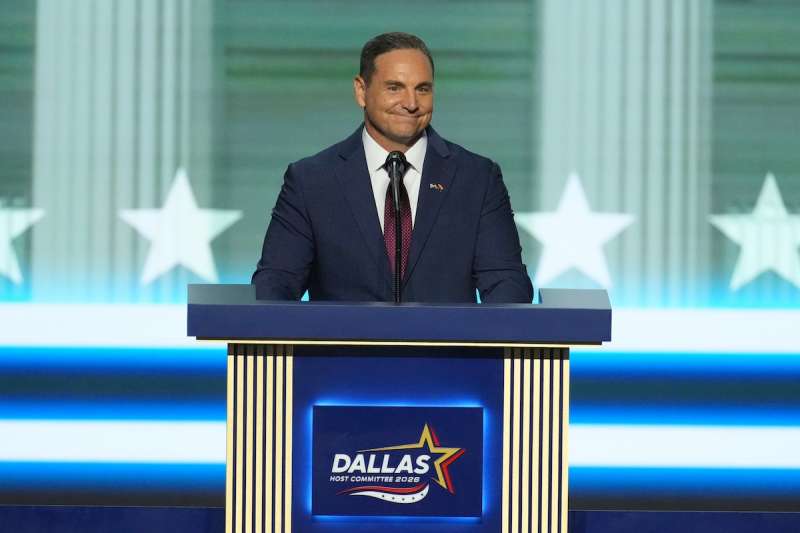
President Donald Trump hasn’t been shy about his support for data centers across the country, arguing that if communities want to be “successful and rich,” they should welcome new data centers in their backyards. But where does Jay Feely, an ex-NFL kicker who won the Republican nomination for Arizona’s 1st Congressional District, stand on the issue?
Backed by Trump, Feely hasn’t been shy about his support for data centers. In June, he received $600,000 from Leading the Future, a pro-AI Super PAC. In the Republican primary that same month, Feely sparred with then-opponents Joe Chaplik (R-Scottsdale) and businessman John Trobough (R) over the issue of data centers. Feely promoted AI data centers and argued public opposition stems from China—a belief shared by Trump, who posted something similar on Truth Social in August.
“The only reason that communities throughout the U.S.A. should not want Data Centers is if they want to end up being backwards and poor. If they want to be successful and rich, with far lower taxes and jobs all over the place, let Data Reign,” Trump wrote in a post on Truth Social Aug. 31. “China could not be happier with this anti Data Center movement. Actually, they can’t believe it is happening!”
At the June debate, Feely argued that data centers can benefit Arizona communities if developers invest in surrounding areas and use recirculated water. Chaplik pushed back, stating while he isn’t against AI data centers, he wouldn’t want them placed in Arizona’s 1st Congressional District.
“I know this district. I live here. I’ve represented it for six years,” Chaplik said. “The people in this district do not want data centers right next to their homes.”
The comment appears to be a slight at Feely, who does not live in the district. Under the US Constitution, congressional candidates are only required to live in the state they represent rather than the specific district, though carpetbagging claims frequently surface in competitive races.
Feely defeated Chaplik and Trobough in the July 21 primary and now faces Democratic nominee Amish Shah, a former state lawmaker and ER doctor, in the Nov. 3 general election.
Could it cost Feely?
Feely’s support for data centers comes at a time when Arizonans across the state, and individuals across party lines, voice opposition to data centers placed in their communities.
In an email statement to the Copper Courier, Shah’s campaign said the Democratic nominee opposes data centers in Arizona’s 1st District, especially amidst a 30-year-long drought, citing concerns about federal cuts to Arizona’s water supply from the Colorado River and fears that the data center boom will only worsen the state’s water crisis.
“[Shah] opposes building data centers in Arizona’s First Congressional District,” wrote Eve Zhurbinskiy, Shah’s campaign manager. “Arizona families already face high utility costs and drastic water shortages. While [Shah] believes we need to develop the technology to stay globally competitive, we shouldn’t be building data centers in the middle of the desert.”
Feely did not respond to a request for comment by the time of publication.
National Republicans have indicated, privately, that a pro-data center stance could dissuade voters this cycle. In a private memo to top AI companies, GOP leaders warned AI companies that association with data centers could hurt Republican chances of winning this November, pointing to the Ohio Senate race, where data centers have become a top issue.
“If he loses and data centers get the blame, politicians across the country will take notice — and they will not go near the next one,” the memo says. “This has become a sleeper issue for the entire election cycle.”
As the AI boom takes over, local leaders have differed on ways to regulate the industry. Democrats have called for regulation while some Republicans, including Trump, have opposed it, arguing the US must beat other countries in global AI dominance.
“The only control or “guardrails” that AI needs is a STRONG AND SMART (High IQ!) PRESIDENT, and the U.S.A. has that, in spades,” Trump said in a Monday post on Truth Social.
Feely seems to echo that sentiment. In an August appearance on the Sean Spicer show, Feely said the US must prioritize advancement to beat China.
“We are in a race with China to win the AI generation that’s coming. It will define who wins the world’s economy and controls the world economy,” Feely said. “By proxy it’s gonna define who controls the world’s security. So we don’t have a choice if we’re gonna win, we have to win it. We can’t let China win.”
Later in the segment, Feely admitted politicians should acknowledge voters’ concern regarding data centers, including voters concerned about water security and higher energy costs that can come with data centers.
Across the country, in communities located near data centers, local residents have noticed higher utility bills. In August, Attorney General Kris Mayes called for a halt on data centers over concerns they are contributing to higher utility costs, and has opposed rate-hike requests from Arizona Public Service Co. and Tucson Electric Power Co. that she says are driven partly by infrastructure needs tied to existing and planned data centers.
Advocates also point to Arizona’s water crisis, arguing that water-guzzling data centers don’t belong in the desert, and that water resources should be prioritized for people rather than technology. A preliminary study by Arizona State University (ASU) also found that data centers increase temperatures of nearby communities by 1 to 4 degrees in a state that already has record high levels of heat.
Feely acknowledged those concerns, stating developers should invest in the community, be off grid, and use recirculated water to mitigate water concerns. As more and more data centers pop up across the country, developers have turned to using reclaimed or recycled water to mitigate water concerns. However, environmental experts argue reclaimed water still negatively impacts water supply.
“Even if they’re using reclaimed or recycled water, that water is no longer going back into the base flow of the rivers and streams,” Julie Bolthouse, director of land policy at the Piedmont Environmental Council, said in an interview with the Lincoln Institute. “That has ecological impacts as well as supply issues. Everybody is upstream from someone else.”
Bolthouse added that evaporative cooling also leaves behind high concentrations of salts and other chemicals, which impacts water quality.
AI warnings
While Arizona communities grapple with the physical toll of data centers — namely groundwater pumping and strained power grids — a parallel battle is unfolding among the very tech workers building the software inside them.
Earlier this month, Anthropic researcher Jacob Coxon, who specializes in training AI models, resigned from the company over concerns that AI companies are rushing without adequate guardrails in place.
“They are racing straight to self-improving superintelligence and gambling with our lives,” Coxon wrote in a post on X. “The people building AI earnestly believe that it could kill us all by the end of the decade.”
Coxon’s comments led to a slew of commentary, with advocates calling on Congress to introduce guardrails to stop the industry from unregulated advancement.
Dario Amodei, the Anthropic CEO, published an essay Sept. 12 calling for slower AI development.
“I believe that if slowing down bought us even an extra year or two before models reach critical levels of capability, and we used that time to advance alignment, we could greatly reduce the risk that something goes seriously wrong,” Amodei said.
Despite all the warnings, Feely still seems to stand in support of data centers, painting them as a need to defeat China in the global race for AI dominance.
Correction: An earlier version incorrectly stated Shah opposes data centers across the state. The story has been updated to reflect his campaign opposes them in Arizona’s 1st Congressional District.