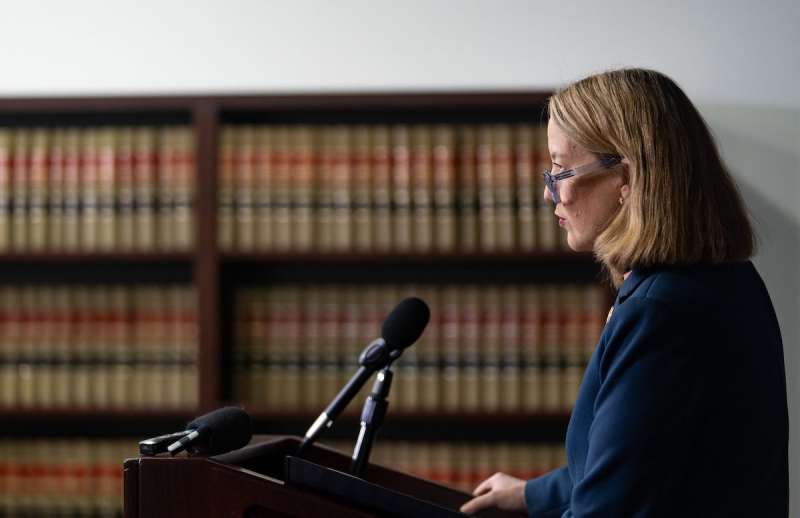
Arizona has joined its 36th lawsuit against the Trump administration with a case that challenges a new childhood vaccine schedule and remade vaccine safety advisory board.
Arizona Attorney General Kris Mayes said the changes were part of Health Secretary Robert F. Kennedy Jr.’s “ideological attack” on vaccines, and not based on scientific evidence or available data.
Kennedy in June sacked all 17 members of the Advisory Committee for Immunization Practices, which critics said would sow doubt in vaccines that had been deemed safe and effective. The Trump administration said the restart was needed to restore trust in the panel’s recommendations, and remove outside influence and agendas from its decision-making.
MORE: ‘I cried’ – Arizona abortion provider reacts to anti-abortion laws getting struck down
Kennedy’s revamped committee has narrowed recommendations on who should get the COVID-19 vaccine and axed guidance that newborns should receive the first dose of hepatitis B vaccine within 24 hours of birth. The lawsuit contends the new members are not qualified under the terms of the committee’s charter or federal law.
Then in January, the Centers for Disease Control and Prevention dropped its requirement for several of 17 childhood vaccines, leaving it up to parents to choose whether to get those shots. The agency did so based on a directive from a presidential memorandum and after a review of other developed nation’s vaccine schedules, a methodology that the states allege does not follow science or the law.
Arizona and California are leading the case, which was filed in California alongside 13 other states. The case asks a judge to set aside the appointments to the committee and the January vaccine changes.
Mayes and her fellow Democratic prosecutors around the nation have become their party’s primary check on what they see as a president that is a threat to democracy.
The 36 cases filed to date have the potential to linger in courts for years before final resolution, but many have seen temporary orders preventing Trump’s agenda from being realized. Those orders have guaranteed Arizona receives over $1.5 billion in federal funding, making for a good return on her estimated staff cost of $2 million to file the cases, Mayes said in October.
Other cases have progressed to the U.S. Supreme Court or prompted mixed decisions from the nation’s appeals courts.
The flurry of legal filings and court rulings can be hard to keep track of. Here, Arizonans can follow along and find every case filed by Mayes’ office since Trump’s second inauguration on Jan. 20 — and the latest status for each.
(This information was last updated Feb. 24.)
Limiting birthright citizenship
Filed: Jan. 21, 2025, in U.S. District Court in the Western District of Washington
The case: The states asserted that Trump’s Day 1 order to end automatic citizenship for children born in the U.S. to undocumented immigrants violated the 14th Amendment, a Civil War-era amendment that said “all personsborn or naturalized in the United States, and subject to the jurisdiction thereof” are citizens. Four states filed the case, but there were at least two other cases filed by other states and private groups opposing the order.
The latest: The 9th U.S. Circuit Court of Appeals in July ruled the executive order was unconstitutional and violated the 14th Amendment. Multiple judges across the country have deemed the order unconstitutional and unenforceable, and the U.S. Supreme Court agreed to take up the caseArizona joined and one other, foreshadowing a ruling that could bring finality to the issue.
That would be a second time the matter goes before the nation’s top court. Another separate case brought by the American Civil Liberties Union prompted the U.S. Supreme Court’s June ruling limiting nationwide injunctions in similar cases.
Federal funding freeze
Filed: Jan. 28, 2025, in U.S. District Court in Rhode Island
The case: The White House budget office’s two-week pause on federal grants and assistance, put in place to allow a review to ensure spending aligns with the Trump administration’s priorities, was the focus of this lawsuit. Arizona and 21 other states were plaintiffs, and they said the pause threatened trillions of dollars in crucial funding.
The latest: The states won an injunction preventing the federal government from withholding the funding in March. The U.S. Court of Appeals for the First Circuit left that injunction in place as an appeal from the Trump administration moves forward. To cut off funding would irreparably harm states, the appeals panel said.
DOGE seeking Treasury information
Filed: Feb. 7, 2025, in U.S. District Court for the Southern District of New York
The case: A coalition of 19 Democratic attorneys general challenged the administration’s policy granting the Department of Government Efficiency and Trump’s billionaire adviser Elon Musk access to a U.S. Treasury system that contains confidential information, such as bank account details and Social Security numbers. The states alleged that access violated individuals’ privacy rights.
The latest: In late February, a federal judge issued an order blocking Treasury employees from accessing personal information. That injunction was later amended to allow certain staffers access as long as they had certain training, and the Trump administration in July appealed to the Second Circuit Court of Appeals to overturn the injunction.
Medical and health research funding
Filed: Feb. 10, 2025, in U.S. District Court of Massachusetts
The case: This lawsuit was the first of multiple filed against the U.S. Department of Health and Human Services and its National Institutes of Health. The case filed by 22 states alleged the administration was unlawfully cutting funds going toward medical and public health research — specifically “indirect cost” reimbursements. That money supported research at Arizona universities and other institutions.
The latest: A federal judge in April issued a permanent injunction preventing the Trump administration from following through on those funding cuts. The Trump administration has appealed and oral argument is set for Nov. 5.
Challenging DOGE powers
Filed: Feb. 13, 2025, filed in U.S. District Court in Washington D.C.
The case: Arizona and 14 other states argued that Trump’s appointment of the billionaire businessman Elon Musk to the newly created Department of Government Efficiency did not follow the law on creating new agencies — which is a power of Congress — and requiring Senate confirmation for agency leaders.
The latest: A judge denied states’ request for a temporary restraining order and consolidated the case with another challenging Musk’s authority. The case is pending in the Washington, D.C. court. In May, Musk stepped down from his role in the Trump administration.
Layoffs of probationary employees
Filed: March 6, 2025, in U.S. District Court in Maryland
The case: Mayes and 19 other attorneys general went to court fighting the Trump administration’s efforts to carry out mass firings of federal employees after the Department of Government Efficiency moved to dismiss tens of thousands of recently hired or promoted probationary employees.
The latest: A federal judge issued a temporary order requested by the states to stop the culling of employees and ordered the Trump administration to reinstate thousands of fired employees. In early September, the U.S. Court of Appeals for the Fourth Circuit said the states lacked legal standing to bring the case and directed the prior judge to dismiss the case.
Dismantling the U.S. Department of Education
Filed: March 13, 2025, in U.S. District Court of Massachusetts
The case: The Trump administration’s attempt to lay off nearly half of the U.S. Department of Education’s workforce was met with this lawsuit filed by 21 attorneys general. Though the federal agency pledged to keep up with funding for priorities like special education, student loans and Pell Grants, its shutdown was not allowed because doing so would require Congressional approval, the lawsuit alleged.
The latest: In May a judge granted an injunction that reinstated hundreds of employees and prevented the shifting of some department duties to other agencies. The U.S. Supreme Court two months later handed Trump a win, allowing the firings and dismantling of the agency while the case goes forward.
Public health grants
Filed: April 1, 2025, U.S. District Court in Rhode Island
The case: The states argued that the U.S. Department of Health and Human Services and Secretary Robert F. Kennedy Jr. could not terminate nearly $12 billion in public health grants, of which hundreds of millions were coming to Arizona. In this case, 23 attorneys general joined.
The latest: In May, a federal judge issued an injunction requested by the states that prevents the health department from cutting off the funding. It built on a prior order requiring the federal government to pay out the grant monies.
Election order on proof of citizenship
Filed: April 3, 2025, in U.S. District Court of Massachusetts
The case: President Donald Trump’s executive order on elections was unconstitutional and an overreach of presidential power, Arizona and 18 other states argued in this lawsuit. The presidential order set deadlines for votes to come in on Election Day and established national proof of citizenship requirements. Mayes and Arizona Secretary of State Adrian Fontes, also a Democrat, warned the order could end early voting.
The latest: A federal judge in June ordered that the Trump administration could not enforce several of the order’s provisions, including requiring proof of citizenship to register to vote in federal elections. The judge denied the federal government’s attempt to dismiss the case, and it is ongoing.
National Institutes of Health grants
Filed: April 4, 2025, in U.S. District Court of Massachusetts
The case: The lawsuit alleges the National Institutes of Health, which falls under the U.S. Department of Health and Human Services, has not conducted grant reviews and has withheld or terminated other grants worth billions of dollars. The grants that were terminated were done so because they had a nexus to diversity, equity and inclusion policies, transgender rights or vaccine hesitancy, which the Trump administration broadly opposes. Sixteen states brought the case.
The latest: In June, a federal judge ruled that terminating the grants was illegal, an order that allowed the money to be paid out. The case is ongoing.
Libraries and museums agencies
Filed: April 4, 2025, in U.S. District Court in Rhode Island
The case: The lawsuit challenges portions of Trump’s March 14 order directing seven smaller federal government entities to reduce their work and workforce to the “minimum presence and function required by law.” One of those was the Institute of Museum and Library Services, which helps fund local libraries and pays the salaries of two dozen full or temporary employees of the Arizona State Library within the Secretary of State’s Office, according to the lawsuit.
The latest: The states won a May injunction that prevented the Trump administration from carrying out the cuts and ordered the rehiring of employees while the case moves forward. In November, U.S. District Court Judge John McConnell sided with the states and issued a permanent order preventing the dismantling of the agencies.
COVID relief funding for schools
Filed: April 10, 2025, in U.S. District Court in the Southern District of New York
The case: U.S. Secretary of Education Linda McMahon’s abrupt decision to cancel COVID-19-era grants to schools was an illegal reversal of a prior decision to give states more time to access the money, the lawsuit said. Districts had already spent funds that the federal government would reimburse, leaving them facing financial peril, the case filed by 16 states said.
The latest: A judge in May prevented the education department from rescinding the grants or changing the deadline to spend the money. The case is ongoing.
Trump’s tariff orders
Filed: April 23, 2025, in the U.S. Court of International Trade
The case: The lawsuit alleges that Trump exceeded his authority in executive orders that imposed tariffs by citing the International Emergency Economic Powers Act. Those orders imposed tariffs on goods from Mexico, Canada and China, as well as reciprocal tariffs on dozens of other nations.
Mayes is co-leading the case with Oregon and 10 other states joined in. The states acknowledge that Congress has afforded presidents the power to impose tariffs, but said that must be in certain circumstances and for limited duration. Trump’s use of the about 50-year-old International Emergency Economic Powers Act was a novel approach and relies on a law that has historically been used for embargoes and sanctions, the lawsuit said.
The latest: A federal judge on May 28 blocked several of Trump’s orders implementing tariffs, though the president’s administration said it would appeal the ruling. The U.S. Supreme Court heard oral arguments Nov. 5, and on Feb. 20 struck down the tariffs, reaffirming that the president needed Congress’ approval to implement them. Trump said after the ruling he would impose tariffs using a different legal authority.
AmeriCorps reductions
Filed: April 29, 2025, filed in U.S. District Court in Maryland
The case: The lawsuit contends workforce reductions and abrupt cancellation of grants to AmeriCorps amount to effectively closing the agency, which was created by Congress. AmeriCorps is a community service program often known for sending young people into communities to work for nonprofits and schools, doing projects like building homes and staffing food banks, among others.
The latest: A judge partially granted the states’ request for an injunction in June, requiring the grants to be paid out and most — but not all — AmeriCorps staffers to be rehired. The federal government requested a pause while the government is shut down, and the judge granted that delay in early October.
Staffing at Health and Human Services
Filed: May 5, 2025, in U.S. District Court in Rhode Island
The case: The target of this lawsuit was sweeping staff and program cuts within the U.S. Department of Health and Human Services, led by Robert F. Kennedy Jr. Nineteen states alleged the firings and cuts effectively abandoned them and was not allowed because the funding was approved by Congress.
The latest: The court prevented the Trump administration from carrying out the staff reductions and program cuts, and an appeals court in September rejected a request from the federal government to put that ruling on pause as the case goes on.
Wind energy projects halted
Filed: May 5, 2025, in U.S. District Court of Massachusetts
The case: Seventeen states challenged Trump’s inauguration day order that halted federal approvals and permits for the development of offshore and onshore wind energy projects. Arizona has three wind energy sites under development in the northern and eastern parts of the state that need federal permits and approvals, according to the lawsuit.
The latest: In July, a judge partially sided with federal agencies and dismissed several of the state’s legal claims, though two legal arguments are continuing. In December the judge ruled in the states’ favor and declared the order unlawful, vacating it completely.
Electric vehicle and infrastructure funding
Filed: May 7, 2025, in U.S. District Court for the Western District of Washington
The case: This lawsuit brought by 17 states contends Trump could not pause $5 billion in funding for electric vehicle infrastructure that was made available by the 2022 Infrastructure Investment and Jobs Act and Inflation Reduction Act. Arizona stood to lose $48 million, according to Mayes’ office.
The latest: The federal government was stopped, via court order, from revoking the funding in June. The case is ongoing with the Trump administration seeking to end the states’ case.
Trump’s energy emergency
Filed: May 9, 2025, in U.S. District Court for the Western District of Washington
The case: Fifteen states sued Trump, the head of the U.S. Army Corps of Engineers, and the Advisory Council on Historic Preservation over a presidential order that waives federal review of environmental and energy projects. Trump’s Jan. 20 order paused those reviews and declared an energy emergency.
The latest: The case is ongoing.
‘Agency priorities’ to stop grants
Filed: June 24, 2025, filed in U.S. District Court of Massachusetts
The case: Twenty-one states and Washington, D.C., claimed that Trump and his Department of Government Efficiency did not have the power to stop billions of dollars in federal grants by relying on a single clause within the federal Office of Management and Budget regulations.
That clause, which was written during Trump’s first term, allowed a grant to be terminated if it “no longer effectuates the program goals or agency priorities.” The Republican president’s administration has used that language to stop funding for programs that do not align with its view on diversity, equity and inclusion, climate change and other policies.
The latest: The case is ongoing.
Medicaid info sharing with immigration enforcement
Filed: July 1, 2025, in U.S. District Court in the Northern District of California
The case: Mayes joined 19 other states in the case even though it was unclear if Arizona was among those impacted by the Trump administration’s directive. The federal government took information provided by Medicaid enrollees and shared it with U.S. Department of Homeland Security without going through formal procedures to change policy, the lawsuit said.
The administration’s action appeared to target states that allowed undocumented immigrants to enroll in health care benefits, and Arizona is not one of those.
The latest: A judge in August put the information sharing on hold, taking issue with the process of how the agencies made the policy change but noting information can be, and sometimes is, legally shared between government entities. The ruling was mixed, and the court denied another of the states’ claims as moot.
Pause on K-12 education funding
Filed: July 14, 2025, in U.S. District Court in Rhode Island
The case: The Trump administration froze over $6 billion in education funding pending a review that one budget office spokesperson said was necessary because money had been spent to “subsidize a radical left-wing agenda.” The funds had a variety of purposes, but some supported English language learners and migrant education that appear to be out of line with Trump’s immigration crackdown. Arizona‘s share of that funding was estimated at $118 million to $132 million.
The latest: The states sought a preliminary injunction, but before that could be heard, the education department released the funds. The states and Trump administration agreed to dismiss the case in August.
Grants to reduce damage from natural disasters
Filed: July 16, 2025, in U.S. District Court of Massachusetts
The case: Twenty states brought the case after the Federal Emergency Management Agency took steps to end a grant program that helps communities across the nation prepare for disasters while potentially reducing the damage from them. Buckeye and Camp Verde were among the municipalities expecting to receive grant dollars, which was jeopardized by the federal government’s stoppage on the grants.
The latest: In August, a judge granted the states an injunction that prevents FEMA from spending the grant money on other purposes while the case continues in court. On Dec. 11, 2025, the judge sided with the states and permanently prevented the “unlawful Executive encroachment on the prerogative of Congress to appropriate funds for a specific and compelling purpose.” In February 2026, Mayes and other attorneys general filed a motion to force the federal government to fund the program, alleging it was not complying with the December order.
Revamping ‘Obamacare’ eligibility rules
Filed: July 17, 2025, in U.S. District Court of Massachusetts
The case: Democratic leaders in 21 states said in the case that a Trump administration rule seeking to change the Affordable Care Act, also known as “Obamacare,” could cause up to 1.8 million people to lose their health insurance. The lawsuit said the rule would have a “catastrophic” impact on states that would pick up more costs. The rule made a slate of changes, including shortening the open enrollment period, increasing out-of-pocket costs, adding income verification procedures, and removing so-called “Dreamers” from health insurance marketplace programs.
The latest: The states sought an injunction to prevent the changes from going into effect, but a federal judge denied that request in October, and the case is ongoing.
Citizenship status a requirement for assistance programs
Filed: July 21, 2025, in U.S. District Court in Rhode Island
The case: Four federal agencies — Health and Human Services, Education, Labor and Justice — coordinated to set rules that reinterpret federal law and restricted states from spending federal funds on people who cannot verify their citizenship status. The rules impact programs like Head Start, Meals on Wheels, community health centers and more, the lawsuit said.
The states warned that the Trump administration was creating a paperwork burden that could also keep U.S. citizens from getting essential help. Twenty states and Washington, D.C., filed the case.
The latest: In September, a judge barred the federal agencies from considering immigration status when determining eligibility for their programs. The judge acknowledged the “mundane, technical” nature of the case that it boiled down to the government instituting “show me your papers” requirements. The case is ongoing but the federal government has sought to delay it while Congress cannot pass a spending bill.
Food stamp beneficiaries’ personal info
Filed: July 28, 2025, in U.S. District Court in the Northern District of California
The case: Twenty states and Washington, D.C., challenged a Trump administration request for personal information of people who receive food stamps from the Supplemental Nutrition Assistance Program. The U.S. Department of Agriculture requested states provide personal information of recipients as part of the initiative to curb waste, fraud and abuse. The lawsuit accused the federal administration of continuing an “Orwellian surveillance campaign” the White House has used in its sweeping immigration enforcement.
The latest: A judge in September halted the Trump administration from seeking the personal information, and in October issued a more lasting injunction. The case is open.
New requirements for crime victim programs
Filed: Oct. 1, 2025, in U.S. District Court in Rhode Island
The case: Twenty states and Washington, D.C., sued Trump’s Department of Justice over a change that required certain grant programs to only pay for services for individuals who could prove legal immigration status. The Trump administration had furthered a change so that three prominent grants — Victims of Crime Act, Byrne Justice Assistance and Violence Against Women Act — could not support people “unlawfully present in the United States.”
The states contended that change was retroactive and violated the U.S. Constitution’s spending clause as well as other federal law.
The latest: The states asked a judge to stop the Trump administration from changing eligibility for the grant programs, but that has not yet been considered. Court records indicate the government agreed not to enforce the changes being challenged in the case until at least Nov. 14.
Solar energy funding
Filed: Oct. 15, 2025, in the U.S. Court of Federal Claims, and Oct. 16, 2025, in the U.S. District Court in the Western District of Washington
The case: Mayes led states in filing a pair of lawsuits in mid-October over the Environmental Protection Agency’s decision to cut grants through the federal government’s Solar for All program. Trump’s sweeping policy bill cut the program, but the states contend the EPA was not permitted to claw back funds already awarded. Filing the pair of cases dealing with a similar issue represents a new strategy for the coalitions of attorneys.
The latest: Ongoing.
Food stamps during the government shutdown
Filed: Oct. 28, 2025, in U.S. District Court of Massachusetts
The case: Arizona and 24 other states challenged the U.S. Department of Agriculture’s plans to stop funding food stamps after Nov. 1 because of the federal government shutdown. The states contended there were other funds to bridge the gap, namely an over $5 billion contingency account, that the federal government had to use because funding the Supplemental Nutrition Assistance Program was not discretionary. The USDA and Republican lawmakers argued that funding was not available without a budget bill continuing the food assistance program.
The latest: A judge in Boston on Oct. 31 sided with the states and directed the federal government to pay partial or full benefits using the contingency fund, though the judge did not immediately order that to occur. Yet the same day, in a separate case, a federal judge in Rhode Island also ordered the government to pay the benefits.
Limits on student loan forgiveness
Filed: Nov. 3, 2025, in the U.S. District Court of Massachusetts
The case: States that the U.S. Department of Education illegally restricted eligibility for the Public Service Loan Forgiveness Program in an effort to punish local programs that are disfavored by the Trump administration. Twenty two states filed the case. The program allows government and nonprofit employees to have federal student loans forgiven after 10 years of work, creating a financial incentive for public service. But a new agency rule allowed federal education officials to declare employers ineligible if they have a “substantial illegal purpose,” which includes supporting undocumented immigrants, diversity, equity and inclusion efforts and more.
The latest: Ongoing.
FEMA, border security grants
Filed: Nov. 4, 2025, in the U.S. District Court of Oregon
The case: Mayes and leaders in 11 other states sued the Department of Homeland Security and Federal Emergency Management Agency over new criteria for two grant programs, which the states contend are part of a Trump-driven effort to sideline FEMA. The grants are the Emergency Management Performance Grant and the Homeland Security Grant Program, and Mayes’ office said $83 million was at risk of being pulled back by the Trump administration.
The latest: Ongoing.
Anti-homelessness programs at HUD
Filed: Nov. 25, 2025 in U.S. District Court in Rhode Island
The case: Mayes and leaders in 20 other states sued the Department of Housing and Urban Development over recent changes to a funding program that aims to prevent homelessness called the Continuum of Care. Previously, the majority of that money supported permanent housing, but was pared back and leaves thousands of people at risk of eviction, Mayes’ office said.
HUD officials said the changes would allow the government to better fund transitional housing and support services, “ending the status quo that perpetuated homelessness through a self-sustaining slush fund.” The lawsuit argues that HUD violated its own policy requiring rulemaking when it made the changes, and violated the law because it did not get congressional approval.
The latest: Ongoing.
$100,000 fees for foreign workers
Filed: Dec. 12, 2025, in the U.S. District Court for Massachusetts
The case: The Trump administration announced in September it would begin charging $100,000 for H-1B visas, which are available to skilled foreign workers in industries like technology, health care and education. The states argue the fee is excessive and beyond what was approved by Congress, and was added by illegally skirting a law that requires formal rulemaking for federal programs. Arizona and 18 other states joined together in the case.
The latest: Ongoing. The states have asked a judge to bar the fee from going into effect.
Electric vehicle charging grid
Filed: Dec. 16, 2025, in U.S. District Court in Western Washington
The case: The U.S. Department of Transportation refused to approve new funding for two programs to expand electric vehicle charging created in the 2022 Infrastructure Investment and Jobs Act. Arizona, 15 other states and Washington, D.C., argued the administration could not refuse to spend dollars appropriated in law and asked a judge to stop the department from withholding funds. Phoenix was among the Arizona municipalities expecting to receive funds, with its share at $15 million, according to Mayes’ office.
The latest: Ongoing.
Consumer Financial Protection Bureau
Filed: Dec. 22, 2025, in the U.S. District Court of Oregon
The case: Arizona, 20 other states and Washington, D.C., want to preserve the bureau created after the economic recession of 2008 with the goal of consolidating advocacy for American consumers and holding organizations like banks accountable. The bureau is led by White House Office of Management and Budget Director Russ Vought, who in November said funding was not available to continue the bureau in 2026. The states contend the bureau and its programs were created by Congress and thus cannot be defunded by the White House.
The latest: The states have asked a federal judge to stop the administration from defunding the program, but the case is ongoing in its earliest stage.
Vaccine advisory panel
Filed: Feb. 24, 2026, in U.S. District Court for the Northern District of California.
The latest: Ongoing.
(This story was updated to add new information.)
Reporting by Stacey Barchenger, Arizona Republic