When the Arizona sun cranks up the heat, even a short walk outside can feel like stepping into an oven. That’s when it makes sense to go … downward.
Going underground is one of the best ways to escape the extreme temperatures, offering cool, steady conditions that feel like natural air conditioning. Arizona is home to a wide range of caves and a passionate community of cavers who explore and preserve these hidden environments.
Many of Arizona’s caves formed over immense spans of time through natural processes like erosion and limestone dissolution. In some areas, slightly acidic groundwater slowly dissolved limestone to create intricate caverns filled with unique formations. In others areas, especially near volcanic regions, lava flows hardened on the outside while molten rock drained away, leaving behind long, hollow tubes.
Here are five of the best caves and caverns to visit in Arizona.
Kartchner Caverns
Kartchner Caverns State Park is one of Arizona’s most impressive natural attractions, known for its remarkably well-preserved limestone cave system. Located near the town of Benson in southern Arizona, the park centers around a living cave, meaning its formations are still actively growing, which is relatively rare and carefully protected.
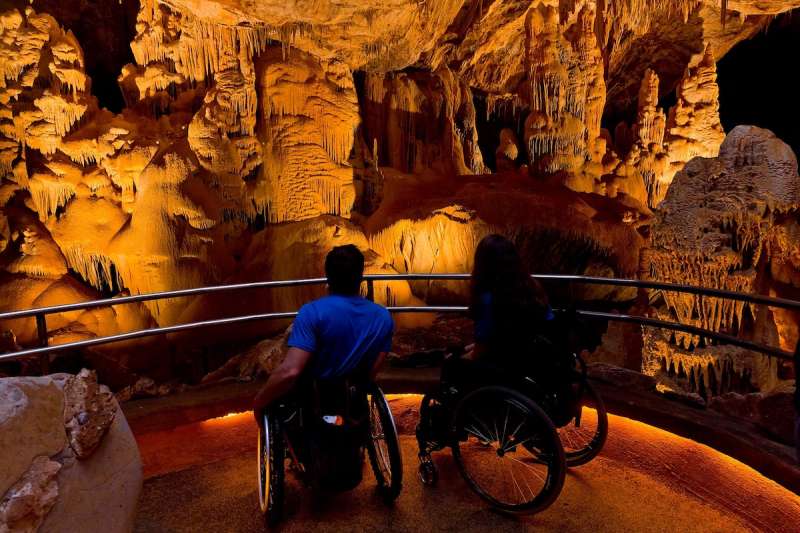
What makes Kartchner Caverns special is its stunning formations like stalactites, stalagmites and columns. Because the cave environment is so sensitive, visitors can only enter on guided tours, and things like lighting, temperature and even door systems are carefully controlled to maintain humidity.
Details: 2980 AZ-90, Benson. $10. azstateparks.com.
Colossal Cave Mountain Park
Colossal Cave Mountain Park is a popular attraction southeast of Tucson. The park is best known for its extensive limestone cave system with stalactites, stalagmites and flowstones.
Colossal Cave has a long history of use, including by Indigenous people, early explorers and even as a hideout for bandits. The park offers guided tours where visitors can explore the underground passages and learn about the cave’s geology, history and legends.
The park also has hiking trails, picnic areas, horseback riding, camping, a museum and a gift shop.
Details: 16721 E. Old Spanish Trail, Vail. $24. colossalcave.com.
Grand Canyon Caverns
Grand Canyon Caverns are a dry cave system near Peach Springs in northwestern Arizona. The lack of moisture helps preserve the formations and keeps the air inside the cave clear and clean. The caverns are 210 feet underground and are accessible via an elevator that takes visitors into the main chamber.
The caverns were created millions of years ago by underground rivers. During guided tours, visitors can see stalactites, stalagmites and flowstones, as well as fossils that are millions of years old.
In addition to the regular tours, the Grand Canyon Caverns also offer more adventurous experiences, such as spelunking tours that take visitors into undeveloped parts of the cave. Visitors used to be able to spend the night in an underground suite, but due to a change in ownership and preservation efforts, that experience was closed.
The caverns are also famous for their historical significance, having been used as a bomb shelter during the Cold War, complete with emergency supplies that are still stored inside.
Details: Grand Canyon Caverns is on Historic Route 66 in Peach Springs, 161 miles east of Kingman. gccaverns.com.
Coronado Cave
Coronado Cave is a limestone cave in Coronado National Memorial in southern Arizona, near the U.S.-Mexico border. It’s about 600 feet long, with a main chamber and several smaller side passages.
Inside the cave, visitors can find impressive stalactites, stalagmites and other formations. The cave is accessible via a moderate, 0.75-mile hike from the park’s visitor center. Entering the cave requires scrambling over rocks. Bring at least two sources of light (headlamps or flashlights) and backup batteries.
Details: Coronado National Memorial, southwest of Hereford in southern Arizona. Free. nps.gov.
Lava River Cave
This mile long lava tube north of Flagstaff formed about 700,000 years ago. During a volcanic eruption, flowing lava solidified on the surface while molten lava continued to flow beneath it. As the lava drained away, it left behind the hollow tube that exists today.
The cave stretches about ¾-mile, and you’ll have to clamber over boulders to enter. The temperature is around 40 degrees year-round, so dress warmly. The floor of the cave is uneven and rocky, with sections of the ceiling varying in height, making crawling or crouching necessary at times.
Wear sturdy shoes and bring at least two sources of light plus extra batteries.
Details: About 13 miles northwest of Flagstaff off U.S. 180. Free. fs.usda.gov.
Reporting by Tiffany Acosta, Arizona Republic