Tohono O’odham tribal leaders continue to voice opposition to the construction of a physical border wall that would cut through their lands and potentially destroy cultural resources, a warning that came as crews damaged a 1,000-year-old site in the Cabeza Prieta National Wildlife Refuge.
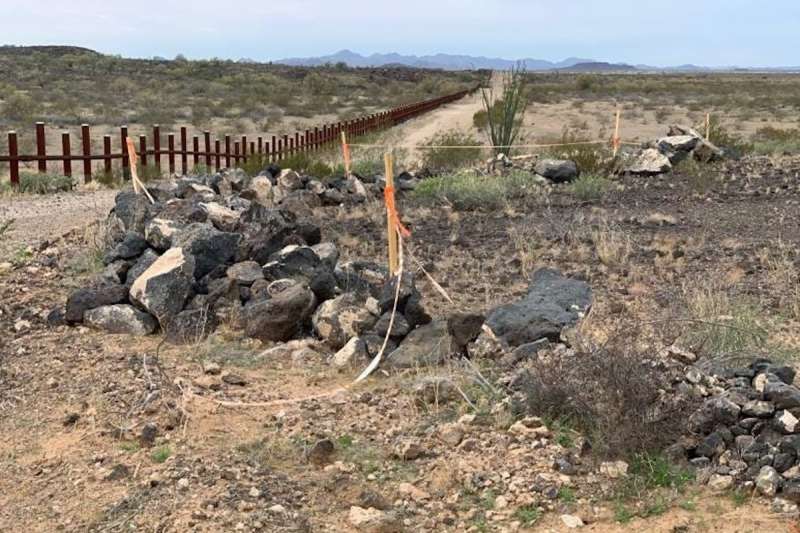
Federal officials acknowledged the damage to a huge intaglio, a carving in the ground, about 30 feet from the border, and said undamaged areas of the site have been contained.
Tohono O’odham tribal leaders met with newly confirmed Department of Homeland Security director Markwayne Mullin to express concerns that plans to build a second border wall through the refuge and Organ Pipe Cactus National Monument would damage multiple sacred sites, including A’al Waipia — also known as Quitobaquito — located in the southwestern corner of Organ Pipe Cactus along the U.S.–Mexico border.
MORE: ICE opening a new office in Flagstaff: Residents worry about tactics, tourism and terror
“Leaders explained that a wall would further divide the O’odham, desecrate sacred sites and burial areas, harm wildlife and the Nation’s land, and interfere with the annual pilgrimage to Magdalena, Sonora, and other cultural practices. Importantly, leaders also explained that a fixed wall would not make the border more secure,” the tribe said in an April 28 news release.
After meeting with Mullin, Tohono O’odham leaders said the new secretary seemed to understand and showed sensitivity to the tribe’s concerns, but he “was also clear that his direction is to construct a wall on the vast majority of the U.S.-Mexico border. It was also made clear that the federal government is attempting to move very quickly on wall construction.”
“We appreciate that the Secretary took time for lengthy discussion with Nation leaders and that he understood the Nation’s concerns that a fixed wall would have on our culture and communities,” Verlon Jose, chairman of the Tohono O’odham Nation, said in a statement.
“This level of insight has not always been the case when meeting with the administration in Washington, D.C. As we told the secretary, we will be meeting with relevant committees and the entire Council as quickly as possible to further discuss this challenging issue.”
Construction damages 1,000-year-old cultural site
Customs and Borders Protection confirmed in a statement to The Arizona Republic that on April 23, a border wall contractor inadvertently disturbed a cultural site known as the Las Playas Intaglio, located west of Ajo, Arizona, along the border. The agency “is engaged directly with tribal leadership to determine appropriate next steps,” the statement said. “The remaining portion of the site has been secured and will be protected in place.”
“I don’t know exactly when the full damage happened,” said Russ McSpadden, a conservation advocate for Center for Biological Diversity. “I was just alerted last week that half of the Intaglio had been scraped. I was in contact with the Tohono O’odham tribe because they were also wondering because CBP had not at all alerted them, which is absolutely unbelievable.”
McSpadden described the intaglio as a large, fish-shaped carving etched into the ground, one best seen from above. It sits roughly 30 feet from the border and stretches just over 250 feet in length and about 49 feet wide, forming a massive, clearly defined figure.
“It’s a fish sort of pointing in the deepest, hottest, driest part of of the desert,” McSpadden said. “It’s pointing towards the Sea of Cortez, which is interesting.”
He said it was not damaged during the initial construction of a border wall built during the first Trump administration, and he knew at that time “CBP was meeting with the tribe and agreed to protect that space.”
“But now, they’re building a second wall,” said McSpadden. “It’s not clear to me if the wall has been built yet, but all the details I’ve been given is it’s just been basically bulldozed for the second one to go through.”
Given the rapid speed and haphazard push to build a secondary wall, it would be easy for contractors to overlook culturally significant sites. The intaglio is estimated to be 1,000 years old, and the original foundations could be several thousands of years old, McSpadden said.
“This is something that I know representatives with the Tohono O’odham have made clear for years to CBP and DHS that this should be treated as a sacred site,” he said.
Blasting through cultural significance
Border apprehensions have dropped by more than 95% over the last two years due to new federal policies and the range of technologies and personnel the Nation has already authorized on its lands, Tohono O’odham leaders said. The tribe has actively supported Customs and Border Protection in efforts to secure the border, including investing $3 million of its own funds toward border security and enforcement to help fulfill the United States’ responsibilities.
Tribal police use more than one-third of their time for border-related matters, such as investigating migrant deaths, conducting illegal drug seizures and addressing human smuggling, Ned Norris Jr. the former chairman of the Tohono O’odham Nation, said in 2020.
In 2020 testimony before the U.S. House Subcommittee for Indigenous People, Norris listed the tribe’s efforts supporting border security, such as the High Intensity Drug Trafficking Task Force; an ICE office and CBP forward operating bases; vehicle barriers on tribal lands; CBP checkpoints on our lands; integrated fixed towers and the Shadow Wolves, an ICE tactical patrol unit. Similar measures are used to this day.
The former chairman talked about what CBP was doing to the land, despite the federal government’s documented recognition of Quitobaquito Springs as a site sacred to the Nation, and despite the Nation’s long-standing relationship with the Border Patrol.
Federal contractors working on the Tucson Sector border wall bulldozed a large area near Quitobaquito Springs, destroying a burial site the Nation had sought to protect and causing irreversible damage to one of the most unique oases in the Sonoran Desert.
Norris said there was no advance consultation notice or effort to avoid or mitigate harm to this sacred site. Contractors also carried out blasting for wall construction at another culturally significant location within Organ Pipe Cactus National Monument known as Monument Hill, which has historically been used for religious ceremonies by the Hia-C’ed O’odham, who share ancestry with the Nation, he continued.
Report outlines cultural, historical ties
In 2019, the Park Service also recognized that there are O’odham burial sites within Quitobaquito, Norris said.
These include archaeological sites — such as graves, trails and trail markers — and constructed features like the pond, dam, irrigation ditches and agricultural fields. While some elements, like archaeological sites, are easier to define, the distribution of plants used for food and medicine is dynamic and not easily confined within fixed boundaries, the report said.
O’odham tribal members continue to visit the site to gather plants, visit their cemetery, conduct ceremonies, and pray, the report said. The landscape includes natural features such as springs, rock outcroppings, edible and medicinal plants and important viewsheds, as well as a range of cultural resources.
A 2024 cultural landscape report by the University of Arizona on Quitobaquito underscores its importance to the O’odham people. Archaeological evidence shows human presence in the area dating to roughly 8,000–10,000 BCE. Quitobaquito came under federal management with the establishment of Organ Pipe Cactus National Monument in 1937, and the last Hia C’ed O’odham family living there departed in 1957 under pressure from the National Park Service.
U.S. Customs and Border Protection plans to build about 222 miles of barrier and secondary barrier in Arizona’s Tucson Sector. On Nov. 19, 2025, the Department of Homeland Security issued a waiver to expedite border barrier and road construction near the U.S.–Mexico border.
The plan includes building and maintaining about 19 miles of primary barrier, up to 42 miles of secondary barrier, and roughly 222 miles of supporting infrastructure — such as lighting, roads, cameras, and utilities — across the Tucson Sector.
This includes the Chihuahuan and Sonoran Deserts, grassland ecosystems, two rivers, key streams and the Madrean Sky Islands — such as the Baboquivari, Pajarita-Atascosa, Patagonia, Huachuca and Peloncillo Mountains. It would impact national parks, wildlife refuges, wilderness areas and hundreds of miles of public land.
The Center for Biological Diversity wrote an opposition letter against the building of the border wall, outlining the risks and irreparable harm to the region’s unique ecosystems, wildlife, water resources, public health and cultural heritage, while offering little clear benefit to CBP’s stated objectives.
The project’s scale and expanded use of technology go beyond prior efforts and threaten one of the most biologically rich and culturally significant regions in North America, the advocacy letter stated.
Reporting by Arlyssa D. Becenti, Arizona Republic