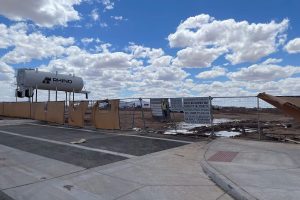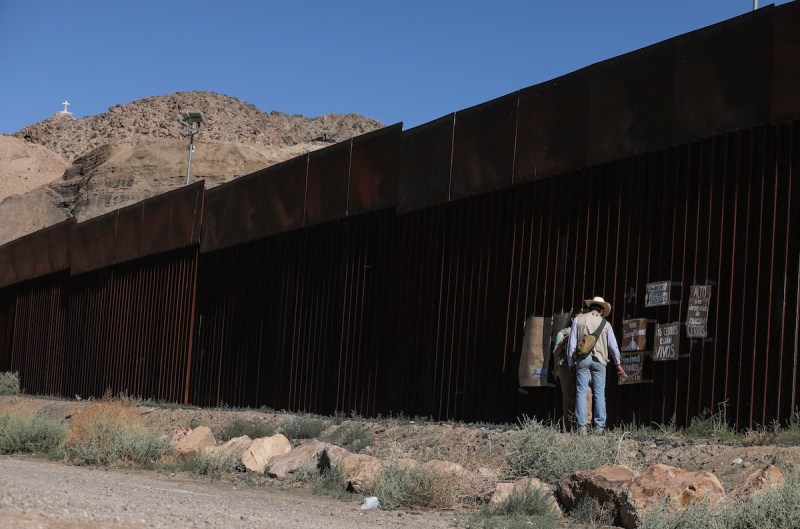
The Tohono O’odham Nation said April 28 it was notified that a Department of Homeland Security (DHS) contractor building a secondary federal border wall destroyed the Las Playas Intaglio — A 1,000-year-old, fish-shaped geoglyph etched into the floor of the Cabeza Prieta National Wildlife Refuge, on the ancestral lands of the Tohono O’odham Nation. About 60 to 70 feet of the roughly 200-foot-long geoglyph were lost. The site had been flagged by a cultural protection monitor as one for contractors to avoid.
For the Nation, the site is not just land whose status can simply be changed by law. It represents a living connection to their ancestors, their history, and their identity. This wall also threatens the animals the tribe considers “spiritual guardians”, including endangered jaguars whose range spans the border.
The Las Playas Intaglio acted as a spiritual compass pointing toward the ocean, which is tied to the salt-gathering ceremonies that bring the summer monsoon rains to replenish the desert, according to David Martinez professor of American Indian studies at Arizona State University.
“When that Intaglio is damaged, and when it’s destroyed, it’s destroying that kinship relationship that we have to maintain… with the spirits that keep our world running,” Martinez said. “The world is out of balance right now because of that destruction.”
After meeting in April with DHS Secretary Markwayne Mullin, who the tribe said in a statement listened but made clear he intends to build more wall as fast as possible, Tohono O’odham Chairman Verlon Jose called the loss “devastating and entirely avoidable.” “There is nothing more important than our history, which is what makes us who we are as O’odham,” Jose said. “The site was also an irreplaceable piece of the United States’ history, one none of us can ever get back.” They also qualified this wall “ineffective and unnecessary” in their press release on April 14.
Weeks later, Interior Secretary Doug Burgum told a House committee the destruction was “a series of mistakes” and confirmed that neither DHS nor the Interior Department consulted the Tohono O’odham Nation before construction began in that area. Both Mullin and CBP Commissioner Rodney Scott have since apologized to tribal leadership, Burgum testified.
A legal fight between the nations and the DHS
The legal fight began in 2025, when tribal leader Austin Nunez sued DHS over its decision to waive environmental and cultural laws meant to protect tribal lands from this kind of destruction. The lawsuit was unsuccessful.
Martinez describes this legal situation as an example of the limits of tribal sovereignty in Arizona. Native Nations, he says, “are not in a situation where we can, as sovereign nations, order that construction to be stopped.” Instead, they petition the federal government for accommodation them under laws written by what he calls their “colonizers.”
The government is legally required to follow a “tribal consultation policy” before disturbing public lands such as the Cabeza Prieta National Wildlife Refuge. But Martinez says federal officials often fail to respect the purpose of that policy. Instead of real consultation, he says, it can become a simple notification: an email or a phone call before bulldozers move in anyway.
For the Hia-Ced O’odham people, this is especially serious because their ancestral lands are directly in the path of construction. Without federal recognition, they have no government standing with Washington, leaving them dependent on the federally recognized Tohono O’odham Nation to advocate for them. Martinez likens their position to a minority group forced to rely on the majority to be remembered.
At the national level, there is a big contradiction. DHS waived environmental and cultural protections to accelerate construction, but destroying a Native American sacred site on federal or tribal land remains a federal crime that can carry fines or prison time.
In California, Kumeyaay Nation leaders are exploring legal action after federal contractors used dynamite to blast their sacred Kuuchamaa Mountain — a peak listed on the National Register of Historic Places since 1992 — to clear a path for new wall sections. A California member of the Kumeyaay Nation Emily Burgueno said : “No one ever consented or supported the use of dynamite on the mountain”.
In New Mexico, US Customs and Border Protection (CBP) is seeking to seize a strip of Mount Cristo Rey from the Roman Catholic Diocese of Las Cruces — a 14-acre pilgrimage site that draws up to 40,000 visitors a year. The Diocese argues construction would violate their First Amendment religious freedom rights.
The Inter-Tribal Association of Arizona, representing 21 tribes, traveled to Washington in April to lobby DHS and CBP. In certain areas, like Big Bend and across 535 miles of rugged terrain, CBP has opted for surveillance technology, patrols, and vehicle barriers — an approach many tribes prefer.
In Arizona, CBP said in a statement that a contractor “inadvertently disturbed” the site west of Ajo on April 23. The agency said it would protect the part of the site that remains. CBP Commissioner Rodney Scott is in discussions with tribal leaders about what to do next.
The human realities of the border
For Hia-Ced O’odham elder Lorraine Marquez Eiler, co-founder and board vice-president of the International Sonoran Desert Alliance (ISDA), this spiritual devastation is compounded by a lack of accountability as the federal government bypasses laws to fast-track the wall. “Somebody is responsible for this, and we all know who that is, and he should be held accountable for it,” Eiler said. “He’s getting away with whatever he wants to do. He’s doing it. No one is stopping him”
Wall construction continues to outpace legal challenges, threatening Indigenous history, sacred traditions, and human ties that predate the border itself. For Marquez Eiler, a physical barrier also misses the point of why people cross.
“There’s no wall that’ll keep anybody out,” Eiler said. “People that are hungry, desperate for survival, and fearful will do anything to come across despite the desert, heat, or fear for their lives”