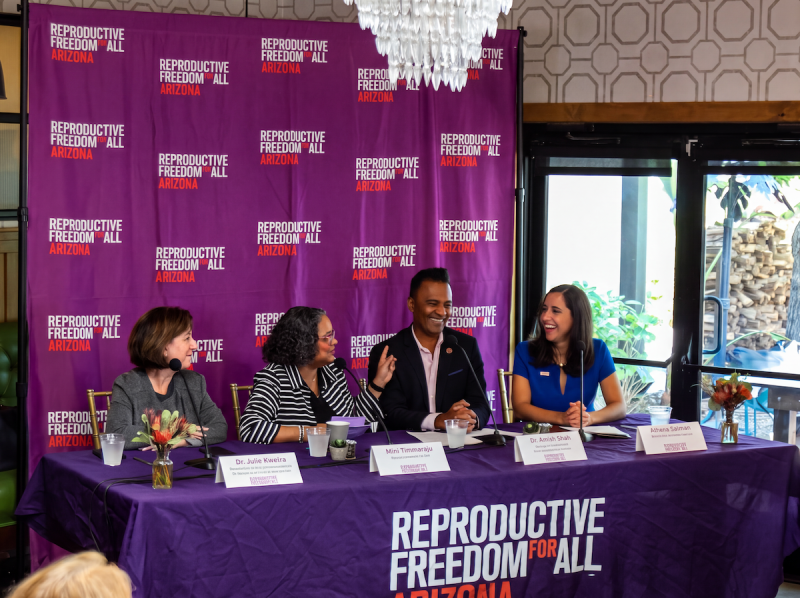
In Arizona’s most competitive district, reproductive rights are in the spotlight two years after Arizonans voted to enshrine abortion protections into the state constitution.
On Aug. 17, Reproductive Freedom for All (RFFA) announced its endorsement of former state lawmaker and emergency room doctor Amish Shah (D) over Republican and ex-NFL kicker Jay Feely in Arizona’s 1st Congressional District. The group said Feely would enact Trump’s “dangerous agenda” if elected.
Mini Timmaraju, president and CEO of Reproductive Freedom for All, pointed to Shah’s experience as a doctor.
“As an emergency room doctor who still works shifts in his district, Dr. Amish Shah knows better than anyone that personal medical decisions belong with patients and their doctors,” Timmaraju said in a press release. “Electing Dr. Shah this November is how we take back Congress and reject the extreme national agenda that Jay Feely is eager to bring to Phoenix. We’re proud to back Dr. Shah and help deliver a Congress committed to reproductive freedom.”
Feely, a self-described “staunch supporter of President Trump,” has indicated opposition to efforts to Democratic efforts to protect Roe v Wade, a landmark Supreme Court precedent that established a constitutional right to abortion, before being overturned in 2022 in Dobbs v. Jackson Women’s Health Organization, which returned abortion regulation back to the states.
Feely’s campaign website is notably silent on abortion, with the only references to gender being opposition to transgender girls’ participation in sports. Past posts on X indicate Feely’s support for gutting funding to Planned Parenthood, which provides reproductive care to over 2 million patients each year.
Trump and Republicans have long celebrated the unraveling of reproductive rights, and have made numerous efforts to further criminalize abortion.
“We terminated Roe v. Wade,” Trump said in 2023.
Feely did not respond to a request for comment by the time of publication.
Reproductive rights remain a central focus for Arizona voters, who voted overwhelmingly to enshrine abortion rights in the state constitution in 2024. Prop. 139 passed with more than 60% of the vote and won in every congressional and legislative district across the state.
The ballot measure came after a tumultuous year for reproductive rights. In April of that year, the state Supreme Court upheld a territorial near-total ban making abortion a felony punishable by two to five years in prison with limited exceptions. After public outcry, lawmakers repealed the law, and Gov. Katie Hobbs signed the repeal into law in May 2024.
Timmaraju says that doesn’t mean abortion can’t be targeted in other ways. She said if elected, Feely could work with the Trump administration to curtail abortion access nationwide, pointing to restrictions on mifepristone, an oral prescription medication used to induce an abortion.
While mifepristone remains nationally approved and available via telehealth and mail delivery, anti-abortion advocates have targeted the medication. The Trump administration has already made efforts targeting the drug, too. Earlier this year, the FDA launched a safety review of Mifepristone, which advocates say sets the foundation for further abortion restrictions.
“The Trump Administration could restrict access to abortion medication by mail,” Timmaraju told 12News. “That is how the majority of abortions in this country are being done right now through medication abortion and telehealth.”
Shah’s record
In the state House, Shah voted against 2022 Republican-sponsored legislation that sought to ban abortion. On his campaign website, reproductive rights are listed as a top issue.
“Dr. Shah has a 100% pro-choice voting record, and he will continue protecting a woman’s right to choose in Congress by codifying Roe v. Wade,” Shah wrote on his campaign website.
Republicans, on the other hand, criticize Shah as “too extreme,” pointing to his veganism and support for transgender children.
Athena Salman, director of Arizona Campaigns for RFFA, added that Shah helped gather petition signatures that sent Prop 139 to the ballot in 2024.
“Dr. Shah knows how important reproductive freedom is, which is why he personally knocked doors to carry Prop 139 across the finish line,” Salman said. “Our more than 100,000 members in Arizona are ready to send him to Congress this November to defend the protections we’ve worked so hard to secure in Arizona.”
At a roundtable alongside RFFA, Shah emphasized that women across the country don’t have the same access to reproductive rights, emphasizing the need to defeat Republicans this November.
“Women across the country don’t necessarily have the protections that we have in Arizona,” Shah said.