
Randy Jones has greeted thousands of Walmart customers in nearly eight years of working there. Standing for eight-hour shifts with his cane is difficult, he said, but he doesn’t really have a choice—he has bills to pay.
Jones, 72, has been working for 63 years—as a lawn mower, UPS driver, warehouse worker at Home Depot and Amazon, and Walmart greeter. His entire life feels like a lot of routines, with just two days off a week, usually filled with errands and appointments he can’t get to during the work week.
“I’m exhausted,” Jones said.
He isn’t sure when, or if, he will ever be able to truly retire. He isn’t alone – nearly 1 in 5 Americans aged 65 and older are still working, often while already in retirement, according to data from Investopedia collected by the Bureau of Labor Statistics in 2024.
In 2024, Jones began collecting Social Security payments, designed to prevent seniors from falling into poverty once they can no longer work.

Randy Jones outside a Walmart. Photo by Sahara Sajjadi.
But as costs continue to rise, Arizona seniors are worried they might not ever be able to stop working–or even slow down.
For Jones, he chose to delay receiving benefits until he turned 70 to secure higher monthly payments. Individuals who delay benefits until age 70 receive significantly more than seniors who retire at 62. The average monthly Social Security benefit for a worker retired at age 70 is $2,275, compared to $1,424 for those who retire at 62.
The payments still aren’t enough to live comfortably, Jones said.
His body is overworked, but he’d rather push himself to work at 70 than at 80. As a Walmart greeter, he makes enough per hour to supplement his Social Security payments, optimistic that he will one day be able to afford a senior-living home. With no family to take care of him in old age, a retirement community is his best hope.
“A lot of us have to work, even though we’re retired, because things are a challenge,” Jones said. “If I could afford to be retired, I would do that and pursue my interests, but working right now is a necessity.”
Christian Weller, professor of public policy at the McCormack Graduate School of Policy and senior fellow at the Center for American Progress, said Jones’ issue isn’t uncommon.
“For a lot of lower income people, they’re often caught between a rock and a hard place,” Weller said. “On the one hand, they need to work longer to get to that full benefit. On the other hand, the health may not cooperate, or they may have just lost their job, and the chance of them getting back into a job is almost zero.”
In April, Jones was diagnosed with emphysema, he said, a progressive lung disease that destroys the air sacs in the lungs. The condition has led to severe fluid retention and swelling in his legs and feet, something that standing for hours as a greeter doesn’t help with. He also suffers from joint issues he attributes to years of being on his feet.
But for Jones, who had no choice but to unenroll from Medicare due to high costs, just one trip to the doctor costs him, on average, more than $400. That’s why his health insurance routine is simple–just think positive thoughts and hope for the best.
“I have to avoid doctors and avoid medicine,” Jones said.
He’s not alone. A 2023 study found that in 2022, more than 20% of adults 65 and older rationed or skipped their prescription medication because of high costs. Just over half of the respondents used strategies to be able to afford their medicine at all.
“There are so many countries in the world where none of this would be an issue,” Jones said. “Nobody loses their shirt over a medical issue, no one has to meter their medication, and there’s no excuse for us in this country.”
A common trope
Rodrigo Sanchez, 64, is in the same boat. He’s paid his dues to the US, working 36 years as a mechanic, laborer, and field worker, on top of ten years of labor back home in Mexico. His body, riddled with pain and aches, is a constant reminder of his more than four decades of hard work.
The physical toll was severe enough that he needed painkillers just to get through his shifts as a mechanic—and said the pain never really left.
For years, he looked forward to retirement, and in 2024, he finally retired and began collecting his benefits.
“[The pain] must be from all those years, from working so hard, putting your body through so much over a lifetime… I just can’t take it,” Caballero said in Spanish.
But two years into retirement, Caballero is bracing himself to re-enter the workforce, to work the fields in irritation. The Social Security payments are just too low to cover his bills—including the mortgage, car payments, and health insurance—while living comfortably.
“There’s nothing I can do. It’s the government.” Caballero said. “I think I’m going to have to work forever, even if it’s picking up cans or whatever, but I have to, to make a living for myself.”
Weller said one of the challenges for older Americans is a workforce that discriminates against old age. One way to ensure better opportunities for older workers who have no choice but to reenter the workforce is to ensure anti-age discrimination laws are strictly followed.
Too old to hire, too broke to retire
About 64% of workers over 50 report seeing or experiencing age discrimination in the workplace, with 22% feeling they are actively pushed out of their jobs. The typical age when age discrimination first begins is 45, and it takes older workers about 3 months longer to secure new employment than their younger counterparts.
The problem is pervasive across industries. Victor Mota, a 68-year-old cook, retired in 2023. Originally from Mexico, he and his wife left in 1988 for a better future, walking through the desert before arriving in Sonoita, Arizona.
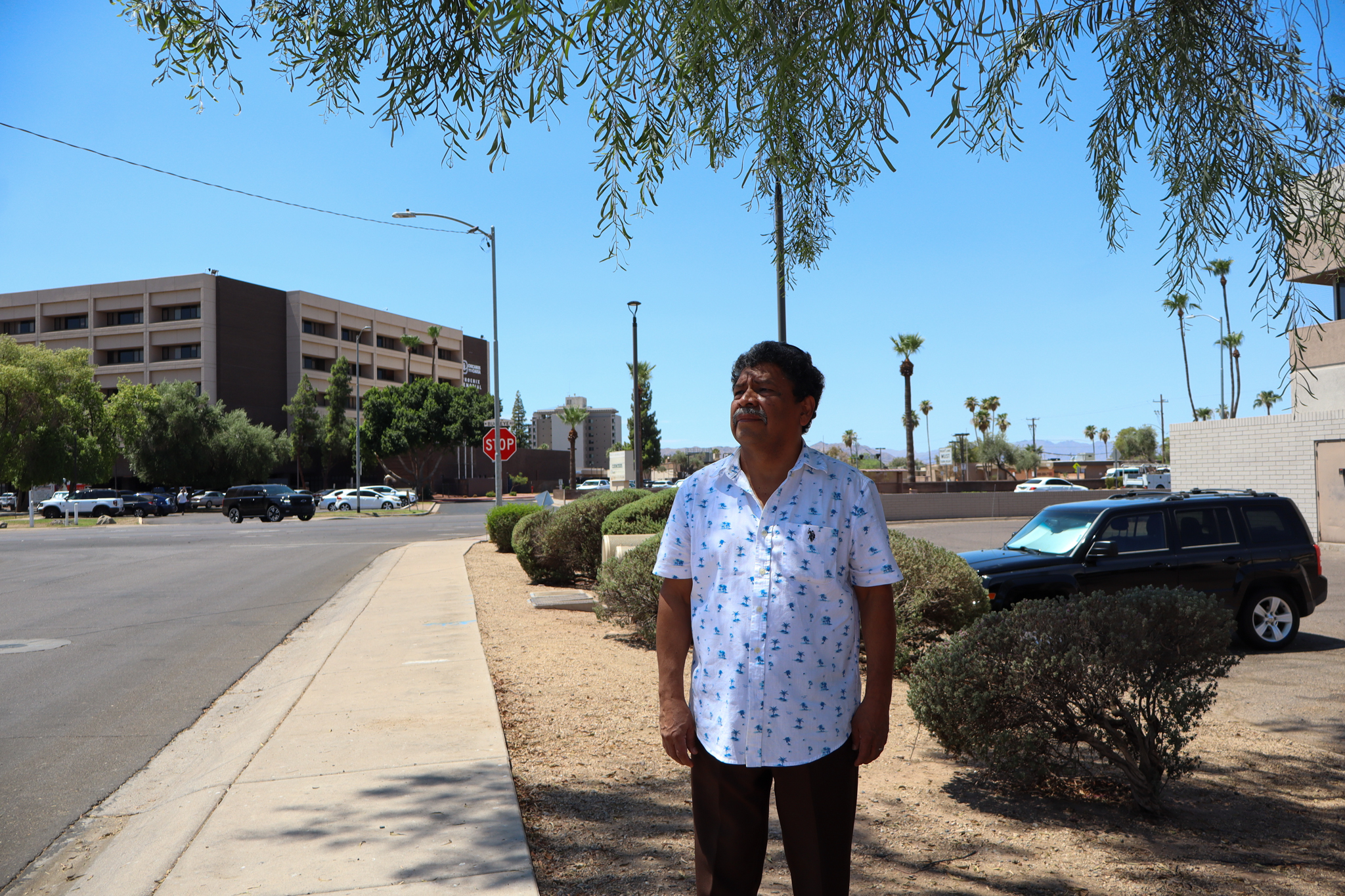
For Mota, he’s unsure if he will ever stop working. Photo by Sahara Sajjadi.
In his 38 years in Arizona, he’s worked at Aramark, a dining service, mostly as a chef. He’s cooked for thousands of Arizona State University (ASU) students, seen the state’s rapid growth, and watched his colleagues rise through the ranks.
He initially thought he would be able to retire and live comfortably. However, once his Social Security payments kicked in, he quickly realized the benefits could not cover his basic needs. His savings quickly flew by and the bills were high.
“Everything is very expensive – gasoline, rent, utilities,” Mota said in Spanish. “I am still paying for my home, and my expenses are very high. I have a large family to support, and I am concerned about my pension benefits. I’m trying to manage it all, but it’s a struggle.”
Between paying his own bills and taking care of his family, he felt he had no choice but to return to work. Mota likes working, thankfully–it keeps him preoccupied. The issue isn’t the job—it’s surviving in today’s economy.
Weller explained that it’s common for seniors to feel this way. Working in old age can help with a social network and keep people busy.
“The important part is not to see work at older ages as purely bad. For a lot of workers, it is fulfilling, it engages their minds, it keeps them socially engaged,” Weller said. “But there is sort of a class difference for low wage workers who often have to work because the Social Security benefits are too low.”
Mota is back working at the ASU downtown Phoenix campus, cooking meals for the allergen station. His time in retirement was short-lived.
“I thank God I can still work and I will continue to work,” Mota said. “In this life, if we don’t work, we don’t eat.”
Immigrants have worse odds
Berhe Weldibanos, who fled Eritrea for the US 16 years ago, has been working as a Sky Chefs dishwasher since he arrived. For years, he and his wife, Sara Mesgna, did long-distance before she was finally able to come to the US four years ago.
“I pray to God for the bills,” Weldibanos said. “We don’t have any money in [the] bank. No savings. When I stop working, [it’ll be a] very big problem. It’s not enough.”
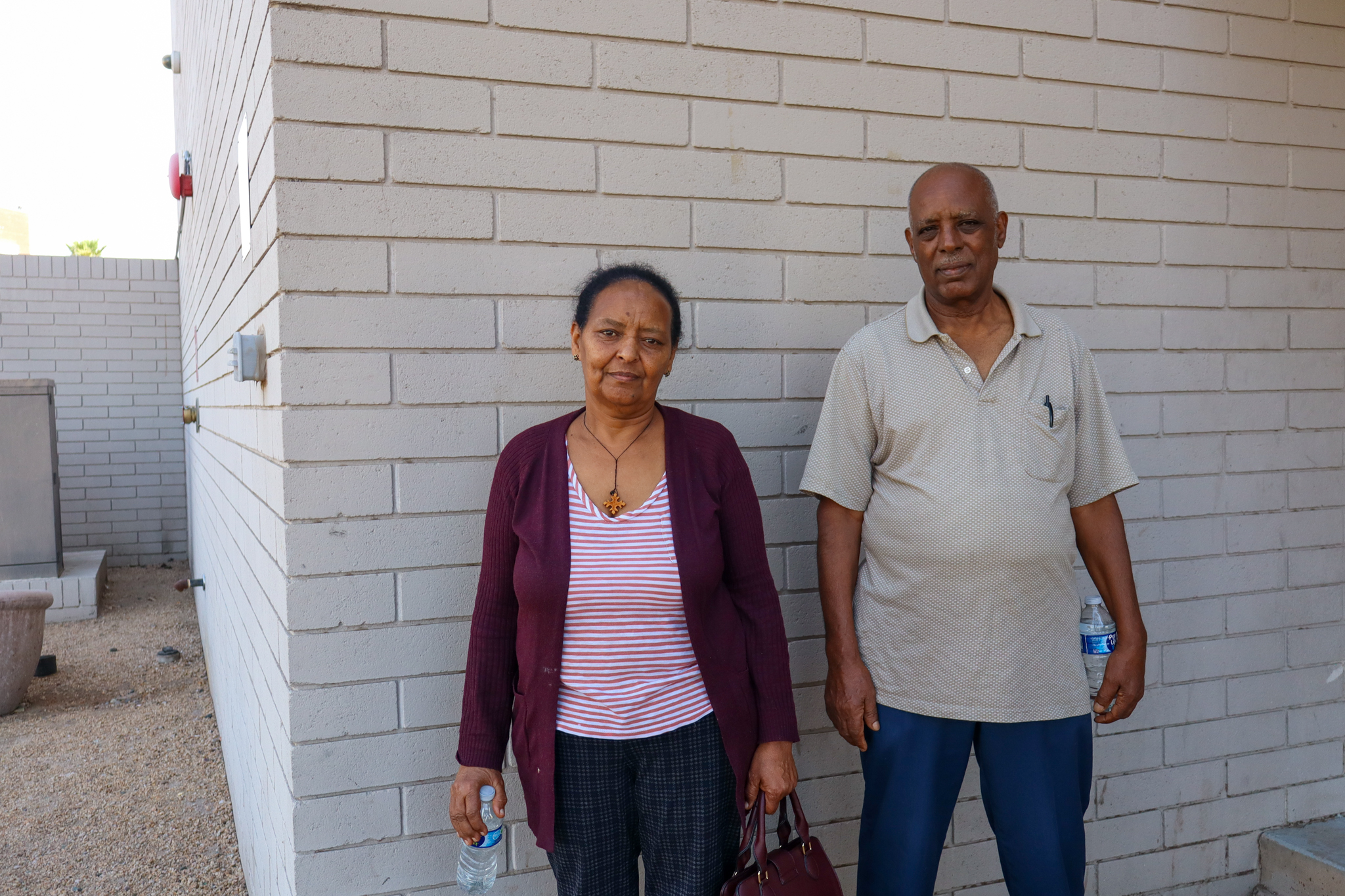
Sara Mesgna and Berhe Weldibanos in downtown Phoenix. Photo by Sahara Sajjadi.
Weller said that Social Security isn’t meant to be a retirement plan. Rather, the program is designed to prevent poverty for older Americans. But to reasonably address the issue, Weller said public policy should focus on preparing people for retirement, including through higher wages, better savings options, affordable healthcare, and a caregiving infrastructure.
For immigrants, who tend to have a lower income and inadequate retirement savings due to lower lifetime earnings, the dream of retiring and living in financial stability is even more elusive. Studies show late-arriving immigrants have even less chance of collecting benefits, and US-born workers retire at nearly 1.5 times the rate of foreign-born citizens—and almost three times the rate of noncitizen workers.
When Weldibanos was bed-ridden last year due to a knee injury, it was Mesgna who had to pick up extra shifts to make ends meet while also taking care of him. Now that he feels better, the 76-year-old is back at work, despite the pain.
It’s why he hasn’t seen his three children, living overseas, in years.
A quiet crisis
Weller explained that stories like Weldibanos’, Mota’s, Caballero’s, and Jones’ point to a broader story about who’s struggling in old age—and why it often goes unnoticed.
“A substantial share of people who are struggling in retirement — they may not be poor. They are often near poor, because Social Security does a really good job lifting people above the poverty line, but just above it,” Weller said.
In 2025, the American Association of Retired Persons (AARP), a nonprofit advocating for older Americans, backed the bipartisan Protecting Older Workers Against Discrimination Act. USAging, a nonprofit advocating for older adults, encouraged Congress to reauthorize and fund the Older Americans Act (OAA), a law designed to support caregiving, meal programs, and services that let seniors age at home.
In what could be a win for older Americans, the Senate voted unanimously July 14 to pass the OAA. It now moves to the House, and if approved, could be a “major step forward in strengthening the nation’s commitment to older adults.”
For Arizona seniors, changes can’t come soon enough. While Social Security benefits help them narrowly escape poverty, they have a lifetime of aches and pains to show for it, and no clear sight on when they might finally be able to work to live rather than work to survive.