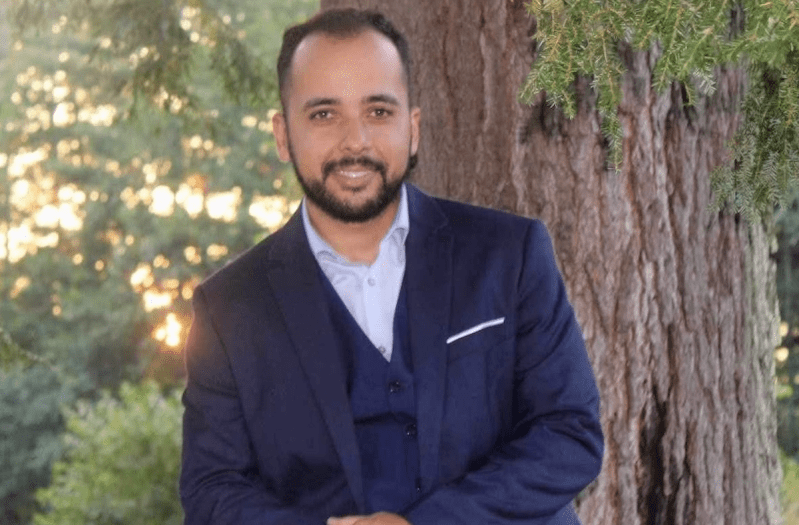
Marcos Gaspar Da Silva had never visited Arizona before.
He lived in Maine, where he ran a general contracting business, remodeling houses to make ends meet. He and his wife, Alessia Gaspar Da Silva, lived a “simple life,” she said.
That life came crashing down on Jan. 20, when Immigration and Customs Enforcement (ICE) agents pulled Da Silva and his co-worker over. They said they were looking for someone else with active warrants, according to Alessia, who was on video call with Da Silva at the time.
Immigration officials asked if the two men were in the US legally. After Da Silva told agents his asylum case was pending, they arrested both men, according to Alessia, in what she called an act of “racial profiling.”
After being detained, Da Silva was shuttled in between detention facilities—from Maine to Massachusetts, then to Louisiana and finally, to Arizona, on Jan. 26, where his wife says he has experienced “deplorable” conditions within Arizona’s ICE facilities.
“Having my husband moved around, his health and life at risk, has been heartwrenching and stressful,” Alessia said. “They have torn lives apart. This administration who claimed ‘make America great again,’ made America hate again.”
Journey to the US
A former lawyer in his home country of Brazil, Da Silva felt he had no choice but to flee after being threatened at gunpoint. He made the journey to the US in 2021, traveling across the southern border and leaving behind his home to start a new life.
It was a rocky start—he spent nearly two weeks detained in Mississippi but was found to have “demonstrated a credible fear of persecution or torture” by a US Citizenship and Immigration Services (USCIS) officer, giving him the legal opportunity to seek asylum.
Da Silva was released on parole as his asylum case progressed before moving to Maine, where he met Alessia.
Da Silva made a life for himself in Maine—he learned English, started his own small business and married Alessia in 2023. He overworked himself to pay the bills, remodeling houses from 6 a.m. to 9 p.m. most days and even on holidays, according to Alessia.
Because Da Silva spoke only Portuguese upon entering the country, he missed an immigration court date and later failed to renew his asylum application, Alessia said. The couple later filed a green card petition, but bureaucratic delays left the application pending when the Trump administration took power, stripping Da Silva of immediate protection and leaving them in fear of the worst—a fear that later became reality.
Arizona detention
Once his plane touched down in Arizona, Da Silva and other detainees waited for more than 30 hours to be processed due to overcrowding, Alessia said.
“They were left there for over 30 hours in chains, full chains, not allowed to go to the bathroom,” Alessia said. “Many of the people soiled themselves because [they] didn’t care about moving them to go to the bathroom.”
Eventually, Alessia said, Da Silva was processed at the Florence Processing Center and given a meal of bread, apple slices, and a juice box, a meal Alessia said wasn’t enough for a grown man.
“The mental warfare that they have done on them is horrible,” Alessia said.
According to her, Da Silva was held at the Florence facility for three days before being transferred to the Arizona Removal Operations Coordinations Center, or AROCC, a detention center at the Mesa-Gateway Airport. While the facility is meant for stays of 12 hours or less before detainees are sent to longer-term facilities, a report by the Arizona Mirror found that the center often holds people for far longer than it’s supposed to.
The guards at AROCC were the cruelest, Alessia said.
Da Silva and about 50 other detainees were crammed into a cell with just one toilet, according to Alessia, leaving no room to lie down, shower, or change clothing.
AROCC has received scrutiny all year for its overcrowding and inhumane treatment of detainees. In April, Democratic US Reps. Yassamin Ansari, Adelita Grijalva, and Greg Stanton made a surprise visit to the facility and discovered people “packed like sardines,” living in “disgusting” conditions.
Because AROCC is meant for short-term stays, it does not have proper bedding or showers. Alessia said her husband told her the toilet in the cell was often overflowing and went uncleaned, leading to bacteria-infested floors they were expected to sleep on.
“It was so crowded that they had to sleep near there. They considered the water drinkable, but it made them all sick,” Alessia said. “He was denied a blanket, clothing, bed, shower, food was sporadic. They said the water was okay, even though it came out brown.”
The Copper Courier reached out to ICE to ask about the allegations made about conditions at Florence and AROCC. ICE did not respond to a request for comment by the time of publication.
Medical neglect
On Feb. 5, after a tumultuous week-long stay at AROCC, Da Silva was transferred back to the Florence Correctional Facility for a longer stay, Alessia said. As of June 30, he is still there, according to the ICE detainee locator.
The conditions are slightly better at Florence, but not by much. For weeks, Da Silva was unable to go outside at all, Alessia said.
The water is undrinkable, too, her husband told her. She said Da Silva would often get stomach pains after drinking the water, so she puts money in his commissary account so he can purchase water bottles. He began purchasing food from the commissary, too, so he could use his bottled water to cook his own meals and avoid the kitchen food that made his stomach ache, according to Alessia.
Guards frequently brush off his medical concerns, too, Alessia said. In February, when Da Silva suspected he had a tooth infection, he informed staff and all they gave him was some ibuprofen, according to Alessia. His condition went untreated for weeks before the tooth was finally removed on April 1 after he fainted twice.
Medical neglect is not uncommon in ICE facilities. In March, Emmanuel Damas, a 56-year-old Haitian asylum seeker held in ICE detention in Arizona, died from complications from an untreated tooth infection.
CoreCivic, a private prison company that operates the Florence facility, disputed the allegations of medical neglect and contaminated water, stating that inmates can sign up for medical care and have access to licensed staff and medication.
“The safety, health and well-being of the individuals entrusted to our care is our top priority,” a spokesperson said. “We take seriously our responsibility to adhere to all applicable federal detention standards in our U.S. Immigration and Customs Enforcement (ICE)-contracted facilities, including our Central Arizona Florence Correctional Center (CAFCC).”
The spokesperson added that the facility receives “the same clean water” as the surrounding community and that staff and detainees drink the same water.
“Any claim otherwise is false,” the spokesperson said.
Da Silva has also suffered from rashes, mouth aches, and weakened muscles—none of which he experienced before being detained.
At one point, his health had deteriorated so badly that he called Alessia to say goodbye in case he did not wake up the next day, she said. He told her he loved her, but, thankfully called again the next day.
When Alessia is able to video chat with her husband, she said he looks noticeably different from the man she remembers.
“He looked very gaunt,” Alessia said. “He had lost weight. You could see that one side of his face was swollen from the infection, and you could see the toll everything had taken. His health was deteriorating.”
The toll
Alessia misses her husband, and normalcy.
She has four kids, including two with special needs, and one grandchild, with another on the way. She’s been left alone to pay household bills that have grown increasingly expensive due to Da Silva’s immigration fight.
Alessia also has a number of health conditions, including congestive heart failure and myocardiopathy, according to documents reviewed by The Copper Courier. She was supposed to go in for an endoscopy earlier this year, but her medical needs have been put on pause. There’s no time, she said, or money.
She said she spends $400 to $500 per month just putting money into her husband’s account so he can call her and buy food from the commissary. She has also spent thousands on lawyer fees and USCIS fees, navigating the bureaucracy of the immigration system—mostly by herself.
To make ends meet, she works for DoorDash, creating her own schedule so she can answer her husband’s calls and manage the never-ending stacks of paperwork.
“It has been horrible for me, with my heart and my health. There’s times that I have to pick between getting food for my son or giving fresh water to my husband,” Alessia said. “It’s a lot of sleepless time, a lot of financial worries, a lot of being spread thin.”
She spent her 50th birthday, Jan. 21, trying to locate her husband, contacting immigration attorneys, and taking care of her children. She spent Valentine’s Day alone after guards put the facility on lockdown and prevented her husband from calling until midnight local time in Maine. The two discussed celebrating the day by eating ramen at the same time, a stark contrast to the Valentine’s Day they spent together a year prior.
“They took my husband, and I have been put in fight and survival mode, not just for him, but for everybody in my family,” Alessia said. “Instead of peace, I’m a victim, but I refuse to be one, and I refuse for my husband to be one, so I’ve done what I’ve always had to do and become a fighter, and it’s exhausting.”
The family has set up a GoFundMe to assist with legal expenses.