At the crack of dawn on June 13, Arizona Republicans wrapped up the 2026 legislative session by placing House Concurrent Resolution 2001 on the November ballot, a proposal that, if approved, will make it harder for millions of Arizona voters to cast a ballot, according to voting rights advocates and Democrats.
HCR2001, or the Fast, Accurate, Secure, Transparent Election Results Act, would make would make numerous changes to state voting laws, including requiring mail-in voters to provide a government-issued photo ID while returning their ballots—without offering a solution as to how millions of Arizonans can send in their ID by mail. The bill has been dubbed a “voter suppression” bill by advocates.
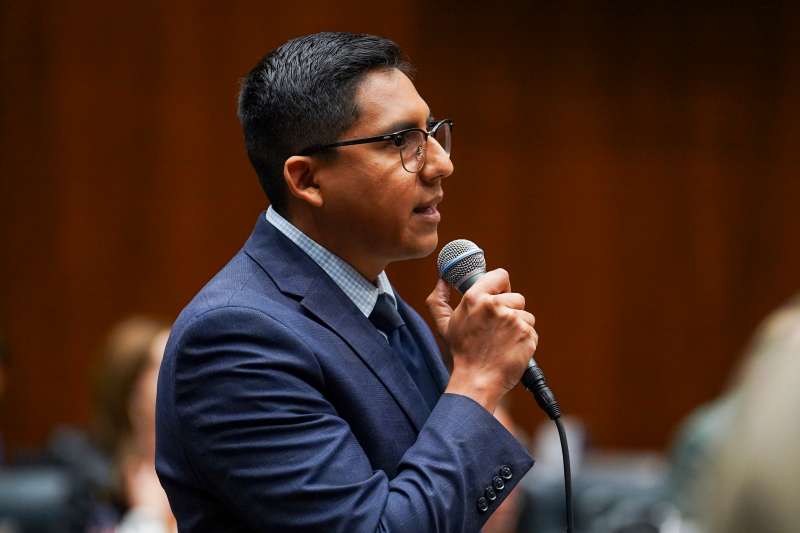
House Minority Leader Oscar De Los Santos (D-Phoenix) called the measure “a blatant attack on our voting rights” that is not in line with the will of Arizona voters.
“What Arizonans want right now is for us to take on corporate greed and to make life more affordable for everybody, to bring down the cost of housing and healthcare and groceries and childcare, and this does none of that,” De Los Santos said. “It’s bizarre that Republicans would want to do something that pretty much everyone opposes.”
De Los Santos isn’t alone in his concern.
A day earlier on the Senate floor, State Sen. Analise Ortiz (D-Maryvale) called the measure a “voter suppression bill” and urged her colleagues to vote against it. But the measure passed both Republican-controlled legislative chambers along party lines.
Voting rights groups have also been sounding the alarm about HCR2001, worried it will hinder Arizona voters, the majority of whom use mail-in voting, from accessing the ballot box.
Lula Haji, policy manager for Our Voice, Our Vote, a voting rights group, called the measure a “hurdle to democracy” that will impact marginalized voters, including students, seniors, rural voters, and voters of color.
“It builds a wall between eligible voters and the ballot box, when we should have everybody participating in our voting process,” Haji said. “Not having unnecessary barriers or hurdles when it comes to voting.”
The core issue, advocates say, is the logistics of the bill. It’s unclear how the majority of Arizonans who vote by mail would provide government ID alongside a mail-in ballot.
Republican Rep. Alexander Kolodin (R-Scottsdale), who is running to be Arizona’s next secretary of state and sponsored the legislation, said there were “many potential options” to implement the system. He pointed to one idea where state officials would issue each voter a unique number and require them to write the last four digits of the number on their ballot envelope.
‘Terrified of not being able to vote’
Haji called the effort a “politically motivated distraction” and pointed to Arizona’s existing secure election laws.
State law already requires voters casting in person ballots to show photo identification or two documents with their name and address. For mail-in ballots, voters must show ID while registering to vote and sign their envelopes when returning their ballot. County election officials later verify their signatures. If an issue arises, such as a signature mismatch, voters are notified and given the chance to correct the mistake.
But Republican lawmakers want that process to be even more complicated, despite more than 75% of Arizonans—including seniors, students, people with disabilities, and rural voters—voting by mail for various reasons. Mail-in ballots offer Arizonans who work or who cannot wait in long lines the chance to make their voices heard at the ballot box.
While knocking on doors in Maryvale for her reelection this week, Ortiz talked to voters who she said immediately asked her if their ballots would still come in the mail.
Ortiz said she’s heard from many residents who are concerned about their voting rights as the Trump administration and Republicans work to stifle voting access.
“These are seniors, these are Latinos, these are disabled people, these are my constituents that are terrified of not being able to vote how they have always voted,” Ortiz said.
Haji worries the measure could impact naturalized citizens, too, who are living in increased fear under the Trump administration. As Immigration and Customs Enforcement (ICE) agents are deployed nationwide, targeting long-term residents, Haji said naturalized citizens might be too distrustful to mail the government their photo ID or other sensitive information.
“This really exposes them to severe identity theft and privacy breaches, because this resolution would demand that their sensitive information be handed over when they’re voting,” Haji said. “But it doesn’t offer a clear process or any safeguards for what happens once the government stores it and who has access to the data.”
The new ballot measure is part of a broader push by Arizona Republicans to restrict early voting, a system originally created by the Republican-led legislature in 1991.
“Vote by mail is in fact a Republican invention that was passed by a Republican legislature in Arizona, and suddenly they’re against it once they started losing elections,” De Los Santos said.
Part of a broader attack on voting rights
Ortiz likened HCR 2001 to the Safeguard American Voter Eligibility, or SAVE Act, which passed the US House of Representatives earlier this year with Republican support. The SAVE Act would implement steep barriers to registering to vote and casting your ballot, with experts saying it would make it harder for underrepresented groups to cast their ballots, if enacted.
While the bill has stalled in the US Senate, where it requires 60 votes to pass, Ortiz said it’s proof that “Republicans know they are losing, and they know the only way to win is to cheat.”
For years, Republican lawmakers, including President Donald Trump, have claimed, without evidence, that mail-in voting leads to “cheating” and have been pushing to make voting harder for millions of Americans.
“Their ideas about giving huge tax cuts to the wealthiest while leaving the working class out to dry are unpopular, so they are willing to sacrifice even their voters in order to make the electorate so small that they end up coming out on top,” Ortiz said.
Ortiz and De Los Santos are both urging voters to vote against the measure.
“The power is in our hands. Sure, maybe the Republicans pass this in the middle of the night and referred it to the ballot, but at the end of the day, we get to decide whether it becomes law or not,” De Los Santos said. “Every single person needs to go out and vote against HCR 2001, because we have the power to stop it, and we need to do it.
The stakes couldn’t be higher, Haji said, expressing concern about what might come next if HCR 2001 passes.
“This really sets a dangerous precedent for future voter restrictions, because this resolution is a gateway to further voter suppression by loosening the standards for election laws,” Haji said. “This really opens the floodgates for future restrictions.”