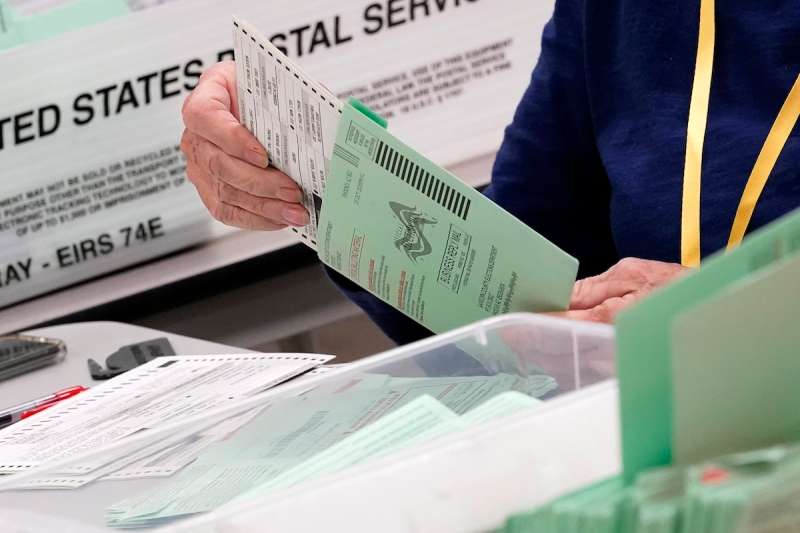
A federal judge in Massachusetts has struck down key parts of President Donald Trump’s effort to screen mail-in voting using the U.S. Postal Service, a ruling with potentially outsized impact in states such as Arizona that rely heavily on that type of balloting.
Arizona was among 22 states and Washington, D.C., that sued to challenge Trump’s March 31 executive order that enlisted federal agencies to help determine voter eligibility.
But U.S. District Judge Indira Talwani, appointed by former President Barack Obama, emphatically held that the president has no authority in state-run elections.
MORE: ‘A voter suppression bill’: AZ Dems, advocates slam GOP effort to overhaul voting laws
“The Constitution does not grant the President any specific powers over elections,” she wrote in a 37-page order. Talwani underlined the words “does not.”
“As the Supreme Court has observed, ‘the President’s power to see that the laws are faithfully executed refutes the idea that he is to be a lawmaker.’”
Arizona Attorney General Kris Mayes, a Democrat, welcomed a ruling that leaves the state’s preferred method of voting unchanged.
“Millions of Independents, Republicans, and Democrats in Arizona have voted by mail for decades,” she said in a statement. “In fact, nearly 80% ofArizona voters cast their ballots this way election after election. Military families vote by mail. Rural Arizonans vote by mail. Tribal members vote by mail.
“Donald Trump’s executive order targeted all of these voters. But today, the courts affirmed what the Constitution makes clear: states run their elections, not the President. Arizona will never allow the Trump administration to seize control of our elections.”
The ruling comes as Trump has waged a multi-pronged effort to rework election procedures across the country ahead of the November midterms.
The administration has lost nine cases to force states, including Arizona, to hand over their registered voter lists.
On June 24, the White House canceled a planned signing ceremony for bipartisan legislation intended to boost the nation’s housing supply unless Congress also passed the SAVE America Act, an unrelated voting measure that would require identification — something Arizona already does — and imposes new restrictions on mail-in voting.
A lawsuit in Washington, D.C., that also challenged the executive order led to a more favorable ruling on May 28 for Trump, with a judge holding that the Postal Service could take initial steps to create a federal voter-eligibility database.
In that case, U.S. District Judge Carl Nichols, a Trump appointee, held that creating such a database would not adversely impact states’ ability to manage their election, at least not yet. That could change, he wrote, but he would not prevent the agency from even considering how to implement Trump’s order.
In her ruling, however, Talwani said that states are already impacted by changes to election rules.
Nearly half the states, for example, had already purchased types of mail envelopes for their ballots that would not meet the executive order’s intended restrictions.
Beyond that, the federal government and agencies like the Postal Service have no legal authority to manage elections, Talwani found.
“No law enacted by Congress delegates authority to control mail-in voting to USPS,” she wrote.
Postmaster General David Steiner signaled on June 24 that he intends for his agency to follow Trump’s directive.
U.S. Sen. Gary Peters, D-Michigan, asked Steiner if states that withheld their absentee voter lists from the federal government would be able to use the mail for balloting.
“Under our proposed regulation, no,” Steiner said during a hearing before the Senate’s Homeland Security Committee.
Reporting by Ronald J. Hansen, Arizona Republic