WASHINGTON – For five years, Ricardo Reyes served the country of his birth as a Marine, pledging to sacrifice his life if necessary to defend the United States.
Nearly two decades later, the Phoenix native doesn’t leave home without his passport card, so he can prove his U.S. citizenship in case he’s stopped by federal authorities.
“I keep that with me just in case I ever need it, because that is a reality we’re living in, that you are going to have to be able to identify yourself eventually,” Reyes said. “Whether you’re here legally or not, brown people will be the target, and brown people are the target right now.”
Want Arizona news in your inbox each morning? Sign up for our free newsletter.
A growing number of American citizens – natural born, such as Reyes, or naturalized – say they are taking such precautions and living in fear of being detained by Immigration and Customs Enforcement, in light of the roundups and deportations ordered by President Donald Trump.
Fears spiked further since the U.S. Supreme Court lifted restrictions on racial profiling by ICE on Sept. 8.
That 6-3 ruling allows agents in the Los Angeles area to target individuals if they use Spanish, appear to be a certain race or ethnicity, hold jobs commonly filled by workers who lack lawful status or are spotted at locations such as car washes, bus stops and day laborer pickup sites.
The ruling technically applies only in Southern California. But civil rights advocates have little doubt the high court would allow immigration authorities to employ racial profiling elsewhere.
“As a Latino veteran, why do I have to worry because of the way I look? Why do I have to worry about being harassed by ICE when I know that my white, older counterpart is never going to have to worry about that?” said Reyes, who runs an advocacy group for veterans called VetsForward. “That’s not equal treatment. That’s against the Constitution, and that’s against the rights that I thought I was protecting when I joined the military.”
RELATED: Phoenix woman with leukemia has been without medical care in ICE detention for 7 months
The Department of Homeland Security vehemently denies that American citizens have been detained, even inadvertently, during its immigrant sweeps. When a citizen is arrested during an operation, officials typically say they had interfered with agents.
“U.S. citizens are NOT `wrongfully’ being arrested by ICE,” the department said Sept. 17, responding to a California man’s allegation that he spent three days behind bars despite telling agents he is an American. “DHS enforcement operations are highly targeted and are not resulting in the arrest of U.S. citizens.”
In May, a number of news outlets reported that Homeland Security Secretary Kristi Noem and White House deputy chief of staff Stephen Miller set a goal of 3,000 immigration arrests per day.
Although the administration denied any such quota in federal court, Trump and others regularly tout an aggressive pace of ICE operations, particularly in “sanctuary cities” that don’t fully cooperate on immigration enforcement, such as Chicago and Boston.
On Tuesday, DHS announced that it has deported about 400,000 people since Trump returned to office on Jan. 20, and expects to hit 600,000 by the end of December. Another 1.6 million have left the country voluntarily.
The administration’s rhetoric and tactics have prompted many citizens to protect themselves in case of an encounter with ICE – among them Phoenix resident Cristalís Capielo Rosario, a citizen since her birth in Puerto Rico.
She and her family members carry around their passports, a habit that started “soon after the new administration took office,” she said.
To avoid drawing unwanted attention, she and her 8-year-old also stopped speaking Spanish in some public spaces.
“My son and I, we have this rule that at the supermarket we speak English because we don’t want to be looked at funny, or have somebody potentially call the authorities on us,” she said.
An associate professor in the School of Counseling and Counseling Psychology at Arizona State University, she said the Supreme Court’s ruling heightened the feeling of being demonized.
“This questioning of our citizenship and whether or not we belong is nothing new. We have been dealing with it for decades,” Capielo Rosario said, referring to being Puerto Rican. “The issue now is that there’s more police presence, federal police presence, so it increases the level of stress.”
For some Arizona residents, the Trump administration’s tactics – combined with free rein for ICE to engage in racial profiling granted by the Supreme Court – bring back memories of the state’s Senate Bill 1070.
Signed into law by Republican Gov. Jan Brewer in 2010, SB1070 included a controversial “show me your papers” provision that allowed police to stop anyone on suspicion of being in the country unlawfully, and to demand proof of citizenship. Parts of the law were struck down as unconstitutional by the Supreme Court.
“I’m concerned because the recent Supreme Court ruling essentially says, based on how you look … based on if you speak Spanish or you have an accent, it allows you to be detained,” said Lisa Magaña, a professor at ASU’s School of Transborder Studies. “You can be detained regardless if you are a U.S. citizen.”
“In some aspects, I think it’s more massive than SB1070. … This is a national issue,” she said.
Justice Sonia Sotomayor, one of the three liberal dissenters on the Sept. 8 ruling, warned that it carries dark implications. “We should not have to live in a country where the Government can seize anyone who looks Latino, speaks Spanish, and appears to work a low wage job,” she wrote.
The decision reversed an order from a federal district court with jurisdiction in Los Angeles and neighboring counties, where a judge deemed ICE enforcement methods unlawful.
The day the Supreme Court issued its ruling, White House border czar Tom Homan told reporters that “we’re not racial profiling anybody.”
Agents, he said, use a “myriad of factors … to establish reasonable suspicion.”
The lower court issued the racial profiling order amid a slew of worksite raids that began in June. As of Aug. 26, DHS tallied 5,000 arrests and highlighted the arrest of “criminal illegal aliens, gang members, child predators, and murderers.”
But not everyone caught in the dragnet was a criminal – or even a foreigner.
In July, George Retes, a 25-year-old Army veteran born in California was heading to his job as a security guard when he came upon a confrontation between protestors and federal agents who were raiding his employer’s Ventura County cannabis farm.
He got out of his car and from a distance – hoping not to be mistaken for either a protester or a target of the raid – shouted to agents: “I’m a citizen. I’m just trying to get to work.”
After some confusion, his car filled with tear gas and he was sprayed in the face with pepper spray. Retes says he was dragged from the car, thrown to the ground and restrained.
“They never asked to see an ID to begin with. They didn’t care if I was a citizen,” Retes said.
He recounted a three-day detention at the Metropolitan Detention Center in Los Angeles, where he missed his daughter’s third birthday.
His lawyer, Marie Miller, an attorney for the Institute for Justice, said Retes intends to sue the government for violating his constitutional rights.
Responding to an op-ed Retes wrote about the incident, DHS posted on X that he was arrested for assault – not for any immigration law violation – after he “became violent and refused to comply with law enforcement.”
The department asserted that its enforcement operations “are not resulting in the arrest of U.S. citizens. We do our due diligence. We know who we are targeting ahead of time. These types of smears are designed to demonize and villainize our brave ICE law enforcement. This kind of garbage has led to a more than 1000% increase in the assaults on enforcement officers.”
In an interview, Reyes said he remains fearful.
“I want to spend as much time being free, enjoying the world and the sun,” he said. “But at the same time when I go out, it’s like, ‘OK, well, what if ICE is just randomly there and this happens again?’”
Because of the looming threat of detention, even relatively innocuous encounters with ICE can leave citizens traumatized.
Six days after Trump’s second term began, the administration launched an immigration enforcement blitz.
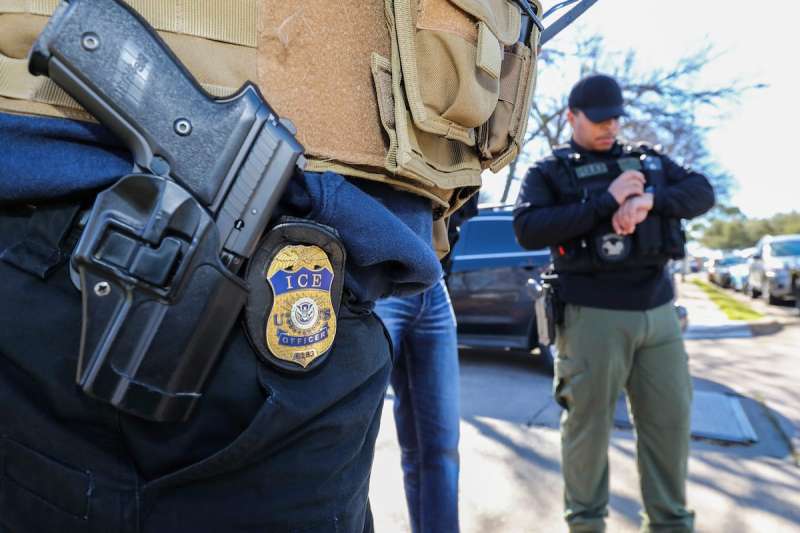
In Phoenix that day, four officers in tactical vests – including one from Enforcement and Removal Operations, a branch of ICE – knocked on the door of Micaela Quihuis.
She was born in Phoenix 43 years ago. She’s a mother of three and a Realtor.
The agents were looking for a man she doesn’t know, she recounted. They asked multiple times to enter her home. She refused unless they produced a warrant.
The officers asked for her identification. Through the closed screen door, she showed her Arizona driver’s license as her 14-year-old daughter recorded the encounter from inside.
“I felt threatened,” Quihuis said, adding that her daughter needed therapy afterward. “She was scared they were going to come back.”
“I’m scared for my kids, because I’m on the darker shade of Mexican. I’m not like, really dark but I’m a morena,” she said, using Spanish slang for a brown-skinned person, “and me driving around now I have the chance of possibly getting pulled over.”
And, she said, “What about my kids?”
For more stories from Cronkite News, visit cronkitenews.azpbs.org.