An Arizona Republican Senator continues pushing legislation attacking transgender and nonbinary youth.
As Arizona’s public schools continue to struggle with funding and teacher retention, state Republicans are advancing a ballot referral to ban public school employees from calling students by their preferred pronouns and prohibit transgender or nonbinary students from using school facilities consistent with their gender identity.
The proposed law would prohibit teachers and public school employees from referring to a student by a name or pronoun different from the one that aligns with the student’s biological sex, without first gaining parent permission, and push schools to “police” their bathrooms and locker rooms.
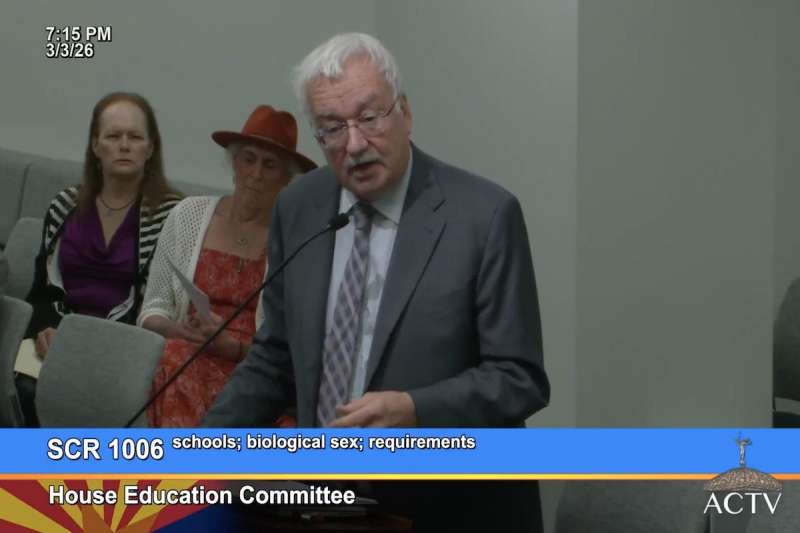
Senate Concurrent Resolution 1006 passed through the Republican-controlled state Senate on Feb. 23, and House lawmakers on the Republican-controlled House Education committee passed the measure on March 3. It would add to the long list of ballot referrals sent to voters on this year’s November ballot, if it passes a floor vote in the Republican-controlled state House.
The proposal, from Sen. John Kavanagh (R-Fountain Hills), is nearly identical to legislation he has pushed for the past three years, which either failed to pass in the legislature or was vetoed by Democratic Gov. Katie Hobbs.
Democratic lawmakers characterized the bill as unnecessary and a distraction from real issues facing Arizona’s public schools that lawmakers should instead be focusing on.
READ MORE: Arizona Republicans push to ban teacher strikes and target union organizing
“Instead of targeting vulnerable kids, this committee should be focused on addressing the out-of-control fraud-plagued voucher program and investing in the public schools that serve the vast majority of Arizona families,” said Rep. Anna Abeytia (D-Glendale).
Spending fraud within Arizona’s “Empowerment Scholarship Account” (ESA) school voucher program continues to be uncovered. Last year the state was found to have unconstitutionally underfunded public schools, and Arizona educators are making a mass exodus from the profession.
“It makes me sick to my stomach to continue to have these bills heard,” said Rep. Nancy Gutierrez, (D-Tucson), who is also a teacher. “Polls have shown that voters are not concerned about this, this is a distraction from what Arizonans really want us to do in this body.”
Most polls don’t register transgender issues as a concern for voters, and 49 percent of Americans think politicians should not be focusing on transgender issues at all, according to a poll from the 19th News.
“At the end of the day, this is a distraction from the real issues…” said Rep. Brian Garcia (D-Tempe).
Same lawmaker, same legislation
For years, Kavanagh has attempted to pass measures that govern how public schools treat transgender and nonbinary students. The Republican first pushed bathroom-ban adjacent legislation in 2013.
He almost sent a nearly identical ballot measure to voters in 2024, but the bill failed after a single Republican lawmaker voted against it.
“I have no doubt that this will pass by…the voters because these are positions that almost everybody believes in,” Kavanagh said of his bill in the Senate Government Committee on Jan. 28.
But Kavanagh has drawn strong pushback on his legislation from the LGBTQ+ community and advocates over the past several years, and according to stances left by Arizonans registered with the Request to Speak (RTS) system, nearly 500 people are opposed to the bill, and only 75 are in support.
“I’m grateful my kids trust me enough to open up to me and tell me who they are. In an ideal world, all kids have families with that kind of trust, but we are not living in that world. For those kids who aren’t ready to share their identities with their parents yet, why should we make their lives even harder?” said Hazel Heinzer, a Tucson resident and the mother of two non-binary children.
Kavanagh’s bill would require schools to offer “reasonable accommodations” for students who do not want to use the restroom that is designated for the sex they were assigned at birth—such as single-occupancy restrooms.
While Kavanagh has said that the separate restrooms are needed so that students aren’t put into uncomfortable situations in school restrooms or locker rooms, LGBTQ advocates doubt he has good intentions behind the measure.
The measure would also open public schools up to lawsuits from students sharing spaces with their transgender peers.
And not only would the law prevent school employees from referring to transgender students by the name consistent with their gender identity without the permission of a parent, but school employees could still refuse to use the student’s preferred name even with parental permission under “religious or moral convictions.”
Kavanagh defends the need for his legislation by consistently bringing up the scenario of a 16-year old biologically female student standing naked next to an 18-year-old biological male student in a communal shower, which he has mentioned in some capacity in nearly every committee hearing his bills are heard in.
While the lawmaker frequently brings up this scenario, he has never been able to provide an example of it actually happening, or named any Arizona school that offers communal showers for students.
Kavanagh also claims that his legislation is aimed at protecting students who are experiencing gender dysphoria, which he described as “a potentially very serious psychological condition where the student questions their sexual identity…associated with depression and sometimes even suicidal thoughts or actions,” in the March 3 committee hearing.
The medical description of gender dysphoria is defined as “distress that can happen when a person’s gender identity differs from the sex assigned at birth,” according to Mayo Clinic.
Social acceptance, such as using a student’s preferred pronouns and name, can reduce feelings of gender dysphoria—which Kavanagh’s bill would specifically prevent if a student does not gain parental permission for their teacher to use their preferred pronouns and name.
“When these kids are in safe affirming environments and are allowed to be themselves, they do just fine and they do not have the same kinds of mental diagnoses and issues that were referenced earlier,” Heinzer said of Kavanaugh’s remarks about gender dysphoria. “Those are issues that come up when kids are in unsupportive homes and are rejected and experienced bullying, and this bill will lead to increased bullying of trans and non-binary kids like mine who are just trying to live.”