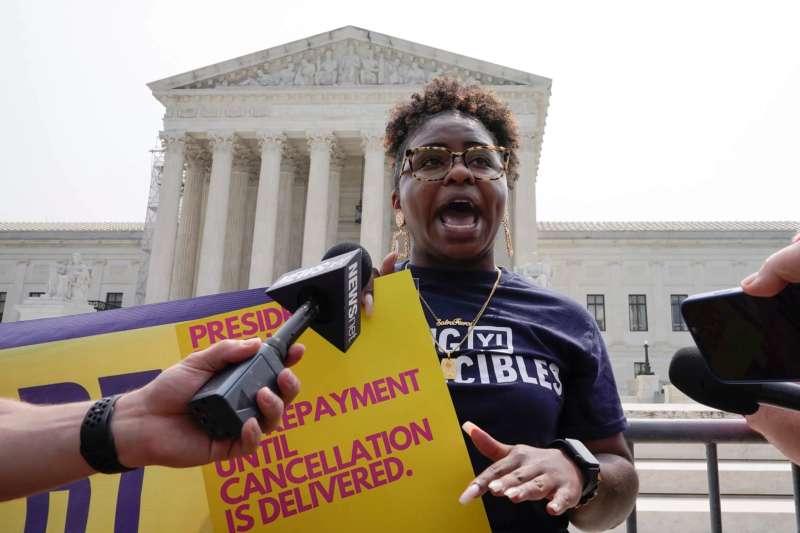
The U.S. Supreme Court on Friday struck down President Biden’s student loan cancellation plan, a major blow to tens of millions of working- and middle-class Americans who stood to benefit from the program.
In a 6-3 decision in Biden v. Nebraska, the Court’s right-wing justices ruled in favor of six states with Republican attorneys general—Nebraska, Missouri, Arkansas, Iowa, Kansas, and South Carolina—who filed a lawsuit against Biden’s plan.
The states argued Biden’s cancellation program would cost them tax revenue by depriving them of student loan debt that they could impose taxes on in the future—an argument that received criticism from many legal experts, including conservative ones.
But the right-wing Court sided with the Republican-led states and ruled that the Biden administration does not have the authority to eliminate student debt, ensuring that tens of millions of borrowers remain in debt rather than get relief.
Nationwide, more than 45 million people owe $1.6 trillion in federal loans for college, according to government data, and as many as 43 million of them stood to benefit from Biden’s cancellation program, which was issued via executive order last year.
Biden’s plan—which fulfilled a campaign promise to cancel student debt—called for $10,000 in debt to be canceled for those who went to college and earned less than $125,000 (or $250,000 for a married couple) in 2020 or 2021, and up to $20,000 in debt to be canceled if you went to college, received Pell Grants (a form of federal financial aid for undergraduate students), and met the income threshold.
Under Biden’s plan, an estimated 20 million people were expected to be eligible to have their remaining debt fully canceled, with benefits overwhelmingly flowing to Americans earning under $75,000 per year.
Nearly 26 million borrowers applied to have some of their student loan debt erased, and 16 million applications were approved before the lawsuits forced the Education Department to stop accepting applications in late 2022.
The Biden administration said its plan was intended to address the coronavirus pandemic and its lingering impacts, and argued that it was legal under the Higher Education Relief Opportunities for Students Act of 2003, also known as the HEROES Act.
That law gives the U.S. secretary of education the ability to “waive or modify any statutory or regulatory provision”—i.e. student loans—to protect borrowers affected by a “national emergency,” such as a pandemic, and ensure they’re not in “a worse position financially” because of the emergency.
In the majority opinion, Chief Justice John Roberts wrote that when Congress passed the HEROES Act, they would never have intended to allow it to be used to “waive or modify” student loans, even as the law almost explicitly authorizes that.
“The Secretary [of Education] asserts that the HEROES Act grants him the authority to cancel $430 billion of student loan principal. It does not,” Roberts wrote. “We hold today that the Act allows the Secretary to ‘waive or modify’ existing statutory or regulatory provisions applicable to financial assistance programs under the Education Act, not to rewrite that statute from the ground up.”
Roberts also said that a mass debt cancellation program of this scope and significance required congressional authorization.
Justice Elena Kagan did not mince words in her dissent, accusing the Court’s conservative justices of effectively using a “made-up” doctrine in the case that was “specially crafted to kill significant regulatory action, by requiring Congress to delegate not just clearly but also microspecifically.”
Kagan, joined by fellow liberal justices Ketanji Brown Jackson and Sonia Sotomayor in dissent, also accused the conservative justices of abandoning their belief in “textualism”—the idea that laws and statute should be interpreted as written—in order to advance their own ideology and substitute themselves in place of “Congress and the executive branch in making national policy about student-loan forgiveness.”
Roberts, a conservative justice appointed by former President George W. Bush, has come under fire repeatedly in recent years for overseeing growing partisanship and right-wing extremism on the Court. The Court has repeatedly overturned existing precedent in recent years, most notably by striking down nationwide abortion rights in last year’s Dobbs v. Jackson Women’s Health Organization, which struck down 1973’s Roe v. Wade.
Two of Roberts’ fellow right-wing justices, Samuel Alito and Clarence Thomas, have recently come under scrutiny as reports show they’ve accepted lavish gifts from billionaire Republican mega-donors.
Amid the Court’s growing conservative bent and allegations of judicial corruption swirling around Alito and Thomas, a recent poll from Quinnipiac University—conducted days before the report about Alito was published—found that 58% of Americans disapprove of the Court’s performance, while only 28% approve. Sixty-eight percent of Americans also think the Court is mainly motivated by politics, while only 25% think it’s mainly motivated by the law.
Biden’s plan was also broadly popular among Americans, according to several polls, a reality that could further harm the Court’s reputation.
The Court’s decision drew immediate backlash from Democrats and student borrower advocates.
“The hypocrisy is clear: As justices accept lavish, six-figure gifts, they don’t dare to help Americans saddled with student loan debt, instead siding with the powerful, big-monied interests,” Senate Majority Leader Chuck Schumer (D-New York) said in a statement.
Mike Pierce, the executive director of the Student Borrower Protection Center, went a step further in a scathing statement.
“Today, a majority of this corrupt court brushed aside the rule of law to advance its ideological crusade against working people. The high court is asking people with student debt to pay the price for decades of government mismanagement and industry abuses across the student loan system—making it clear that, once again, the wealthy and powerful play by a different set of rules from the rest of us,” Pierce said in a statement.
“Corruption is Chief Justice John Roberts’ legacy,” he added.
Cody Hounanian, the executive director of the Student Debt Crisis Center, called on Biden to use his power to try other approaches to canceling debt.
“We are angry, we are disappointed, but we are also resiliently hopeful. History has shown us that bold decisions and transformative policies are often met with initial resistance. We now look to President Biden to deliver on his promise by canceling student debt using other powers available to him,” Hounanian said in a statement.
As the media organization More Perfect Union and some Democratic lawmakers have noted, Biden does have other potential tools in the toolbox to cancel student debt.
Biden is expected to address the Court’s ruling on Friday and “announce new actions to protect student loan borrowers,” according to the White House.
On Thursday, responding to the Court’s decision to strike down consideration of race in college admissions, Biden said it was “not a normal court.” He stopped shy, however, of endorsing expansion of the Court, a priority for some liberals who want to restore balance to the increasingly right-wing institution.
Pierce, however, called on him to embrace court reform—as did some Democrats in Congress and advocates for court reform.
“This court will go down in history as one dedicated to expanding the rights of powerful special interests while stripping rights away from everyone else,” Pierce said. “The time for court reform is now. It now also falls to President Biden to stand with student loan borrowers and use the full might of the federal government to answer their demand for justice and relief in the face of this lawless and shamefully political ruling. Borrowers cannot afford to wait any longer.”
Beyond the devastating blow to borrowers who were set to get debt relief, the Court’s decision is also likely to cause headaches as the Education Department attempts to resume collecting student loan payments this fall. Interest on debt will once again begin accruing on Sept. 1, but borrowers won’t need to make payments until October.