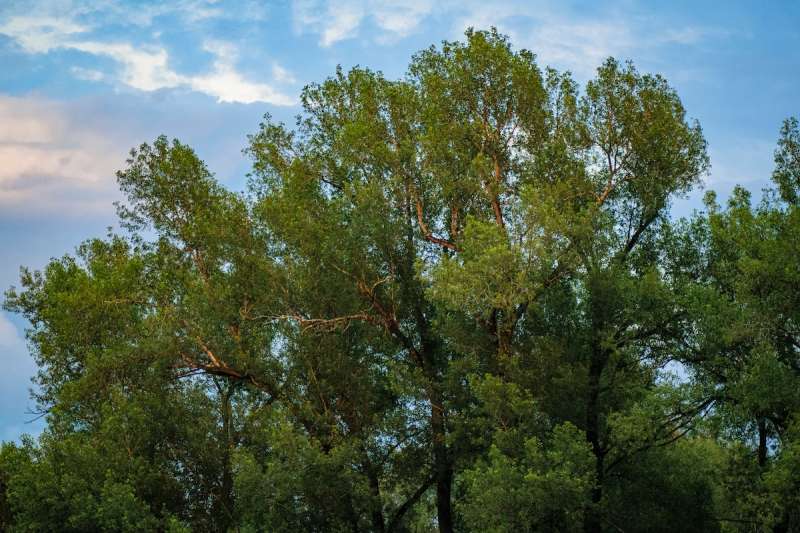
As part of President Donald Trump’s efforts to curb immigration to the US, a multi-billion dollar border wall expansion cut down three trees, estimated to be between 100 and 250 years old, along the Arizona and Texas borders.
On July 27, contractors for the Department of Homeland Security (DHS) felled the first of the three trees located in Lochiel, Arizona, a small town roughly 25 miles east of Nogales. That same day, the Santa Cruz County Sheriff’s Office arrested Logan Miller for criminal trespassing as he attempted to watch construction and was later released on his own recognizance.
For local residents and conservation groups like the Sierra Club and the Center for Biological Diversity, the 200-year-old Fremont cottonwoods—affectionately known as the “grandmother trees”—serve as a critical lifeline in the desert. The ancient grove once formed a rare shade canopy bridging the US–Mexico border, anchoring underground water sources in the dry San Rafael Valley. Beyond their deep cultural value to the borderland community, the trees provide vital nesting habitat and shelter for threatened species, including the western yellow-billed cuckoo.
In footage shared on Instagram, Miller is shown in handcuffs.
“Do this to show the people of America can take a stand to stop the destruction going on across this country,” Miller said. “Save the grandmother trees, f*ck the border wall.”
Despite efforts from activists, contractors destroyed all three trees. On July 29, protesters staged a sit-in to stop crews from destroying the last standing tree.
The destruction follows a June 18 letter in which Customs and Border Protection (CBP) confirmed plans to tear down the trees. In the letter, the agency promised safeguards to protect active nesting bird species.
“If construction activities will result in the disturbance or harm of a migratory bird, then coordination with the appropriate federal agencies will occur,” the letter reads. “The contractor will also establish a buffer zone around active nests until nestlings have fledged and abandoned the nest.”
But activists said they saw no effort to protect nesting bird species. Erick Meza, borderlands program coordinator with the Sierra Club, told KJZZ no environmental monitors were onsite to check for nests as demolition ensued. Meza added the organization sent video of nesting activity in the trees directly to CBP, but received no response.
In December, the Trump administration awarded roughly $1.4 billion to construction firm Fisher Sand and Gravel Co., to build 19 miles of a new wall and secondary wall along with 136 miles of detection technology in Arizona.
The contract is part of a multibillion-dollar project announced by the administration last year to build a Smart Wall system in Arizona and Texas, which includes lights, surveillance, and in some cases, a secondary wall.
Congressional pushback
It comes after members of Congress pressed the Trump administration on what steps it would take to minimize further environmental harm in the process after border wall construction destroyed a 1,000-year-old sacred site on the ancestral lands of the Tohono O’odham Nation— despite being flagged by a cultural protection monitor as one for contractors to avoid.
US Rep. Adelita Grijalva (D-Tucson) slammed the Trump administration for the decision in an Aug. 3 press release.
“The Trump administration is bulldozing our public lands, destroying century-old trees, and endangering wildlife —all to build an unnecessary second border wall. That’s not border security; it’s reckless destruction,” Grijalva wrote. “Arizonans deserve better than an administration that treats our natural landscapes and border communities as collateral damage for a political stunt.”