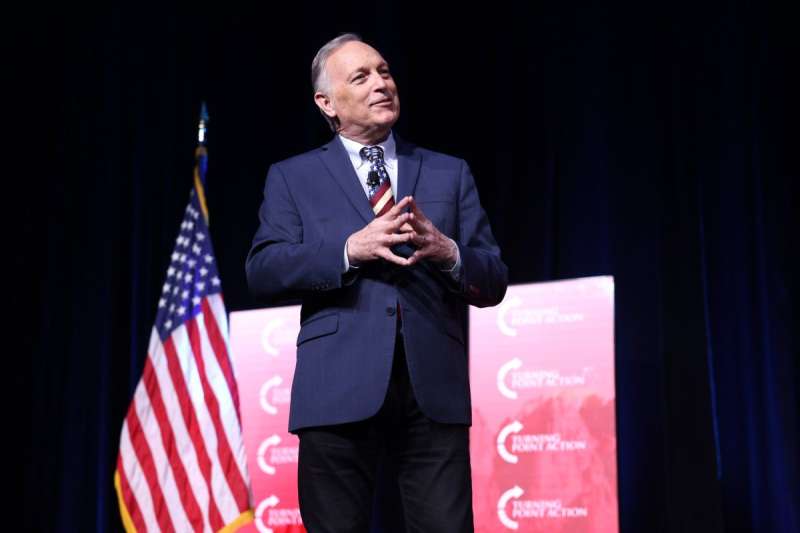
US Rep. Andy Biggs has held office in Arizona since 2003, working as a state representative and state senator before being elected to Congress in 2016. In his time representing the people of Arizona, the 67-year-old Republican has built a record that demonstrates his values—and offers voters an indication of how he’d rule as governor, if he’s elected on Nov. 3.
Biggs opposed funding for the September 11 Victims Compensation Fund, voted against establishing Juneteenth as a federal holiday, is a climate change denier, and personally blocked a bill banning texting while driving for new drivers with learners’ permits. He also chaired the House Freedom Caucus—widely considered the most conservative bloc in the US House of Representatives.
When it comes to reproductive rights, Biggs has spent more than two decades backing restrictions on abortion and reproductive healthcare, from parental consent requirements and insurance limits in the Arizona Legislature to federal ultrasound mandates and repeated efforts to defund Planned Parenthood in Congress.
Arizona voters protected a constitutional right to abortion in 2024 through Prop 139, limiting how far a governor can go. But Biggs’ record offers a guide to what he could support if elected: laws that regulate providers, add procedural barriers, restrict coverage and funding, and test the boundaries of the state’s new constitutional protections.
RELATED: Judge tosses Arizona abortion restrictions, says state can’t second-guess a woman’s decision
Biggs’ record on reproductive rights
While working in the Arizona House from 2003-2011, the Arizona Senate from 2011-2017, and as a Congressman representing Arizona in the US House of Representatives from 2017-present, Biggs established a consistent record of prioritizing anti-abortion ideologies.
He backed multiple measures to delay patients from getting abortion care, including co-sponsoring the Ultrasound Informed Consent Act, which would require providers nationwide to perform an ultrasound, make cardiac sounds audible, and describe an embryo’s dimensions before a patient could consent to an abortion. If a provider didn’t follow the protocol, they could face civil penalties.
Biggs has supported redefining the term “person” to include the moment an egg is fertilized, along with the zygote and blastocyst stages prior to implantation. That change would come through the Life at Conception Act, which would give all stages of pregnancy equal protection under the 14th Amendment and could result in a national abortion ban.
“What we have seen with Andy Biggs in Congress is that in every opportunity he has had to sponsor legislation that would put the entire country under an abortion ban, or vote on legislation that would make it harder for Arizonans and other folks in this country to access reproductive healthcare, he has always fallen in line,” said Athena Salman, Arizona director for the Reproductive Freedom For All organization. “He is an ideologue and is not someone who we have any expectations is willing or able to respect the will of the voters.”
Biggs also voted for a law requiring clinicians to tell patients that medication abortion could be “reversed,” a dangerous and unproven claim. He supported making abortion accessible to only wealthier patients by limiting insurance coverage for the procedure. Similarly, he repeatedly supported defunding Planned Parenthood, which offers substantial reproductive healthcare services to low-income women, from annual check-ups to cancer screenings to pregnancy care.
These efforts did not land well for Arizonans. Aside from filling the comments of his tweets with messages of disapproval, voters overwhelmingly passed Prop 139 in 2024. When asked by the Arizona Capitol Times if Biggs would support an attempt to repeal Prop 139 as governor, his campaign advisor did not address the question and redirected by insulting Biggs’ opponent, the incumbent Gov. Katie Hobbs.
His campaign has additionally scrubbed his website of anti-abortion sentiments. A Wayback Machine search from Nov. 5, 2025 showed Biggs’ congressional campaign website with a section called “Defending Life,” in which Biggs wrote inaccurate information about abortion, used anti-abortion jargon, and boasted about his record fighting to defund Planned Parenthood.
Biggsforcongress.com now reroutes to Biggs’ gubernatorial candidacy site. His new campaign website makes no mention of his position on abortion under the “Issues” tab.
Where the governor’s office can reach
Arizona has a history to look back on when it comes to how a governor can impact reproductive rights.
In 2006, Democratic Gov. Janet Napolitano vetoed a law that would have required forms signed by parents allowing their minor children to have an abortion to be formally notarized by a notary public. Had the law been passed, some of the most urgent abortions in Arizona—those for children who had become pregnant—would have required a time delay to attain the paid service of notarization. Beyond limiting abortion to only those who could pay for the notary service, the law could have had serious issues for children who had become pregnant due to abuse and only had a short window of time away from their abuser for the abortion.
Three years later, Republican Gov. Jan Brewer had been elected into the office, and she signed the bill into law as part of HB 2564, an omnibus bill that additionally imposed mandated in-person counseling and a 24-hour waiting period before all abortions.
Today, Democratic Gov. Hobbs has similarly vetoed bills to restrict women’s reproductive healthcare. If Biggs were elected in November, he would have the opportunity to sign multiple anti-abortion laws. Some have already been written and could be resurfaced.
In 2025, House Republicans advanced what some called a “backdoor abortion ban,” and Hobbs vetoed it. The bill would require AHCCCS, Arizona’s Medicaid agency, to prohibit Medicaid funds from going to any provider that performs or “promotes” abortion. That would mean any clinic offering or educating about abortion could be prevented from accepting patients on Medicaid for any reason, not just abortion, severely limiting women’s healthcare options and encouraging reproductive healthcare clinics to stop providing abortion education.
And back in 2021, Sen. Sine Kerr, now Biggs’ running mate for lieutenant governor, proposed an amendment to HB 2140, an otherwise unrelated bill concerning license plate designs. The amendment Kerr added to this license plate bill would have made it a felony for a physician to perform an abortion after detecting a fetal heartbeat. After the Senate Appropriations Committee adopted the amendment, the bill was dropped after not being scheduled for a floor vote.
Were Biggs to become governor, Arizona Republicans in the state Legislature could reintroduce such anti-abortion and anti-reproductive rights bills, or creatively amend other bills to allow restrictive measures to sneak through.
“I think we would see the floodgates open if Andy Biggs was able to lock in that governor’s seat,” Salman said. “And it would just be more of the same, just lawsuit after lawsuit and just wasting taxpayer money when Prop 139 won every single legislative district in the state.”
Even if Biggs were to sign bills into law that were determined to be unconstitutional, opponents would have to contend with years of litigation while the laws remained in place.
Salman pointed to a pending challenge dealing with advanced practice clinicians such as nurse practitioners, who are trained to provide abortions early in pregnancy but are barred from doing so under Arizona law. The suit was filed at the end of February, and Salman said oral arguments aren’t scheduled until next May.
In 2023, Hobbs signed an executive order turning all abortion-related prosecutions over to Arizona Attorney General Kris Mayes’ office, stripping that authority from county attorneys. Mayes, a Democrat, has said she will never prosecute abortion. If elected governor, Biggs could simply rescind that executive order.
Judicial selections could also result in anti-abortion judges in local and state courts.
Salman said Republican Gov. Doug Ducey’s tenure (2015-2023) showed how much influence a governor holds over the courts. He expanded the Arizona Supreme Court and reshaped the commission that screens nominees.
“There’s a lot of power the governor holds to try and shape what our judicial bench looks like, and we suffer the consequences now, but the last thing we can do is let it get worse,” she said.