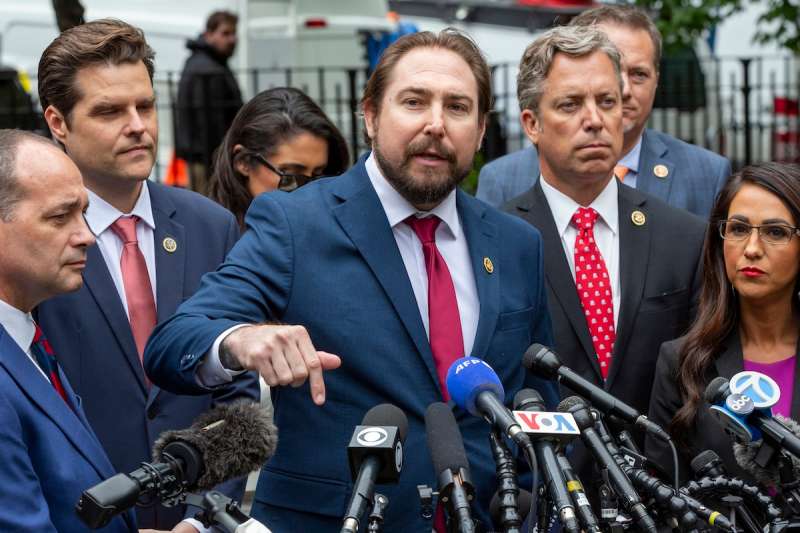
As data centers pop up across Arizona, US Rep. Eli Crane (R-Flagstaff) has taken campaign cash from the industry while voting in its favor.
Crane, who has represented the district since 2023, has collected more than $35,000 from donors and companies who stand to profit from the data center boom. At the same time, the congressman has voted for legislation—including President Donald Trump’s One Big Beautiful Bill Act (OBBBA)—that would “significantly lower barriers” for large data centers, including those built by big tech companies like Amazon and Google.
How did the OBBBA help data centers?
While most commentators have focused on the law’s steep Medicaid and SNAP cuts, it also includes a series of moves that help the data center industry amid the AI boom. Trump and other GOP leaders haven’t been shy about their support for the industry, despite Democrats calling for regulation.
“If you want to be poor, you want to have no money, if you don’t want to have a job, and if you want to live in a crime-infested area, squalor, all the things that go along with it, you should not have a data center,” Trump said in an October interview with Time.
The OBBBA restored a tax break that lets companies write off 100% of the cost of new equipment bought after Jan. 19, 2025, in the first year they start using it, instead of spreading the write-off over many years. That puts money into the hands of companies that would have otherwise been taxed. For data center companies that spend billions on servers, chips, cooling systems, and other components, it means a huge windfall.
The new law also introduced qualified rural opportunity funds, which experts say could lower barriers for large-scale projects in rural areas. It comes as activists in Crane’s district—in Page—have been fighting against a $10 billion data center in their community, located near Horseshoe Bend.
Since the bill became law, big tech companies benefiting from the AI boom, including Amazon, Alphabet, Meta, Microsoft, and Oracle, collectively reported $422 billion in profits and paid an effective federal income tax of just 4.5%. That’s roughly $70 billion in tax breaks, according to the Institute of Taxation and Economic Policy.
In Dec. 2025, Crane voted for the SPEED Act, favored by many of the same companies.” The bill would make it easier to obtain federal permits for energy and infrastructure projects, including those needed to build AI infrastructure. It passed the House 221-196, but stalled in the Senate.
How is the law affecting Arizonans?
The OBBBA also repealed Biden-era clean energy credits and incentives for things like solar panels, batteries, and clean vehicles. Critics say it’s contributing to higher costs: a September report by the Center for American Progress, a left-leaning think tank, argues that Trump administration policies are driving up electric bills in Arizona.
The report also found that the cancellation of a $1.8 billion federal loan to Arizona Public Service will cost customers about $250 million. APS and Tucson Electric Power, which have both requested rate hikes from the Arizona Corporation Commission, have cited federal policies as one reason for higher costs. A decision is expected by the end of the year. Data centers are also driving up power demand: In its rate hike request, APS proposed a 45% increase for data centers and other large energy users.
Crane’s vote comes as residents in his district report struggling with high costs. Laura Carter, of Flagstaff, said that with rising grocery and gas prices, one more rising bill could threaten her financial security.
“It’s like this daily little bit of stress, the pinch that I’m experiencing because everything’s more expensive,” Carter said in a September interview with the Copper Courier.
Crane’s Funding ties
Crane rose to prominence after an appearance on Shark Tank, pitching Bottle Breacher, a company that manufactures custom bottle openers out of recycled or dummy bullet casings. Mark Cuban and Kevin O’Leary offered Crane funding in exchange for a 20% stake. Crane later sold the company but maintains a relationship with O’Leary, who is increasingly in the news for his push for a massive data center in Utah that has been met with fierce opposition from local residents.
Crane also has prominent campaign donors slated to benefit from the data center boom. Koch PAC, the political action committee of Koch Industries, gave Crane $5,000 in 2022. The PAC is affiliated with the Koch family and its company, led by Charles Koch, is one of the GOP’s most prominent megadonors. In July, Bloomberg reported that Koch Real Estate Investments is weighing bids to sell its data center business, Edged, which operates a data center in Phoenix, in a deal that could be worth more than $15 billion.
In 2023, Oracle’s PAC donated $1,500 to Crane.The Space Exploration Technologies Corp. PAC, associated with Elon Musk, the world’s richest man, donated $7,000 to Crane in April 2026. That came about two months after SpaceX acquired Musk’s AI company, xAI. Musk also gave Crane $5,800 in March 2025.
Other notable contributors include Pinnacle West Capital Corp.’s PAC, which gave $7,500 between 2023 and 2024. Pinnacle West is the parent company of Arizona Public Service. The PAC of Broadcom Inc., which makes semiconductors and infrastructure software for data centers, donated $741 in August 2025. Rio Tinto America Inc.’s PAC gave $2,500 in 2023; Rio Tinto is the majority owner of Resolution Copper, a proposed copper mine at Oak Flat in Crane’s district.
The Salt River Valley Water Users’ Association Political Involvement Committee, affiliated with the Salt River Project (SRP), donated $5,000 in 2025. SRP has received criticism for reports that its ratepayers pay at least $500,000 annually to support the PAC’s initiatives.
Crane did not respond to a request for comment by the time of publication.
Will it matter to voters?
Crane is running in a Republican-leaning district, which the Cook Political Report rates “likely Republican,” but national Democrats have eyed the race in the hopes of flipping it blue in November. Crane represents the state’s largest district by area—Arizona’s 2nd Congressional District—which he flipped red in 2022 after redistricting, defeating three-term Democratic Rep. Tom O’Halleran.
His Democratic challenger, former Navajo Nation President Jonathan Nez, is making his second bid for Congress. If elected, Nez would be the first Native American to represent Arizona.
According to the Cook Political Report, Nez made the district competitive in 2024, outperforming Vice President Kamala Harris in the 2nd District by 3.5% and surpassing Sen. Ruben Gallego’s numbers in the district during his Senate race.
Crane and Nez will face off in the Nov. 3 election.