When Republicans in Congress or the Arizona Legislature talk about defunding Planned Parenthood, they frequently frame it as a fight over taxpayer dollars and abortion. Yet the two haven’t been linked in any meaningful sense for around 50 years.
Why is that important?
A section of the “One Big Beautiful Bill Act” made it illegal for Medicaid reimbursements to go to Planned Parenthood—which supporters of the act say prevented spending taxpayer dollars on abortions. But we’ve looked into it, and that’s simply not true. What did happen was that Republicans used the talking point of “defunding Planned Parenthood to prevent abortions” to stop the nation’s health insurance program for low-income people from covering basic care, such as a regular check-up or cancer screening.
It impacted thousands of people across the country—and it’s set to expire in just two months. Arizonans need to know that Congress could decide to re-up the ban, and how that would affect healthcare across the state.
Let’s break down the main points:
In 2025, President Donald Trump’s “One Big Beautiful Bill Act” ended the use of Medicaid funds at Planned Parenthood clinics nationwide. A common misconception is that this was intended to stop the use of taxpayer funding, in the form of Medicaid, to pay for abortions.
However, Medicaid never covered abortions (with very limited exceptions, like to save the life of the mother).
Medicaid is a federal health insurance program for low-income Americans. It covers approximately 80 million people—that’s about one in four people in the US. The program primarily serves low-income children, low-income adults, elderly people, and people with disabilities.
Notably, it pays for 41% of all births in the US, along with the prenatal care that goes with them.
Millions of Americans use Planned Parenthood for healthcare—but especially people who face barriers to accessing care. That means rural residents, people of color, and low-income people tend to use the clinics more frequently than others.
Did cutting funding stop abortions?
No. The Big Beautiful Bill didn’t impact abortions at all. That’s largely to do with the Hyde Amendment.
The Hyde Amendment first passed in 1976, and it has been renewed in every federal appropriations bill since. It bars federal Medicaid dollars from paying for almost all abortions, with the typical exceptions of rape, incest, and threats to the life of the mother.
Every other abortion in the US is paid for out of pocket, through private insurance, or through donations and patient-assistance programs at the clinics.
In Arizona, the state’s Medicaid program, called the Arizona Health Care Cost Containment System (AHCCCS), follows the Hyde Amendment rules.
“Arizona does not use state funds to cover abortion for Medicaid beneficiaries with limited exceptions,” Urban Institute wrote in its post-Dobbs state policy review.
When Arizona politicians talk about cutting off taxpayer dollars from Planned Parenthood, they’re cutting off money from something else entirely.
What Medicaid actually pays for at Planned Parenthood
Medicaid reimbursements at Planned Parenthood, in Arizona and nationally, pay for non-abortion services.
In fact, 96% of the services that Medicaid pays for at Planned Parenthood clinics are for everyday healthcare, like Pap smears, contraception, breast exams, cancer screenings, and prenatal care.
So when anti-abortion politicians champion the “defund Planned Parenthood” slogan, they’re not actually trying to redirect taxpayer money away from abortion. They’re redirecting taxpayer money away from essential medical services for low-income people.
Section 71113 is a game-changer
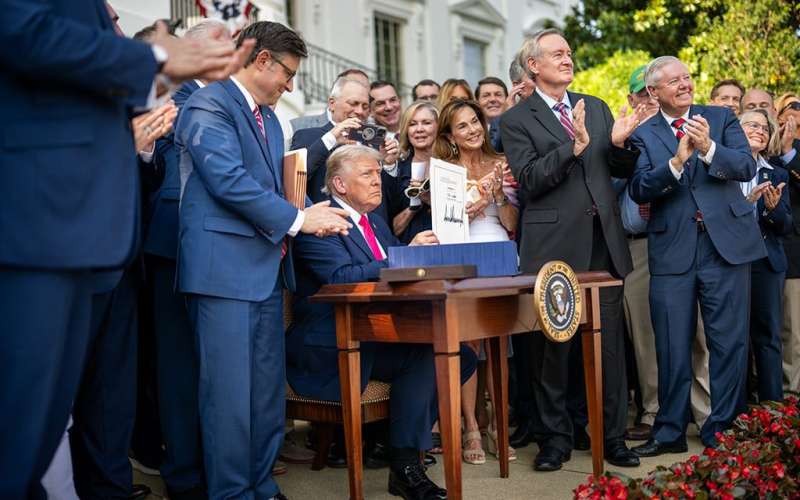
The Big Beautiful Bill, passed by congressional Republicans and signed by President Trump on July 4, 2025, has a provision in it called Section 71113. That’s the part of the bill that banned Medicaid reimbursements to Planned Parenthood clinics. But it also contained something else: an end date.
The ban lasts for one year from the day of signing, which means it’ll expire on July 4, 2026. Congress may, at that point, decide to renew the ban or replicate it in another bill.
For an idea of what could happen if it’s renewed, consider that in the 10 months since the Big Beautiful Bill passed, roughly 50 Planned Parenthood clinics have closed.
What happened in Arizona
Planned Parenthood of Arizona has seven clinics across the state. They stopped billing AHCCCS on Oct. 1, 2025. At the time, Planned Parenthood Arizona CEO and President April Donovan called the Big Beautiful Bill unconstitutional.
“This callous effort by politicians to ‘defund’ Planned Parenthood is an unconstitutional act that is now eliminating critical care from Arizona’s most vulnerable patients—namely, STI and cancer screenings and treatment, birth control, and other family planning services,” Donovan said.
The suspension of billing didn’t mean the clinics closed. They’re still open and seeing patients. They just aren’t billing AHCCCS for those visits. Other affiliates nationally made the same call to keep doors open and eat the cost of care for Medicaid patients from donations and reserve money to wait out the one-year provision.
Arizona Republican lawmakers have spent over a decade trying to cut Planned Parenthood out of AHCCCS. In 2012, the legislature passed HB 2800, a bill explicitly designed to bar abortion providers from receiving any Medicaid payments, including for those non-abortion services that make up the overwhelming majority of payments.
Then-Gov. Jan Brewer, a Republican, signed the bill into law. A circuit court struck down the law in 2013.
Arizonans chose differently
Despite these efforts from Republicans, Arizona voters made their choice clear in 2024 by approving Proposition 139, the Arizona Abortion Access Act, which put abortion access into the state constitution as a right.
An Arizona judge ruled a 2022 state law that banned abortion after 15-weeks was unconstitutional in 2025. Ten clinics in Arizona currently offer abortion care, according to abortionfinder.org.
But constitutional protection for abortions doesn’t mean the money is moving again. According to the Urban Institute, roughly 1.5 million women of reproductive age live in Arizona as of 2023, and 16.7% are likely eligible for Medicaid because of their income level.
Those ~250,000 women can no longer use their coverage at Planned Parenthood.
They can, however, let their representatives in Congress know whether they want the ban to continue once it expires in July. And this November, all nine US House seats from Arizona and both of Arizona’s US Senate seats will be on the ballot.