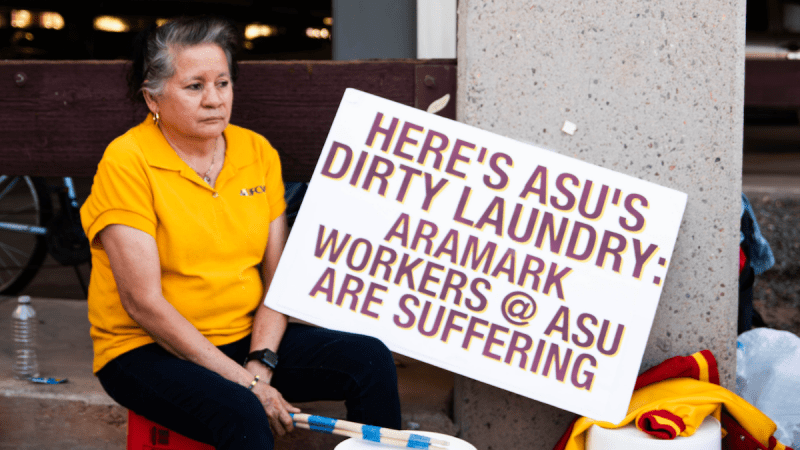
Ellen Stant came to the Tooker House dining hall at Arizona State University (ASU) the way many of her colleagues did — through hard times.
The 54-year-old, a food service worker, got her job while living in a homeless shelter run by St. Vincent de Paul in Tempe. It was at ASU where she found stability, a paycheck, and a purpose feeding thousands of students every day.
But nearly a year into the job, she said she earns $19 an hour, her hours have been cut as the summer semester begins, and she recently discovered she is uninsured — despite believing she had coverage.
“I just got into an apartment, and now I’m stressed and trying to make ends meet, paying $1,200 a month, and it’s just very difficult,” Stant said. “I don’t even buy food because we’re allowed one meal, so one meal’s all I’m going to get. Because I can’t afford to pay for food.”
On May 11, while a record 22,631 students in caps and gowns celebrated their graduation inside Mountain America Stadium, Stant and her colleagues stood outside with drums, signs and a banner, demanding a new contract from Aramark, the company ASU pays to run its food service operations.
‘There are people whose plan to retire is: I’m gonna work until I die’
The timing was intentional.
The demonstration, organized by workers and their union, UNITE HERE Local 11, was planned for Monday to coincide with ASU’s undergraduate commencement — a deliberate choice “to make a bunch of noise so that they can’t ignore us” said Eric Cadman, a Hassayampa dining hall worker who has worked at ASU since the fall of 2023.
“We feed the students, we feed their families, we feed the faculty,” said Cadman, “The people who are serving you, who are giving you clean dining halls, healthy food—we can’t afford to live in Tempe. There are people living out of their cars, living in homeless shelters, people who can’t afford medicine. And there are people whose plan to retire is: I’m gonna work until I die.”
Workers represented by UNITE HERE Local 11 have been negotiating with Aramark since the previous contract expired at the end of August 2025. After months of failed talks, workers voted 99% in favor of a strike in November 2025, then walked off the job across all four ASU campuses in February 2026.
Their demands: higher wages, affordable healthcare, pension access, fair staffing, and workplace protections against immigration enforcement.
The average worker earns $19 an hour and cooks slightly more at $20 to $21 according to Cadman.
Workers say that rate isn’t enough. In Phoenix, where the average rent runs about $1,303 a month, workers say rising costs have left them stretched thin. In contrast, Aramark reported $18.5 billion in revenue in its most recent fiscal year, ending October 3, 2025 — a 6.4% increase from the previous year.
“They have been dragging their feet on wages, healthcare for people who are uninsured, pension for people who need to retire,” Cadman said. “And they have been ignoring us and pushing back and lowballing us on all these things.”
Workers have also filed multiple complaints against Aramark with the National Labor Relations Board over the past year, alleging unfair labor practices, including management intimidation of workers during negotiations, according to reporting by KJZZ. Aramark has said it “continues to actively negotiate with the union and respects the right of employees to demonstrate.”
Workers in fear
Among those who marched were workers often left out of public view — refugees and immigrants who worry that speaking out publicly could put them at risk.
Jawaher Abbas, a UNITE HERE Local 11 and Worker Power organizer who is herself a Sudanese refugee and has lived in the US for more than 20 years, said she spent the weekend organizing van rides to bring members of her community to the picket. But many more stayed home.
“When I ask them to come and fight for themselves, they are afraid. They are scared,” Abbas said. “They tell me, ‘I just want peace and food for my kids.’”
That fear has grown in recent months as the Trump administration has ramped up immigrant enforcement. Many workers are not citizens, Abbas said, and worry that speaking out carries real risks.
Inadequate healthcare policies
Workers described a healthcare situation that leaves them without coverage when they need it most.
Cadman referenced a colleague who qualifies for Arizona’s Medicaid program, known as AHCCCS, only during the summer as she loses eligibility during the school year. “If anything happens to her throughout the whole school year, she just has no insurance and has to pay out of pocket,” the worker said. Another coworker, according to Cadman, had to choose between food and her cancer medication over spring break after management slashed hours.
Mari Yepez, Arizona organizing director for UNITE HERE Local 11, said Aramark has consistently come to the table with proposals that fall short.
“We have people that have lived in shelters, that are living paycheck to paycheck, that currently do not have a home and come here to work because they think it’s a good job,” Yepez said. “It’s just not enough.”
The dispute has drawn political attention. US Sen. Mark Kelly, a Democrat, joined workers on the picket line April 9 at ASU’s Downtown Phoenix campus. Dozens of state legislators also submitted a letter to Aramark urging a timely resolution. State Sen. Lauren Kuby, who spoke at Monday’s picket, called the conditions at ASU a moral failure.
“No one should have to risk their health simply to work, simply to bring home a paycheck for their family,” Kuby said.
Two organizers were arrested during demonstrations, according to ASU Police. The spokesperson said they were arrested for “trespassing prior to the undergraduate ceremony.”
Workers say they are not done fighting for better conditions, despite the hardships they continue to face.
Heather G. Dotchel, Aramark’s Corporate Communications, said the company has held six formal bargaining sessions with the union and made repeated requests to resume negotiations. “We’ve been negotiating in good faith with Local 11 for the past five months and remain committed to continuing those discussions,” the spokesperson said.
The company’s current proposal includes wages it says average more than 11% above industry benchmarks across 25 job classifications.
ASU’s Media Relations office, through Assistant Director Jerry Gonzalez, declined to comment on the negotiations with UNITE HERE , directing inquiries to Aramark.
For Stant, now working to keep the first apartment she has had in years, the fight is about more than a contract. It’s about whether the people who keep the university running can survive in the city where they work.
“They need to pay attention,” she said. “Because we’re here and we’re not going anywhere.”