When Immigration and Customs Enforcement (ICE) agents showed up at courthouses across the country last May to detain unsuspecting immigrants at their routine check-in appointments, Lorena Austin wasted no time mobilizing to fight for immigrant communities.
Austin, a Democratic state Representative from Mesa, was one of a handful of state legislators who showed up to the downtown Phoenix courthouse to stand with the immigrant community— literally, standing with protesters in the scorching Arizona heat—as ICE agents lingered nearby, watching from a parking lot rooftop.
Austin also used social media as a way to spread the word and inform communities of ICE activities, and observed court hearings so immigrants afraid of ICE knew they weren’t alone.
“The immigrant community is the backbone of this country, first and last. There’s no denial that the contributions of our immigrant community is what keeps us going every single day,” Austin said. “I think it’s my job to utilize my voice to support them.”
When legislators introduce policies that could help ICE, Austin actively pushes back, delivering sharp testimonies on the House floor and leading trainings on how to protect immigrant communities. Austin, a grandchild of immigrants, has grown increasingly angry as ICE has detained and deported longtime Arizona residents. But they remain hopeful it will serve as a wake-up call to Americans who might be desensitized to the violence Austin has grown accustomed to.
“To see people kidnapped in front of you, to see families ripped apart, to have children not have their parents come home, it’s the most inhumane thing I can ever imagine,” Austin said. “I think It’s been a really big wake up call for people. People are seeing [what] they cannot unsee.”
To understand Austin’s willingness to fight means understanding the generations who came before them.
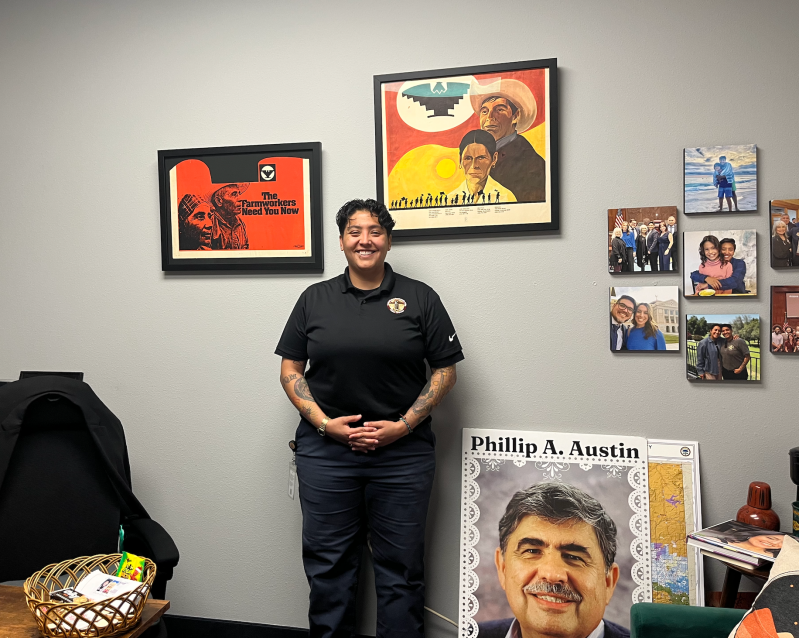
Austin’s lineage in Arizona dates back to 1860. Their father, Phil Austin, grew up in Mesa and attended Brophy College Preparatory, a private high school in Phoenix, before studying at Santa Clara University, where he was arrested while protesting the firing of a Latino faculty member, Austin said.
When the lawyer who was supposed to bail her father out never showed up, he decided to become an attorney to defend people who looked like him. Phil obtained a law degree from Berkeley Law School before moving back to Mesa, where he went on to become the Civil Rights director for the Arizona Attorney General’s office, where he worked for 16 years, Austin said.
Austin’s mother grew up in California, where she became heavily involved in the Chicano movement, a social and political movement to dismantle structural racism and embrace a Chicano identity.
“I get so much from both of my parents. My mom’s tenacity and unwavering ability to use your voice. My dad was such an amazing communicator and community builder and champion,” Austin said. “I’m just really lucky to come from this incredible family who’s always been committed to service and justice and community.”
Austin inherited their family’s disposition towards activism. But they never thought they’d one day serve in the Arizona Legislature, where they’ve represented West Mesa and a small part of Tempe since 2023. In hindsight, it only made sense for Austin to carry their family’s torch.
“My family’s motto is ‘Adelante, siempre adelante’ It means forward, always forward. I say that a lot, and that’s what gets me through everyday,” Austin said.
Arizona’s first nonbinary legislator
It wasn’t always smooth sailing for Austin. They knew they were queer and nonbinary since they were a young child, but it took years for them to come out to their family and to the public.
“I never used to call myself queer. Growing up, that was like a bad word, and it’s kind of been reclaimed in recent years,” Austin said. “When I learned about the term nonbinary, I just thought, well, that really fits me. It’s been such a wonderful journey.”
Austin made national headlines in 2023 for a heartwrenching testimony speaking out against Senate Bill 1001. Known as the “Pronoun bill,” SB1001 would have banned the use of preferred pronouns if they did not match a student’s biological sex or a name on official school documents. Austin’s testimony later went viral on Youtube and TikTok and earned Austin national attention.
“It has been my lived experience since I was five years old,” Austin said at the time. “I cannot imagine being 14 again and having a bill like this come through because I grew up in a community where I knew I would not be accepted. I knew I would not be supported in my home or in public. I need you to hear that this is my lived experience, school was literally the one place where I could breathe.”
Many viewers of that speech thought it represented Austin’s public “coming out.” Austin never saw their testimony that way.
“People thought I was keeping a secret or something, but it wasn’t that,” Austin said. “It was just that no one knew who I was. I had no idea that I was running to become the first of anything, people had to tell me that afterwards.”
The bill was later vetoed by Gov. Katie Hobbs, but it remains a defining moment for Austin, who is now known as the first openly nonbinary legislator in the Arizona Legislature.
Austin has continued pushing back against anti-LGBTQ+ legislation at the local level, including Republican-led anti-trans legislation like HB 2062 in 2025, which would have enforced a strict definition of biological sex to be enshrined into state law. The bill was vetoed by Gov. Katie Hobbs. In 2024, Austin opposed SB 1166, which failed, but would have forced schools to alert parents if their child tried to use a different name or pronoun than their given name and biological sex.
“The MAGA Party Republicans have made homophobia part of their platform. It’s undeniable. To them, queer people don’t exist,” Austin said.
Austin said they’ll keep fighting for LGBTQ+ people as their rights come under attack, pointing to a recent US Supreme Court decision in which the justices struck down Colorado’s ban on “conversion therapy,” a discredited practice that seeks to change a person’s sexual orientation or gender identity.
In this political climate, Austin believes fighting for LGBTQ+ rights and representation is more urgent than ever. That’s why they keep pushing for legislation that would create LGBTQ+ specific license plates—to increase visibility and celebrate LGBTQ+ communities—but the bill has repeatedly been blocked by Arizona Republicans.
“People need to see themselves represented, and that’s what creates a safe space,” Austin said. “I want people to feel accepted, loved, because it’s a community that doesn’t feel safe a lot of the time.”
Austin embraces the title of first nonbinary legislator, but says that identity is a part of them, not all of them. They’re focused on an array of policies to help working class Arizonans, including greater investments in affordable housing and public education, along with social services that help community members stand on their own two feet.
“I see that promise in every person that I serve,” Austin said. “No matter where you come from, you’re deserving to just live here and breathe and be free.”
Policy proposals crafted through lived experience
In their three years in the legislature, Austin has introduced a number of bills to help local communities, including bills focusing on expanding housing, making higher education more accessible, and expanding pensions for Arizonans.
“A lot of legislation that I run is for just regular people, because they’re the most overlooked, and I just don’t know why we have a government if not to help people,” Austin said.
Growing up, Austin’s household lacked financial security. Austin’s parents split when they were about four years old and their mom took Austin and their brother to Clovis, California. They struggled to stay afloat, moving often and struggling to make ends meet, an experience that shaped Austin’s understanding regarding the urgency of affordable housing, and set the foundation for one of Austin’s first proposals in 2023.
Austin introduced HB 2772, a bill that sought to address Arizona’s affordable housing crisis by requiring municipalities to allow the development of middle housing—duplexes, triplexes, quadplexes, cottage clusters, and townhouses—in residential zones, which are often more affordable.
At one point in their childhood, Austin’s mother was in an abusive relationship and the family sought refuge in a domestic violence shelter. After escaping her abusive relationship, Austin’s mother took classes and obtained a degree in social work. Austin credits the shelter with saving their family and still holds a special place in their heart for social services.
Today, Austin takes time to volunteer with local food banks and other community organizations dedicated to helping underserved communities, because they know firsthand how impactful such help can be for working class families.
“My lived experience definitely plays into it, because I understand what that’s like. I know what it’s like to have an unstable housing situation. I know what it’s like to look for quarters on the ground to get gas.”
Finding their way
After high school, Austin moved back to Arizona to be closer to their father, but like so many young adults, struggled to find their way in the world, enrolling in and dropping out of community college, picking up a job at the local YMCA, and eventually moving away from home, following their brother to St. Louis, Missouri.
“I loved living in St Louis. I have nothing but good things to say about my time there. I was able to come out as queer, I found an amazing group of incredible humans who are still my best friends to this day, I was working bars and odd jobs, and I was totally fine, that was my livelihood.” Austin said. “I do think it just kind of pushed me even more to go back home, and I’m glad I did.”
Austin moved home to Arizona in 2014. Soon after, they attended a meeting at Mesa Community College (MCC). After hearing Austin speak, the director of MCC’s Student Life leadership, Dr. Kris Bliss, offered Austin a job. Austin initially turned the offer down, since they did not have a degree.
“She dragged my ass down to the enrollment center and she made me take a placement test,” Austin said. “She gave me a job with Student Life and Leadership [and] changed my life, because I now had a community that I didn’t have before.”
Austin dove in “head first,” and didn’t look back, graduating from MCC in 2018 before getting a full ride scholarship from the Next Generation Service Corps, a scholarship group focused on developing future leaders, to attend Arizona State University (ASU).
Austin wouldn’t have been able to afford higher education had it not been for the scholarship. Today, Austin champions higher education, helping secure an additional $20 million for the Arizona Promise Program, a scholarship program for eligible Arizona residents that covers tuition and fees at Arizona’s public universities.
Austin also supports improving public education for Arizona K-12 students, frequently calling for more public school funding to improve both educational quality and support underpaid Arizona teachers. They also oppose the state’s controversial universal school voucher program, blaming it in part for worsening public school quality as the program redirects public funds from public to private schools and has limited guardrails in place to prevent fraud.
“Public schools are literally the foundations of our future. I will do everything I can to protect our public schools, to ensure our students in the state of Arizona have the best future possible,” Austin said in 2023.
Journey to the Legislature
By 2022, Austin was planning to attend law school, believing that was the path through which they could contribute to their community. But a single phone call from a friend changed their life.
What if you run for political office, her friend asked.
Austin had never considered running for office before. But Arizona’s legislative maps had been redrawn, and Legislative District 9 in Mesa was a brand new district in Austin’s hometown.
Austin initially told their friend no, that someone else might be better fit, until Austin’s friend informed them that nobody from the community was running, and if Austin didn’t, West Mesa could get stuck with a representation from outside of the district—someone who might not have the city’s best interests in mind.
That changed Austin’s mind.
“I just didn’t think someone who didn’t know our community, who didn’t look like it, who didn’t understand it, should be advocating for people,” Austin said.
Legislative district nine is a diverse district, home to predominantly White and Hispanic communities where the average individual income is $35,000 a year. The district is considered highly competitive with a near even split of registered Democrats, Republicans, and Independents.
Austin got to work knocking on doors and making phone calls to community members, often chatting with constituents who already knew Austin from their family’s long record of advocacy within the community. In November 2022, Austin won their race.
“It was such a community effort. I think people wanted someone who actually understood them to advocate for them, and that’s what I’ve been doing for four years.”
If a constituent calls with a concern, Austin isn’t checking to see if they’re a registered Democrat or Republican. They’re helping, regardless of party affiliation.
And as the Trump administration cracks down on immigrants and other marginalized groups, aided by Arizona Republicans who follow suit at the local level, Austin vowed to keep doing everything in their power to push back.
“I love Mesa more than anything, and I’ll do anything to keep people safe and fight for them,” Austin said. “This is my life, and it’s part of my story. This is Mesa, and LD9 is my everything.”