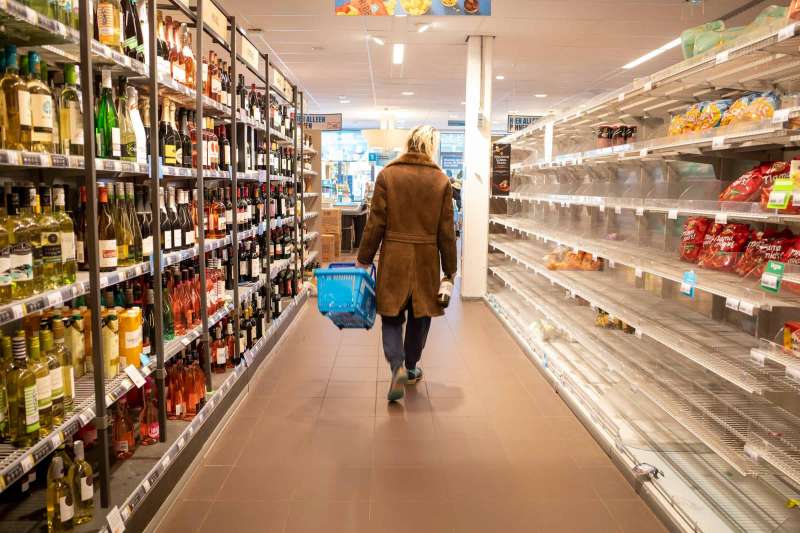
You don’t have to be an economist to know that the US economy isn’t working for many Americans—and hasn’t been for several years. National debt continues to grow, and people are struggling more and more to afford their bills. And it gets worse when you take a look at individual states.
Arizona’s food prices have soared so far in 2026, with staple grocery items like coffee, produce, and ground beef selling at considerably higher prices than last year (via the US Bureau of Labor Statistics). These prices only get worse when you live in a food desert, where you may not have access to fresh foods at all.
High costs of living and many other geopolitical and socioeconomic issues give way to food insecurity, especially in lower-income or more rural areas. This largely means that fresh foods are out of reach, leaving unhealthy, shelf-stable options in their wake. When folks can only rely on these options, their well-being gets put on the back burner.
And as it sadly turns out, Arizona’s Maricopa County is full of food deserts—55 to be exact. According to the county’s website, Maricopa County is the “fourth [most] populous county in the nation,” thanks to its inclusion of Phoenix, Scottsdale, Mesa, and other medium-to-large cities. But how great is it to live in a highly populated place if the majority of folks can’t reasonably and sustainably fuel themselves and their families? Let’s talk about it.
What exactly is a food desert?
The now-common phrase “food desert” comes from Scotland, where it began circulating in the ’90s, according to a 2009 study published in the journal Preventing Chronic Disease. At the time, communities across the country were facing food insecurity, and unfortunately, the problem hasn’t entirely gone away. Decades later, areas like Castlemilk are still fighting to access fresh food regularly, per The Glasgow Wrap.
These issues led to the term’s creation, and its definition is rather simple. Stateside, the National Library of Medicine defines food deserts as “neighborhoods and communities that have limited access to affordable and nutritious foods.” In practice, this typically means not having any grocery stores, either local or big-box, nearby. It can also mean that any groceries nearby are too expensive to be reliable. This forces folks to rely on convenience stores and other less healthy food options, which can lead to nutrient deficiencies, weight gain, and more.
Despite Maricopa County being home to some of Arizona’s largest metropolitan hubs, the county has a whopping 55 communities that fall under the “food desert” umbrella.
Why does Maricopa County have so many food deserts?
The first thing many naturally wonder is why Maricopa County has so many food deserts—and it’s a good question, even if not easily answered. The truth is that many factors affect locals’ access to nutritious food across Maricopa County.
First, there’s the fact that Arizona is a literal desert. Water isn’t abundant, and the heat is brutal, especially during the summer. These two issues combined create less-than-desirable growing circumstances for fruits, vegetables, and grains.
That heat also makes it harder to get to food, as explained by the nonprofit Good to Grow, which aims to combat food insecurity in Phoenix and nationwide. Some people physically cannot travel to food when the temperature outdoors is searing. Add poor public transportation options and spread-out grocers to the mix, and you’ve got a perfect storm that creates nutritional voids countywide. It’s so bad, in fact, that at least 13% of Arizonans across the state live in food deserts, per Good to Grow.
Which areas of Maricopa County are considered food deserts?
As we established, Maricopa County is large, including vast stretches of desert. Because the people in the county are largely concentrated in larger hubs, most of the food deserts are located in the county’s cities, not scattered around. More specifically, 43 of the county’s 55 food deserts are in Phoenix, according to Cronkite News.
If that weren’t bad enough, one congressional district is being hit harder than others: District 8, located in the northwest of the city and extending into the suburbs, contains 25 of the 55 food deserts all on its own. The district has been helmed by Republican US Rep. Abraham Hamadeh since 2025. Before Hamadeh, Republican US Rep. Debbie Lesko represented the district beginning in 2018. The last Democrat to represent District 8 only sat from 2012 to 2013.
According to the City of Phoenix’s 2025 Food Action Plan Impact Report, food deserts are found in at least parts of Estrella, Maryvale, Laveen, South Mountain, Central City, Encanto, North Mountain, and Deer Valley. Altogether, “nearly half of Phoenix’s population lives within a food desert,” per the report. To see if you might be living in one, check out the map of the neighborhoods in the report.
Resources for those who live in one of Maricopa County’s food deserts
Maricopa County’s food desert problem has long been out of control, and the city knows it. The Phoenix Food Action Plan (PFAP) went into effect in March 2020, around the time the COVID-19 pandemic began—a time when communal care took center stage. And in the years since, the PFAP has seen some success, even if the food deserts remain. For one, more than 5 million meals have been delivered to local households, and more than 22 million pounds of food have been given out.
Some of the efforts to help everyday people include getting food banks more resources. Then, there are those creating their own paths to end the food deserts facing their communities. Take Nika Forté as a shining example. According to Cronkite News, Forté established the Heart & Soil People’s Garden in South Phoenix to feed her neighborhood, and in recent months, gardening lessons have begun at the center. The more folks involved, the more food can be grown and distributed. Interested? You can donate money to fund the garden or fill out an interest form here.
For more immediate care, check out these food banks in the greater Phoenix area.
1. Desert Mission Food Bank
Address: 9229 N. Fourth St,. Phoenix
Hours: Monday-Thursday: 9 a.m.-2:30 p.m.; Friday: 9 a.m.-11:30 a.m.
Desert Mission Food Bank can be found on the property of the HonorHealth John C. Lincoln Medical Center. This food bank requires an ID to be served, and it also verifies income. However, don’t hesitate to check it out if you think you’ll be eligible; Desert Mission has nearly endless positive reviews for aiding residents in the area.
2. St. Mary’s Food Bank—Phoenix Neighborhood Food Center
Address: 3131 W. Thomas Road, Phoenix
Hours: Monday-Friday: 7:30 a.m.-1:30 p.m.
St. Mary’s Food Bank has two locations in the greater Phoenix area, with the West Thomas Road location serving as the main hub for Phoenix proper. The organization also offers home delivery if you’re immunocompromised, don’t have consistent transportation, or are unable to leave your home for another reason.
3. St. Mary’s Food Bank—Surprise Neighborhood Food Center
Address: 13050 W. Elm St., Surprise
Hours: Monday-Friday: 8 a.m.-2 p.m.
Located close to Phoenix proper is the St. Mary’s Food Bank in Surprise. If you want to and are able to help the community stay healthy, you can donate bottled water to any St. Mary’s Food Bank. It’s a highly requested item at the time of writing.
4. Mom’s Pantry
Address: 13440 N. Cave Creek Road, Phoenix
Hours: Saturday: 10 a.m.-2 p.m.; Sunday: 10 a.m.-1 p.m.
Mom’s Pantry is a faith-based nonprofit that seeks to keep families and children in Phoenix fed by following God’s example of aiding those in need.
5. Hope for Hunger Food Bank
Address: 5605 N. 55th Ave., Glendale
Hours: Monday-Friday: 8 a.m.-12 p.m.
Hope for Hunger Food Bank is operated by Phoenix Rescue Mission, and its goal is simple: to keep locals fed and hydrated. The organization jumped into action when the distribution of SNAP benefits was delayed in early 2026, ensuring no one went hungry as a result.
This article first appeared on Good Info News Wire and is republished here under a Creative Commons license.