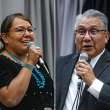
When Lesley Chavez found out she was pregnant at age 16, she saw her daughter as a blessing from God and never considered an abortion, a view reinforced by her devout Christian mother. If she could have voted at the time, Chavez would have opposed expanding abortion access.
RELATED: Kamala Harris wants to end the Senate filibuster to restore national abortion rights
But 10 years later — as she and other Arizona residents braced for a possible ban on nearly all abortions — Chavez drove over 300 miles (480 kilometers) to California to help a friend get one. That experience with someone she knew who was struggling financially and couldn’t support another child was the final push that changed Chavez’s stance on the issue.
“I just kind of felt like, dang, if I didn’t have nobody, I would want someone like me to be there. I would want someone that’s not going to judge me and actually help,” she said.
Now, she helps deliver that message to other Latinos in Arizona, one of nine states that is considering constitutional amendments to enshrine abortion rights.
As abortion-rights groups court Latino voters through door-knocking and Spanish-language ads, they say the fast-growing group could determine the outcome of abortion ballot measures across the U.S., particularly in states such as Arizona and Florida with large Latino populations.
Like other Americans, Latinos have an array of personal feelings and connections to the issue that can be impacted by religion, culture, country of origin and other things, organizers say. But their views are often misunderstood and oversimplified by people who assume they are all Catholic and, therefore, anti-abortion, said Natasha Sutherland, communications director for Floridians Protecting Freedom, which is behind an abortion measure in that state.
A recent poll from The Associated Press-NORC Center for Public Affairs Research found that about two-thirds of Hispanic Americans think abortion should be legal in all or most cases. About 4 in 10 U.S. Hispanics identify as Catholic, about one-third as Protestant or “other Christian,” and about one-quarter as religiously unaffiliated.
RELATED: Fact-checking Trump’s lies on abortion during the presidential debate
Efforts to reach Latino voters often hinge on one-on-one conversations — “old-school, boots on the ground organizing,” said Alex Berrios, co-founder of the grassroots Florida group Mi Vecino, or “my neighbor.”
Overall, about 14.7% of eligible voters, or 36.2 million people, are Latino, according to the Pew Research Center.
In Florida, 18% of registered voters are Hispanic, or 2.4 million people, according to an October 2023 analysis by the nonpartisan Latino advocacy organization NALEO Educational Fund. More than 855,000 Latinos are expected to cast ballots in Arizona for the November election, making up about 1 in 4 Arizona voters, according to NALEO.
As a lead canvasser for the grassroots Arizona group Poder in Action, Chavez has knocked on the doors of ambivalent Latino voters, persuading them to support a measure that would guarantee access to abortion until fetal viability, a term used by health care providers to describe whether a pregnancy is expected to continue developing normally or whether a fetus might survive outside the uterus. It’s generally considered to be around 23 or 24 weeks.
Living United for Change in Arizona, or LUCHA, moved the measure to the top of its canvassing script because voters kept bringing up the issue. LUCHA campaigns to low-income Latino, Black and Indigenous voters.
“People initiated the conversation like, ‘Oh yeah I just heard on the news what happened with the 1800 abortion ban,’” Abril Gallardo, chief of staff for LUCHA, said, referring to the 1864 abortion ban that the Arizona Supreme Court signaled in April the state could enforce but that lawmakers later repealed.
Another group, Mi Familia Vota, has put $200,000 toward its efforts to mobilize Latino voters to support the measure.

The official campaign against the proposal— It Goes Too Far — has enlisted Hispanic volunteers in its effort to sway voters.
Abortion is one of the most important issues in the upcoming election to about 4 in 10 Hispanic voters, below the economy, crime, and health care, and about on par with immigration, according to the AP-NORC poll.
In Florida, abortion is illegal after the first six weeks of pregnancy. The November ballot measure would legalize abortion until fetal viability.
“The Latino community is a huge part of any campaign in Florida,” Sutherland said. “We can’t win this without Latinos, so Latino outreach is essential.”
Sutherland said her group uses bilingual phone banking and canvassing efforts, hosted a bilingual campaign launch rally, hired a Latino outreach manager and holds weekly Spanish-language meetings to discuss strategy.
The opposing campaign has ads in Spanish and has a Spanish version of its website called “Vota No En La 4.”
Berrios’ group, Mi Vecino, has focused on Florida’s 9th Congressional District, which includes Osceola County and Orlando and was the first majority Hispanic district to meet the signature requirement for putting abortion rights on the ballot. Berrios tells supporters of Republican presidential candidate Donald Trump that they can vote for him and for abortion rights.
“We saw a need for a culturally competent nonpartisan effort to engage and educate Hispanic voters on reproductive freedom,” Berrios said.
For Latino men especially, it has been helpful to include messaging about limiting government decisions in family and health care decisions, several Florida organizers said.
“You need to have conversations that are tailored to the person in front of you. For folks in Florida, for example, who escaped communism in their own countries, they’re really moved by things having to do with freedom and the power to determine the conditions of their own lives. We try to be as nuanced as possible,” said Lupe Rodriguez, executive director of the National Latina Institute for Reproductive Justice.
Rocio Garcia, an assistant professor of sociology at Arizona State University, said that over time, Latinas, including those who are Catholic, have swung toward supporting abortion access, even if they would not get an abortion themselves.
Alyssa Sanchez, a 23-year-old Mexican American who is Catholic, plans to vote for Arizona’s measure. Her family members have been supportive of the issue as long as she could remember.
“You do still have to take Bibles, sayings, everything about the Catholic religion to your own interpretation,” said Sanchez, a lifelong Arizona resident. “And then battling that thought it just comes down to, I believe in people’s choice to their own bodies stronger than I believe in anything else.”
Sinsi Hernández-Cancio, vice president for health justice at the National Partnership for Women & Families, said abortion-rights supporters cannot afford to assume Latino voters do not support abortion rights, especially in majority-Republican Florida, which requires 60% voter support to pass a constitutional amendment.
“If you’re going to approach any voter with false assumptions, you’re not going to be able to connect,” she said.