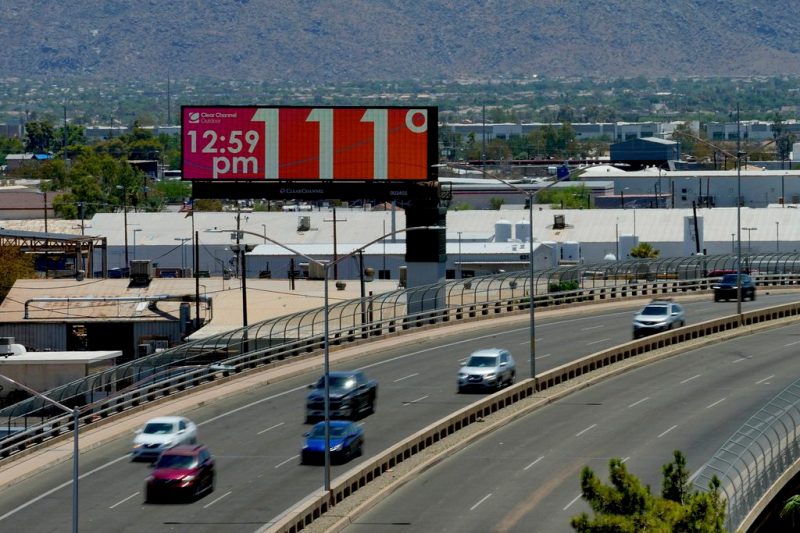
When Phoenix logged a record 113 straight days above 100 degrees in the summer of 2024, the consequences landed in the area’s hospitals and emergency rooms.
Extreme heat is the most dangerous weather condition Arizona faces, and it’s not just summer driving higher temps anymore. Extreme heat now stretches beyond summer, into the neighboring seasons.
Arizona’s first heat death in 2026 happened in early April, when the typical max temperatures reach the low-to-mid 80s, according to 1991-2020 data from the National Weather Service.
Around 4,300 Arizonans end up in an emergency room or hospital for heat-related illness in a typical year, according to the Arizona Department of Health Services. Those visits have been on an upward trend for over a decade.
Heat deaths have reached alarming levels. In its 2026 heat plan, Maricopa County reported 645 heat-related deaths in 2023, 608 in 2024, and preliminary numbers for 2025 at 427. That’s two years of decline, but it still means more than one death per day.
“Heat remains one of the most serious public health threats facing our community,” said Dr. Nick Staab, chief medical officer for the Maricopa County Department of Public Health. “Reducing heat-related deaths takes a coordinated response at every level.”
Who the heat kills
The people least able to protect themselves are often the ones who die the most often from heat. County data shows older adults, people who work or sleep outdoors, and people without air conditioning die from heat-related deaths at disproportionately higher rates.
Access to a working air conditioner can be the line between life and death. In 2018, 72-year-old Stephanie Pullman died of heat exposure in Sun City West after Arizona Public Service cut her power for $51 in unpaid bills. On the day she died, it was 107 degrees.
Her death prompted Arizona regulators to prohibit utilities from disconnecting customers during the hottest months. For people on limited or fixed incomes, an unpaid utility bill had become a matter of survival.
Infrastructure hurts
The desert also injures people in a way that places like New York City or Seattle don’t. At the Arizona Burn Center at Valleywise Health in Phoenix, surgeons treat people who fall onto the pavement.
Pavement in Phoenix can reach up to 180 degrees—hot enough to cause a second-degree burn in just seconds.
Valleywise Health only treated nine contact burn cases in 2008, when average summer temperatures were milder. By 2023, contact burn cases jumped to over 100, according to reporting from CBS News.
The Associated Press reported that in the first weeks of 2024 alone, 50 people were hospitalized with contact burns and four died.
Limited relief once the sun goes down
Modern heat is so deadly because Phoenix doesn’t really cool off at night. The urban heat island effect means that all the concrete and roads and buildings suck up and absorb the heat throughout the day, and that heat persists through the night.
In 2025, 23 nights in Phoenix never dropped out of the 90s. That’s more than triple what the city used to average in a year.
Without a cooler night, the body doesn’t get the recovery it needs, and the danger compounds across multi-day heat waves.
National Oceanic and Atmospheric Administration records show the planet’s 10 warmest years on record have all come since 2015, and forecasters expect Arizona’s trend to continue. The danger is arriving earlier, too. A record March 2026 heat wave pushed Phoenix past 100 degrees weeks ahead of schedule and forced the closure of popular hiking trails, in an attempt to protect tourists as well as locals.
The push to protect Arizonans
Arizona’s response has grown, though gaps remain. Outdoor workers gained new state heat-safety guidelines via executive order in December 2025 that call for water, shade, rest, and training.
But those rules are voluntary rather than enforceable, which still leaves workers exposed.
The state is also building public-health responses under its first chief heat officer, Dr. Eugene Livar, including a heat relief network of cooling and hydration sites and, in Phoenix, cooling centers that now stay open around the clock.
In May 2026, Gov. Katie Hobbs, a Democrat, credited the state’s heat plan for the drop in deaths and emergency visits.
“While heat-related deaths and emergency visits are down, one death is too many and our work must continue,” Hobbs said in a press release.
The progress is walking a fine line, though. Maricopa County noted that 2026 is the final year of the federal pandemic relief money that paid for much of Arizona’s expanded heat relief.
The preferred number of heat deaths in Arizona would be zero in an ideal world. But the season for heat death seems to be expanding each year, and the nights are staying warmer longer.
Visit this 2-1-1 map to find the closest cooling centers and hydration stations.