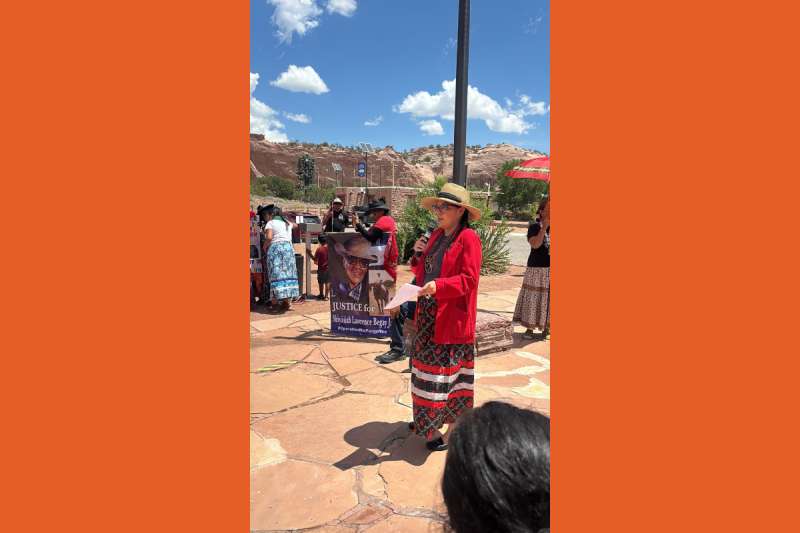
Alyssa Begay’s growing concern over the rapid expansion of AI data centers across the country has driven her to push for action before similar developments reach the Navajo Nation. She believes time is of the essence.
During the Navajo Nation Council’s opening day of the summer session, face-to-face with Navajo Nation President Buu Nygren and some of his staff, Begay voiced her concerns about the rapid expansion of data centers.
During the exchange, she discussed a three-page template resolution she drafted and later shared on her social media platforms. She encouraged people attending the session, as well as those watching online, to utilize the resolution and present it at their local chapter planning meetings for consideration.
MORE: Navajo Nation will deploy hundreds of Flock cameras. What to know
The resolution seeks to formally ban data centers on the Navajo Nation, arguing that “a predatory wave of digital-infrastructure expansion is currently targeting rural, coal-dependent, and tribal communities across Turtle Island, treating sovereign Native lands as commodities and exploiting tribal resources under the false promise of economic development.”
“After seeing corruption at multiple levels of government both on and off the reservation, I needed the people to see they had the power,” Begay told The Republic. “A tool like a resolution template seemed to be the only way to demonstrate we had the power. The voice of the people would be heard with one consistent resolution in multiple parts of the reservation. The peoples’ voice would echo beyond the three branches of Navajo Nation and hopefully inspire and motivate others that we the people have the power.”
Begay said her first real exposure to AI came from a Forbes article, probably in late 2024 or early 2025 about how much water is actually needed to sustain it. At the time, AI was mostly being used for fairly basic things, like writing real estate scripts or simple marketing copy. It wasn’t nearly as widespread as it is today, she said.
As she watched AI become more accessible and its use grow, she realized this wasn’t just another technology trend—it was something that was going to have a much bigger impact. That’s what pushed her to start learning more about it.
“As a business owner, I am watching the trend go from not really used to now used almost every day,” said Begay. “I think it’s just becoming a crutch that we’re going to eventually be fused to if we’re not careful.”
Data center plans spread across the West
When Begay says data centers are moving closer to the Navajo Nation, she isn’t exaggerating. Across every state the Navajo Nation spans, large-scale data center projects are being proposed, approved or challenged.
One of the largest is the Stratos Project in Box Elder County, Utah, an artificial intelligence data center campus that would cover about 40,000 acres across two desert valleys separated by a small mountain range. At full buildout, the campus is expected to demand up to 9 gigawatts of electricity.
The project’s potential water demand has also drawn attention. In May, officials reported that an application had been submitted to transfer 1,900 acre-feet of water from ranching use to supply the proposed Stratos hyperscale data center.
In late July, reports surfaced that the Tooele Valley Project Area was planned for western Utah, a proposal that would include a 500-megawatt data center and a truck stop. Plans also call for piping up to 250,000 gallons of treated wastewater each day.
In Arizona, metro Phoenix has 178 data centers built or under construction, according to Data Center Map. Last September, the Arizona Corporation Commission said that the state had 4,154 megawatts in planned data center developments.
In New Mexico, Project Jupiter is a 1,400-acre artificial intelligence data center campus being built in Santa Teresa, Doña Ana County. Several counties there have adopted moratoriums on new data centers following this Project Jupiter.
In Gallup—a border community serving nearby tribal nations, including the Navajo Nation and the Zuni Reservation—residents are urging the City Council to enact a similar moratorium. Their concerns intensified after an April meeting in which a representative of Teraplex Data Centers LLC outlined plans for a proposed 330-acre data center that would use an estimated 10 million gallons of wastewater annually.
Begay said her initial resolution was narrowly focused. It opposed the construction of the data center in Gallup. In June, she was able to secure approval from the Shiprock Chapter for her initial resolution opposing that project.
“So, I wasn’t even focused on the Navajo Nation at first because I was trying to get more information,” said Begay.
Another of Begay’s concerns is the Navajo-Gallup Water Supply Project. She said conversations with people familiar with the project have only deepened her worries about whether its water could eventually be used to support data center development.
“What I uncovered from an upper echelon was promises were made to give 100,000 acre-feet of water from the Navajo-Gallup water pipeline to NTUA, not just NTUA, but also possibly this other entity that is trying to come in,” said Begay, who also raised concerns about a recent water rate increase and discussed those concerns while speaking outside the council chamber with Nygren present. “And another upper echelon from McKinley County had told me that there were two efforts to bring in this data center.”
She said one proposal would locate the data center near Navajo Nation homes with homesite leases. She also said she was told that the same company was seeking to connect the project to the Navajo-Gallup Water Supply Project.
In April, there were reports that a nearly $7.3 million contract has been awarded to continue construction on the $2.2 billion Navajo-Gallup Water Supply Project, a federal initiative to deliver clean water to the eastern Navajo Nation, the southwestern Jicarilla Apache Nation and the city of Gallup.
Funded by New Mexico, the Navajo Nation’s Síhasin Fund and the U.S. Bureau of Reclamation, the completed project will include about 300 miles of pipeline, 19 pumping plants and two water treatment plants, serving an estimated 250,000 people for the next 40 years.
“So I now hear it from two different areas that this is something that could be already promised or already happening,” said Begay. “And its super concerning because that water is supposed to go to Farmington, our people, Gallup and the Jicarilla Nation.”
Navajo government reform proposal draws critics
Begay was raised in the Native American Church and is taking courses in Navajo Nation law at Diné College. Through the program, students learn about the unique legal and policy relationships between the Navajo Nation, state governments and federal entities, as well as the foundations of Navajo Nation fundamental, civil and criminal law.
The 2002 Diné Fundamental Laws are considered some of the earliest examples of the Rights of Nature being codified within a legal framework.
The Diné Fundamental Laws provide a written expression of longstanding Navajo philosophy, values and principles, including the Navajo worldview and respect for the sacredness of all creation. The laws outline the rights, responsibilities and guiding principles of the Navajo Nation and its people while codifying the Diné Life Way. The Fundamental Laws transform generations of oral traditions, teachings and philosophies into a recognized legal framework while incorporating concepts such as natural law, customary law, common law and traditional law.
“That program was designed for Navajo leaders,” Begay said about her courses. “I think if they took advantage of that and attend, that would really change their perception, because we are learning from these medicine people that are our professors…I would say its a nostalgic lifestyle that I know my grandparents and parents were a part of. So for me (Fundamental Law) is more than just a law. It’s more than just paper. It’s our life and it’s really hard for people who weren’t raised that way to grasp it, and that’s why you see a lot of these deals being made. They’re not seeing our land as a relative. They’re seeing it as a resource.”
Within her data ban resolution template, Begay says that under Fundamental Law, “the Navajo people possess an unalterable, traditional duty to serve as stewards of the land, meaning that our natural resources cannot be commodified, depleted, or sacrificed for external corporate greed without violating the natural order and spiritual well-being of the Diné.”
Over the past several months, the Office of Navajo Government Development has promoted its draft government reform proposal, raising concerns among Begay and other Navajo citizens about the language and direction of the plan in its current form. So Begay decided to try to become one of 12 commissioners on the group after having a disappointing interaction with the director of the ONGD when she brought up issues that she saw within the document.
“I had done so because I recognized that reading the 113-page paper (draft government reform) there was a lot of inconsistencies that I didn’t really like,” said Begay. “For instance, veterans aren’t mentioned at all, hataałii (medicine people) are only mentioned two times, and elders are mentioned four times. For me it needed to be more than that.”
Aside from rarely discussing these important groups, Begay said there is also “essentially the fourth branch” of the government that was introduced in the draft: the Navajo Nation Department of Energy, where voters will vote in an executive of the department. This person would be considered “the most powerful person on the Navajo Nation.”
The draft also introduced the Investors Bill of Rights, which states that the Navajo Nation commits to treating all investors fairly and in good faith. Investors cannot be denied any rights granted under the Investor Bill of Rights without due process of law, and those rights cannot be removed through a bill of attainder or an ex post facto law.
For Begay and other critics, the use of Navajo language and concepts within the document has been used incorrectly and “misappropriates sacred Diné concepts and terminology.” Critics have also argued that sections such as the Investor Bill of Rights could give corporations and investors broad access to the Nation’s infrastructure, water and energy resources without sufficient limitations.
“Investor rights does not belong in any reform of out government,” wrote Leland Grass, president of the Diné Medicine Men Association, and Avery Denny, president of the Diné Hataałii Association about the reform proposal. “Foreign companies with investment money must never be empowered to supersede our own inherent right to regulate the use of our lands. Additionally, extraction industries should not be encouraged. We must learn from the contamination, pollution, and degradation of our sacred land, air, water, plants, animals, and the health and wellbeing of our People that occurred because of extraction industries.”
Begay hopes creating a template for the public to use is the first step toward broader action. She believes that if one of the Navajo Nation’s 110 chapters can demonstrate that change is possible, it could encourage others to follow. That effort began with the Shiprock Chapter, the largest chapter on the Navajo Nation, located in San Juan County, New Mexico, when the chapter passed her initial referendum in June 2026.
Despite that success, Begay said she has faced resistance from some Navajo leaders and community members who have challenged or attempted to undermine her data center ban resolution all of which she sees as being “calculated and strategic.”
Begay said concerns about the government’s misuse of Navajo language and its provisions for industry have largely been dismissed. She said she has repeatedly heard that younger generations are not interested in traditional teachings and that too few medicine people are willing to share their knowledge, an argument she believes is being used to justify limiting traditional Diné perspectives in the reform.
“My hopes are that they are strong in taking a stand and going back to the idea of working for the thought process… and realizing that systemic oppression is real, environmental racism is real, and how are they going to fight back,” Begay said about her hopes of the incoming Navajo leadership. “You have to be brave in order to say no to such a big monster and that’s what my hopes are. I’m hoping with all the fuss I’m making it’ll inspire and motivate others to continue that fuss and amplify one another so that we as a community begin to demand more from our leadership.”
Reporting by Arlyssa D. Becenti, Arizona Republic