Angelica Garcia spent two months looking into a nearly empty fridge while the state kept her off food assistance.
Her congressman, US Rep. Juan Ciscomani (R-Tucson), had voted a year earlier for the One Big Beautiful Bill Act (OBBBA), the law that rewrote who qualifies. It also cut SNAP food assistance and Medicaid by more than $1 trillion over the next decade.
Positioned as “cutting fraud” by Republicans, Garcia doesn’t see it that way. Her family struggled to eat after Garcia lost her job in March working as a Lyft driver when her car’s air conditioning broke. To make ends meet, she turned to assistance programs, such as SNAP, and was met with bureaucracy that kept her off the program for two months, while she leaned on her community to keep her family from going hungry.
“It’s pretty dismal when you look in the fridge and there’s hardly anything. Look in your cupboards and there’s hardly anything,” Garcia said. “Luckily, we know how to make cheap meals. Healthy food was a little bit more scarce.”
For months, Garcia, a single mother, lived on potatoes, beans, rice, and other cheap staples. Struggling to find a job and without SNAP food assistance, she had to ration the little money she and her oldest daughter had to afford groceries, which have increased by about 2.7% in the last year under President Donald Trump’s administration. She relied on her family to help afford meals, promising to pay them back when she could, and even visited a local food bank for help.
“Fifty dollars doesn’t go far at all. Seeing our fridge pretty empty is a wake-up call,” Garcia said. “Times are really really rough sometimes.”
After seeing her struggle, Garcia’s youngest daughter, 14, has become far more conservative with spending, Garcia said, often trying to buy less or find cheaper alternatives to avoid financial duress. At times, her daughter would rely on snacks at the school library to avoid hunger.
“I don’t think kids should normally have that problem,” Garcia said. “They shouldn’t have to worry about the price or what their meal is going to cost.”
When Garcia called the Department of Economic Security (DES) in March, nobody answered. If they did answer, they hung up quickly, Garcia said. It wasn’t until she went into the DES office in Tucson that she met, after an hour-long wait, with a worker who instructed her to bring in the paperwork. After three visits and a lot of back and forth, she was finally approved in May.
Face to face at the Capitol
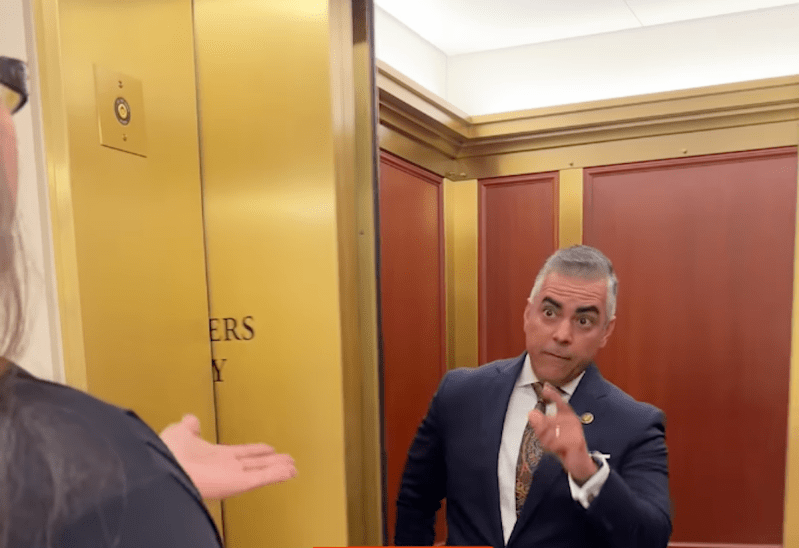
After the Center for American Progress, a liberal think tank, reached out to her, Garcia traveled to Washington, D.C., on July 21 to confront her congressman, Ciscomani, about how the cuts affect her.
In a video posted by the center on Instagram, Garcia has a brief interaction with Ciscomani on his ‘yes’ vote before the GOP representative ran off.
“It’s harming people like me,” Garcia said face-to-face with Ciscomani. In a brief reply before closing the elevator doors, Ciscomani said, “No, what it did is–”
For Garcia, the moment was about looking eye to eye with her representative and speaking up about her experience. But she said she was instead met with a “dismissive” congressman, who she said did not stop to talk with her but rather “dodged” the questions and spoke over her.
“I was pretty upset after the interaction, just by the way he responded and the way he was dismissive,” Garcia said. “That just goes to show that he’s not for the people. He’s out of touch. He doesn’t realize, or maybe he does realize, how it’s affecting thousands and thousands of people.”
Ciscomani has defended the vote publicly. At an Aug. 25, 2025 roundtable, he called claims that people with disabilities would lose coverage “the biggest pieces of misinformation out there,” arguing that the new work requirements and eligibility checks target “waste, fraud and abuse” rather than people who need the program. Prior to the bill’s passage, he signed onto letters to Republican leadership, stating he “cannot and will not vote for legislation that reduces Medicaid,” before voting for the bill just a few weeks later.
Arizona leads the nation in SNAP losses
Ever since the law passed in July 2025, Arizona has been hit the hardest in the nation, with more than 400,000 Arizonans losing access to SNAP food assistance, including 180,000 children, roughly 47% of Arizona’s caseload, according to DES.
DES said it is navigating a backlog in cases after implementing a new program to comply with new policies from the megabill. The agency added that while they’ve made some progress, outdated technology means slower processing rates for applicants.
At the time of the bill’s passage, Ciscomani downplayed concerns about the cuts, arguing the changes will strengthen social programs like Medicaid by targeting fraud and “protect it for the people that need it the most.”
For Garcia, that statement couldn’t be further from the truth.
“They’re out of touch because people who are struggling financially, or who don’t have good-paying jobs, or who are homeless, need these services,” Garcia said. “They’re not fraud.”
While cutting SNAP and Medicaid, the law, backed by all Arizona Republicans, also gave massive tax breaks to the wealthy, a stark contrast to Garcia, who struggled to feed her children under the same law that gave relief to the wealthiest Americans.
The law has hit Ciscomani’s district in particular. An analysis by the Arizona Mirror found that Southern Arizona hospitals are at risk of losing $110 million a year from Medicaid cuts, and one Tucson hospital has already closed its doors. In Pima County, too, 77,000 SNAP recipients have been thrown off the program and food banks are struggling to fill the gaps. The bill also cut Biden-era tax credits, laying off hundreds of Casa Grande workers at Lucid Motors.
Ciscomani did not respond to a request for comment by the time of publication.
Garcia had never been very political before, but she said under this administration and its policies, she’s been motivated to get more involved, including in efforts to push Ciscomani out of his seat this November, when he will face Navy and Marine Corps veteran JoAnna Mendoza, a Democrat.
The Cook Political Report has labeled this race a “toss-up.” Ciscomani won the seat narrowly both times — by just 2.5 points in 2024 and 1.5 points in 2022. National Democrats are hoping to flip the seat blue this November, and Garcia said she hopes to be a part of that push.
“I’m definitely trying to stand up and fight back, let my voice be heard if I can,” Garcia said. “We need major changes, and I’m definitely willing to be a part of that.”