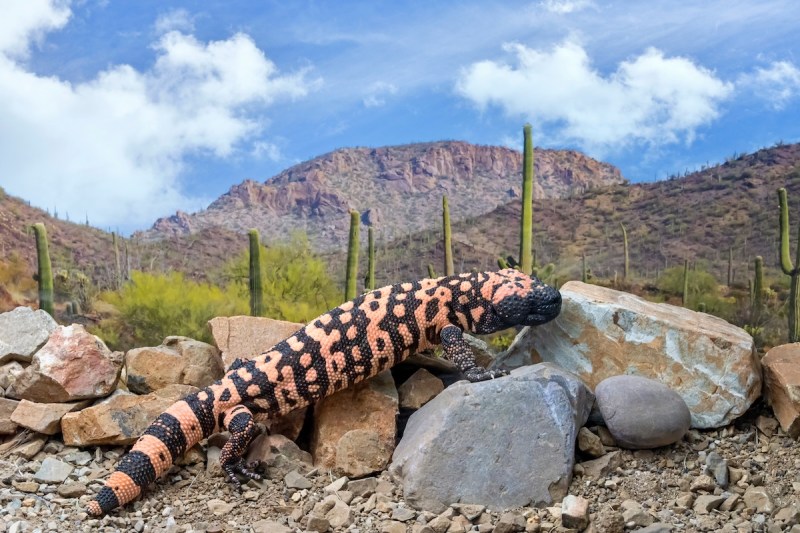
Walking along the dusty trails and mountain ranges surrounds you. As you hike along and try to watch your step, you notice a black and pink-orange lizard with bumpy, bead-like scales. But don’t get too close because you just encountered the venomous Gila monster.
These creatures are relatively slow-moving reptiles that grow to about 18-22 inches and some can grow up to 24 inches. They have short, sturdy legs and a thick tail. Gila monsters spend much of their lives underground in burrows to escape the heat, which is why it’s rare to spot them in the wild.
They come out either when it’s cooler or after rain, where you can spot them hunting for birds, small mammals or even reptile eggs.
Here is everything to know about Gila monsters and why you should avoid them.
Are Gila monsters found in Arizona?
We talked to Dale DeNardo, professor of the School of Life Sciences at Arizona State University, who told us that Gila monsters can be found throughout much of the Sonoran Desert in Arizona.
“But they are most commonly found in Upland Sonoran Desert habitat, which is characterized by having larger plants such as saguaro cacti, mesquite trees, paloverde trees and ironwood trees,” said DeNardo.
What happens if a Gila monster bites you?
DeNardo explains that Gila monster bites are almost immediately extremely painful, similar to slamming your finger in a car door repeatedly.
“Swelling will also occur, as will a dramatic increase in heart rate, up to about 200 beats per minute, which can lead to light-headedness and even fainting,” DeNardo said.
Can a human survive a Gila monster bite?
Yes, humans can survive a bite from a Gila monster. DeNardo said that the bites aren’t likely to kill healthy adults, but a man did die in February 2024 after a Gila monster.
While it’s unlikely to be fatal for a healthy adult, complications can arise in children and older adults or people with underlying health issues.
How rare is it to see a Gila monster in Arizona?
While Gila monsters actively forage for their prey, they are not commonly seen.
“One reason for not seeing them often is that during the hotter months, mid-May through September, they tend to be active almost exclusively at night,” said DeNardo. “The best time of year to see them is during the morning in April and early May when temperatures are not yet so warm to force them to be nocturnal and males are actively seeking not only prey but also mates.”
Are Gila monsters friendly to humans?
DeNardo explains that Gila monsters see humans as potential predators, so they become quite defensive upon being encountered.
“If they feel that there is sufficient distance from a human and a usable escape route, the Gila monster may simply just turn and scuttle off,” said DeNardo. “However, more commonly, they will turn and face a detected human, opening their mouth and hissing. They will not attack but will defend themselves quite effectively if someone tries to pick them up. They can turn their head extremely quickly, so being bitten on the hand is the likely outcome of any attempt to grab them.”
Seeing a Gila monster while hiking is rare, but if you do spot one, make sure to provide several feet of distance to be safe and not to stress the Gila monster.
Has a Gila monster ever killed a human?
As mentioned by DeNardo, the death of an adult male from a Gila monster bite did happen in February 2024. But before 2024, there were no documented deaths in nearly 100 years.
Where do Gila monsters live in the US?
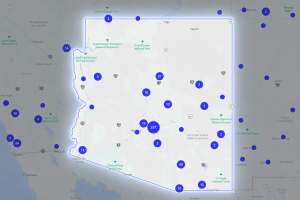
Gila monsters almost exclusively live in the Sonoran Desert of Arizona and Sonora, Mexico.
“However, their range expands east up the Gila River drainage into western New Mexico and north in the Virgin River drainage in southern Nevada and southwest Utah. There are also very rare sightings in eastern California,” said DeNardo.
Reporting by Tiffany Acosta, Arizona Republic