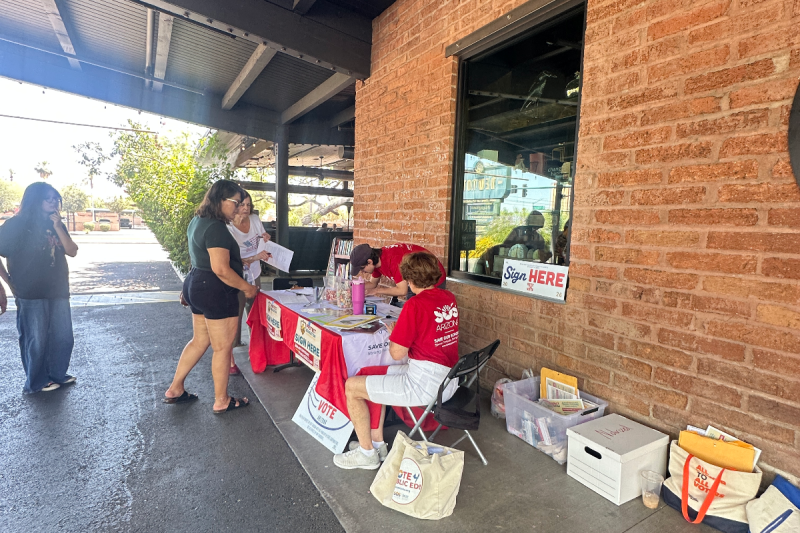
On a Wednesday evening outside of Changing Hands bookstore in Phoenix, Jean Cooper worked as a volunteer notary for the Protect Education, Accountability Now Act, a citizen ballot initiative that would put limits on Arizona’s universal school voucher program.
Cooper, 76, is a retired clinical nurse who has lived in Arizona since 1990. She still does legal nurse consulting work, doesn’t have children, and isn’t a teacher. None of her work is related to public or private education, but when the organizer at an event she attended said the campaign needed notaries, Cooper volunteered.
“Education is extremely important,” Cooper said. “It is the foundation of our culture, of our country, and we as voters need to strive to have the best foundation for our children.”
Ruth Lambert, 76, has been doing similar work for longer. She’s been in Arizona for 22 years and recently relocated in the Valley from Anthem to Buckeye. Lambert, originally from just outside Boston, attended Catholic school and then a private girls’ school during her childhood.
Despite those ties to private education, she’s been volunteering for public education for years. Her children and grandchildren went through the public school system.
Both Cooper and Lambert are spending their time on a citizen ballot measure to limit the runaway universal voucher program. Though they reached the same conclusion that vouchers need to be regulated, each arrived at there from different lines of thought.
Why this ballot measure?
The Protect Education Act would cap voucher eligibility at family incomes under $150,000 starting in the 2027-28 school year, with the exception for students with disabilities. It would ban the use of voucher money on luxury and non-education items, require schools that accept voucher dollars meet basic safety standards like background checks for staff, and require almost all unused voucher funds to return to public school general funds.
The program it would rein in, Arizona’s Empowerment Scholarship Account program, expanded to all students regardless of income in 2022. That program tops $1 billion a year and enrolls over 100,000 students.
Roughly 71% of new enrollees after the universal expansion had never attended a public school, according to a 2024 Learning Policy Institute analysis. In 2022, the Arizona Department of Education said that around 75% of universal voucher applicants didn’t have a prior record of public school enrollment in Arizona.
That means the state is subsidizing families who could already afford private or homeschooling.
12News reporting on the program documented 84,000 banned purchases ranging from luxury hotel stays to electric dirt bikes.
Arizona voters rejected voucher expansion in 2018. The Republican-majority Arizona Legislature passed the expansion anyway, and then-Gov. Doug Ducey signed it into law.
READ MORE: Arizona school vouchers—What they are and how they affect you
Organizers need just over 250,000 valid signatures by July 2 to put the Protect Education Act on the November 2026 ballot.
Jean’s path
Cooper voted for universal voucher expansion in 2018.
“I think I did vote for it because it seemed like an okay idea, that it would be facilitating those on the periphery, on the fringe,” Cooper said. “Like [people with] disabilities.”
She still thinks the underlying carve-out for students with disabilities is a good one, but what changed her mind on expansion was seeing mismanagement of the program. The reports of fraud and misuse that surfaced after universal expansion quickly soured her perception of its effectiveness.
“Maybe the voucher system isn’t necessarily bad, but the way it is being managed at this time is of concern,” she said. “The responsible spending of the money and good stewardship of the money is important, and it doesn’t seem like it is being handled appropriately at this time.”
Cooper grew up in Connecticut and went to public school for her entire education there. She’s signed many ballot measure petitions as a voter in Arizona. Her argument for why anyone, even people without children, should care about this fight about education was direct.
“Whether we have kids or not, we’re part of this community, and I think it’s important to support this community,” Cooper said. “I’m [part of the] public. So my tax dollars go for public education, and I would like it to stay that way.”
Ruth’s path
Ruth Lambert took a different route to the same place. Her parents put four of their five children through Catholic and private schools as they grew up. The difference between her parents and Arizona’s current situation? They paid for it themselves while remaining “huge public [school] advocates,” Lambert said.
“They could really separate the idea of [school] choice and funding,” Lambert said of her parents. “They knew that was their choice, and the funding of it was their responsibility.”
The distinction between choice to use a private school and the responsibility of a family to pay for it themselves is Lambert’s primary argument against the universal voucher program.
She moved to Arizona in the early 2000s, and after a decade in the state, she realized she didn’t know too much about how state government worked here.
“I could’ve been embarrassed and stayed ignorant, or I could’ve got myself down there to learn,” she said. “So that’s what I did.”
She started going to the Capitol, sitting in the gallery, and in committee meetings to listen.
What she heard concerned her enough to get involved. From there, she got involved with Save Our Schools Arizona as a volunteer and has been working with the organization since around the time of the 2018 voucher fight.
Lambert said she served as a PTA president for ten of the years her daughter was in public school, across several states.
She’s extremely pro-public education, but when she encounters a family that uses vouchers, she isn’t confrontational.
“If you have a need for a voucher, and you’re using that appropriately, I’m glad your child is getting what they need,” is how Lambert said she typically responds.
“I’ll leave it at that because I think there are people who use vouchers appropriately,” she said.
What Lambert said she is less willing to leave alone is the rhetoric she hears from Arizona Republican politicians.
Kimberly Yee, Arizona’s State Treasurer, is running to be the next state superintendent. In her Republican primary debate, she flaunted her so-called “school choice” credentials.
“Back in the 1990s, I helped write early school choice laws with charter schools,” Yee said in the debate.
“The fact that they call them government schools and not public schools, I think really tells you a lot right there,” Lambert said.
What they share
Cooper and Lambert came to volunteer for pro-public school legislation from different backgrounds.
But they both landed at similar conclusions about how public schools should be funded, and they draw the line at Arizona’s wealthiest taking their tax dollars from public schools and delivering it to private schools or homeschooling.
Cooper’s version of this is a bit shorter. “The way things are happening now, it decreases the spending opportunities for truly public education, and that compromises education,” she said.
Both women said they’ve noticed many people are puzzled about the state of education funding before signing the petition.
“They’d say, ‘Well,why do citizens have to do this? Isn’t this something that the state or the Arizona Department of Education or somebody else should take a look at and change?’” Lambert said.
Her answer to them is that the people currently making laws in Arizona, Republicans, are not going to fix it.
“They’re the ones that want to foster, you know, private industry schools,” she said.
The state legislature passed the universal vouchers expansion in 2022 despite voters rejecting a similar measure in 2018 by a roughly two-to-one margin. Thousands of banned purchases have been allowed to be made. The ballot initiative exists because the conventional levers of power haven’t worked or mirrored what the public expressed they wanted.
Neither Cooper nor Lambert has a child presently enrolled in Arizona K-12 public schooling.. They technically do not have any skin in the game anymore.
Despite that, Cooper expressed that it is important to remain civically engaged.
“You pay taxes too, and don’t you want to have some say in how your taxes are spent?” Cooper said, “This gives you that opportunity.”