As data centers pour into Arizona, the state is already straining under a water crisis and extreme heat concerns. That issue is playing out in the race for the state’s 1st Congressional District, which spans Scottsdale, Paradise Valley, Cave Creek, Fountain Hills and parts of Phoenix.
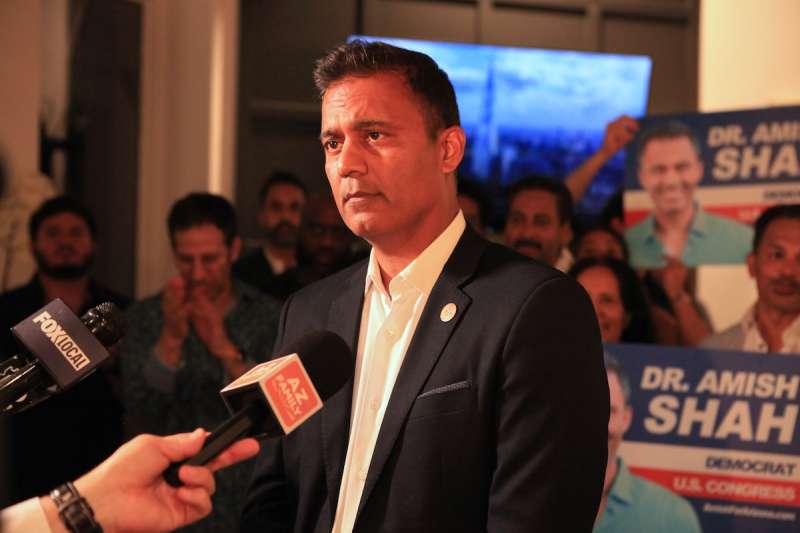
Democrat Amish Shah, a former state lawmaker and emergency room doctor, says he’s running for Congress to fix things, and the data center boom impacting the 1st district is on his list. It’s also one area where he differs with his Republican opponent, former NFL kicker and CBS analyst Jay Feely.
Feely has expressed strong support for AI data centers, a position he shares with President Donald Trump. Shah, on the other hand, has a firm stance: no new data centers in Arizona’s First Congressional District.
Arizona is home to more than 150 data centers, according to Data Center Map, and the growth has been met with fierce opposition from Arizonans across the state. In areas near data centers, residents report tainted water supplies and higher electric bills, which advocates attribute to the large amounts of water and energy data centers use.
Shah says that in a state with a more than 20-year-long drought and limited water resources, there’s no need for more data centers in the district he’s seeking to represent.
“We are here in the desert, running out of water,” Shah said. “The Trump administration cut our allocation recently, and he wants to put data centers into CD 1. Not on my watch. You’re not going to put a bunch of data centers here to chew up more of our water, which is just going to hit people in the pocketbook.”
Earlier this year, the Trump administration cut 30% of Arizona’s Colorado River water supply—the largest cuts among the seven states and tribes that rely on the river. The plan will run through 2028.
Shah said Arizona is in “a particularly vulnerable position.” Without an ocean or desalination plants, the state has limited water supplies but increasing strains—like data centers—that threaten its survival, he said.
If elected to the US House, he’d fight against the cuts, he said. He also suggested potentially paying other states for their water rights.
Data centers, water and power bills
Shah proposed putting data centers in parts of the country that have the resources, rather than drought-stricken Arizona. He isn’t opposed to data centers in the US, but argues placement should account for areas that can afford the water and energy strain—unlike Arizona’s 1st district.
“We can’t have them here in our district,” Shah said. “We can have them in other places in America where they have an abundance of water, which we don’t have here.”
He added that developers should account for their high energy usage to ensure costs don’t get passed on to consumers. The concern isn’t hypothetical. Arizona Public Service (APS) requested a 14% rate hike from the Arizona Corporation Commission in 2025. If approved, Arizonans can expect to pay an additional $240 a year.
An Arizona State University study found that in areas near data centers, temperatures increased by about 4 degrees. In a state like Arizona, where temperatures can reach 120 degrees, even a few degrees can make dangerous heat worse for state residents—and increase energy bills even further for those nearby who need to keep cool.
Arizona has been a hot spot for developers after the state implemented sales and use tax incentives for computer data centers in 2013, which provided a 100% exemption from Transaction Privilege Tax and Use Tax on qualifying equipment for up to 20 years. In June, Democratic Gov. Katie Hobbs axed the tax incentives and said the money would be rerouted to childcare and healthcare. Data center developers rushed to submit applications before the moratorium went into place in July. Developers can still build in Arizona, but will no longer receive tax breaks.
Shah added that utility companies should consider renewable and clean energy to ensure grid reliability and keep costs low for Arizonans.
Seven out of 10 Americans oppose AI data centers in their communities, according to a Gallup poll. Most cited concerns about the environment and traffic impacts on surrounding areas.
AI accountability
Shah says AI has a place in the US, but it must be developed responsibly—and overseeing it is Congress’ job.
AI leaders have been sounding the alarm that companies are rushing forward without adequate guardrails in place.
“They are racing straight to self-improving superintelligence and gambling with our lives,” Anthropic researcher Jacob Coxon wrote in a post on X. “The people building AI earnestly believe that it could kill us all by the end of the decade.”
Earlier this month, Arizona’s Democratic Rep. Yassamin Ansari (D-Phoenix), penned a letter to the Trump administration calling for international efforts to slow development.
“We strongly urge your administration to lead a coordinated international effort to establish a global framework to guide the development of this technology and a shared vision for AI end use,” Ansari wrote in a letter signed by fellow members of Congress.
Despite the warnings, Trump and other GOP leaders have opposed regulations, arguing the US must achieve AI dominance over other countries, despite the risks.
“The only control or ‘guardrails’ that AI needs is a STRONG AND SMART (High IQ!) PRESIDENT, and the USA has that, in spades,” Trump said in a Sept. 14 post on Truth Social.
Shah doesn’t see it that way.
“I’m squarely on the side of AI safety. Human dignity and human safety is non-negotiable, as far as I’m concerned,” Shah said. “AI has the potential in the future to provide benefits, but we have to make sure that any technology that we use has to be used responsibly.”
Where does Feely stand?
Feely has consistently been pro-data center, even as National Republicans acknowledge it’s a losing stance for the GOP.
At the June Republican primary debate, Feely argued in favor of data centers, arguing that developers should invest in surrounding areas and use recirculated water to lower impacts on communities. His then-opponent, Rep. Joe Chaplik (R-Scottsdale), pushed back, stating that while he doesn’t oppose data centers, he doesn’t want any in the district.
“Joe Chaplik actually was on the right side of this when he said that he didn’t want data centers here, and with that sentiment, I agree,” Shah said.
In an August appearance on “The Sean Spicer Show,” Feely argued the US must lead the way in development to beat China.
“We are in a race with China to win the AI generation that’s coming. It will define who wins the world’s economy and controls the world economy,” Feely said. “By proxy it’s gonna define who controls the world’s security. So we don’t have a choice if we’re gonna win, we have to win it. We can’t let China win.”
Beyond rhetorical support, Feely has benefited from $600,000 in spending by Leading the Future, a pro-AI super PAC.
Feely did not respond to a request for comment by the time of publication.
The two will face off in the Nov. 3 election. Early voting begins Oct. 7.