April Butler’s family has lived in Surprise for six generations. She’s seen jets crash at nearby Luke Air Force Base, watched the state’s air quality worsen, and lived through the water crisis.
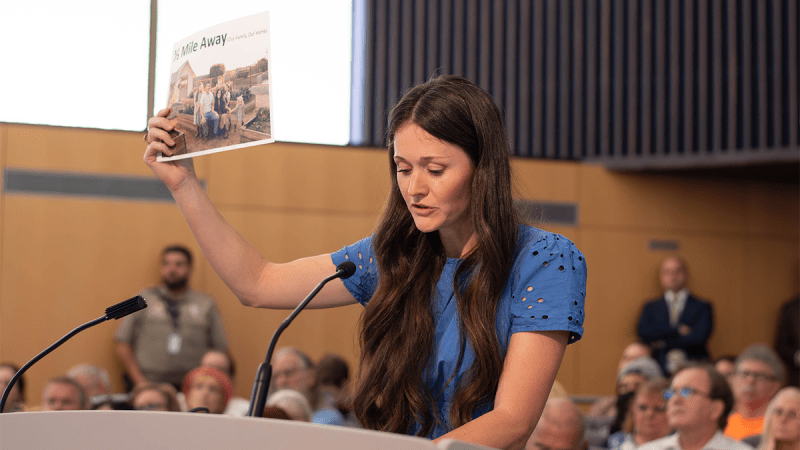
On May 6, Butler walked up to the Maricopa County Board of Supervisors and implored them to consider the health of her community and vote against a military compatibility permit for Project Baccara, a $36 billion data center campus near the city of Surprise.
“Why would anybody think this would be a good site, so close to homes, so close to the end of a runway,” Butler said.
She wasn’t alone. Dozens of residents spoke in opposition to ‘Project Baccara,’ a 160-acre data center site, but the roughly three-hour meeting ended with the board voting 4-1 to approve the special military permit developers needed to proceed with construction.
‘We’re all choking and sick’
“We’ve got a fire that’s burning right now, and we’re all choking and sick, and now they’re gonna put this in my backyard? Butler said. “I’m extremely disappointed. My grandchildren are going to have to live with this for many, many years. It’s going to impact generations and their health.”
The project would place two data centers and a natural gas power plant about 400 feet away from about a dozen homes, according to Tom Ellsworth, director of the Maricopa County Planning and Development Department. The county received 553 emails opposing the project and more than 8,000 signatures on a Change.org petition, compared with five emails in support.
Supervisors also expressed concern regarding the data center’s proximity to Luke Air Force Base, a military site with a history of crashes. In a letter from the base’s commanding officer, the Department of the Air Force said the construction is not currently “compatible and consistent with its high noise or accident potential zone,” before offering a series of steps for the developers to take to ensure compatibility.
“A catastrophic fire in these facilities could result should an aircraft mishap occur on site,” the letter reads, and that “mitigation measures for a gas plant failure are critical to avoid risking the health/safety of Luke Air Force Base personnel and surrounding communities.”
At the meeting, Ed Bull, a lawyer for Project Baccara, told the board the company’s CEO had accepted all of the Air Force’s conditions in writing..
It was convincing enough for most of the board.
Steve Gallardo was the lone dissenting vote, citing concerns about its compatibility with the military site along with air quality concerns.
“Is this compatible for the Luke Air Force Base military area? I have a hard time swallowing that. With that, I will be opposing the motion,” Gallardo said.
More data centers, worse air
Local residents also expressed concerns about its proximity to the base along with air quality and environmental issues. Maricopa County already ranks among the most polluted counties in the country, and the data center could make it worse, they said.
Arizona already has more than 100 data centers operating in Maricopa County alone. A state report released this year warned that the pace of data center construction is outpacing the grid’s ability to support it, with potential rate impacts for residential customers.
In communities near data centers, residents have dealt with higher utility bills and drained water resources. A preliminary study from Arizona State University found that data centers are warming nearby communities by “several degrees,” and as the state deals with a water crisis, activists warned that a new data center could worsen Arizona’s drought conditions.
Hollie Tolmachoff, a mother who lives less than half a mile away, said the community’s concerns were dismissed. “You can’t drink data, you can’t eat data,” she said, questioning why Arizona keeps bearing the burden of the nation’s data infrastructure.
“We have been giving real data from across the country and across the world, showing that these types of things are just extremely unsafe,” Tolmachoff said. “I have four young children, all under the age of nine, and those populations are most impacted by the sound, the pollution, and the things being put in the water.”
Beth Mortensen, another nearby resident, cited fears over 360,000 gallons of propane stored on-site and the impact on local air quality. Residents say there are limited mechanisms available for them to express their opposition to the implementation of this project. “I feel that getting to the people that actually make those decisions is very difficult, and having them actually hear our side is really hard in a two-minute window,” Mortensen said.
The proposed site sits in unincorporated Maricopa County, though the city of Glendale recently voted to begin annexation proceedings for the property. The Arizona Corporation Commission approved an environmental compatibility certificate for the project’s power plant in a 5-0 vote in February, clearing an earlier regulatory hurdle.
With the permit approved, construction is expected to begin in the third quarter of 2026, pending approval. The first building is slated to come online in 2028 — the second, in 2030. A recent Pew Research Center analysis shows that as of February, Arizona has become one of the nation’s leading data center hubs and had more data centers operational or planned than most other states — a fact that, for the neighbors of Project Baccara, makes the clock feel like it’s already been running for a while.
“The reality of the situation is that a lot of the data that we use this for is not necessary for everyday life. It might be a luxury. It might be the trend right now, but it’s not necessary compared to clean air, clean, available water,” Tolmachoff said.