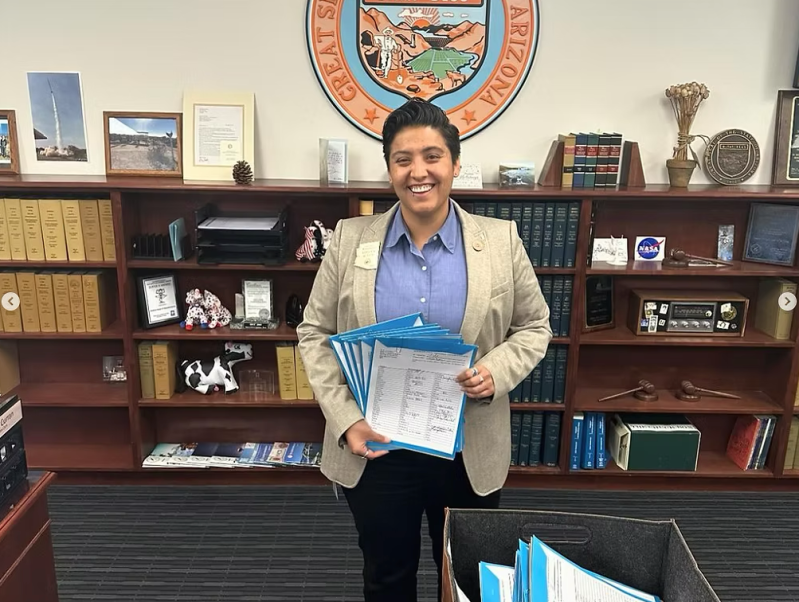
Arizona State Rep. Lorena Austin knows what it’s like to work multiple jobs and still barely scrape by. They have lived in subsidized housing, gone without knowing where the next meal would come from and felt a constant cloud of uncertainty.
Austin’s economic vision is simple: Arizonans shouldn’t have to struggle to make ends meet the same way they once did.
Austin, who goes by they/them pronouns, was elected in 2022 to represent District 9 in the state House, which covers west Mesa and a small portion of east Tempe.
Their Mesa community is what fuels them to continue to advocate for affordability.
It’s evident that people are struggling in my district and in the entire state, Austin said. About 13% of Austin’s district lives below the federal poverty threshold.
Since Austin’s election, and re-election in 2024, they have watched what they call the backwards priorities of Arizona’s Republican-controlled state legislature take shape, they said.
“It’s really flabbergasting to me, I think being here has shown me that our priorities are in the wrong place, and I think they should be in the place of making sure that people don’t have to work multiple jobs to live, shouldn’t have to live paycheck to paycheck or be derailed by one medical bill,” Austin said.
While seniors on fixed incomes can’t keep up with the cost of living, and people avoid ambulances over fear of the bill, Republican lawmakers have pushed to regulate flying cars, Austin said.
“There’s so many ways that I envision this state being better, I know it can be better, but we have to have the right priorities in place and the right people there to make it happen,” Austin said. “We can have a government that works for the people, but we have to get the right people there who believe in that.”
The urgency behind Austin’s message has fresh data behind it. A report released on April 14 by the Common Sense Institute, a center-right think tank, ranked Arizona 45th in the nation for affordability — seventh-worst overall. Arizona households now spend about $19,300 more per year on essential expenses than they did in 2019, with shelter and utility costs up 59% over the same period. Before the pandemic, the state ranked 33rd.
Austin is trying to be that “right person” to make it happen, but keeps running into the same obstacle: a Republican majority determined to block any Democrat-backed bill on affordability.
“I just wish more people here [in the state legislature] had more of that relatable type of history, because I think it would impact what legislation we run,” Austin said.
Pushing for affordability
Austin has never had a bill receive a committee hearing in all three years they have been in office, though that’s not for lack of trying.
“My opinion is because I’m in a more competitive district, that’s one of the reasons why my bills don’t get heard,” Austin said.
Austin’s district is one of the state’s most competitive, with a near-even split of registered Democrats, Republicans, and independents. They won the seat by just over 2%, in the 2024 election.
It’s not just Austin—the rest of the Democratic caucus faces the same problem with getting their bills heard.
Democrats make up 44% of the legislature, yet not a single bill they sponsored has reached Gov. Katie Hobbs’ desk this session. Meanwhile, 105 Republican-sponsored bills have been sent to Hobbs, according to the Arizona Agenda. Last year only 11 Democratic bills made it through.
“If you’re a Democrat, the likelihood that you’re getting a bill heard is very small, I don’t think that’s fair, I don’t think that’s very democratic,” Austin said.
Republicans have controlled both chambers of Arizona’s state Legislature for decades, and there has never been a Democratic trifecta—where the party controls the governor’s office, the state Senate, and the state House—in the state’s modern history.
Republicans currently hold a slight majority, 33-27, in the Arizona House; and in the State Senate, 17-13. As the majority party, they control the committees that bills receive a hearing in, so Democrat-backed bills never get assigned to be heard in the first place.
It hurtful and frustrating to Arizonans who are struggling, Austin said. “‘They might perceive or say, “why is no one doing anything on affordability or to really help us?” and we’ve submitted so many bills, they just don’t get hearings,” Austin said.
Legislative track record
For the past three years, Austin has proposed a bill that would create a state retirement savings program to help self-employed workers and others — such as restaurant and service workers — who lack access to an employer-sponsored retirement plan.
“Everyone who starts to work should have something to show for it,” Austin said. “I was that person, I worked in bars and restaurants and even grocery stores, and I didn’t have access to a pension, and I wish I would have.”
Austin sees the role of the government as to improve the lives of people in every way possible, they said. “But I think we’ve set up generations before us to fail financially, and I don’t think we can afford to do that anymore.”
They are the original sponsor of the bill that helped to create the Arizona Promise Program—even though the bill itself was never heard—a scholarship program for eligible Arizona residents that covers tuition and fees at Arizona’s public universities, and has continued to help secure funding for it in years that have followed.
Austin introduced a bill in 2023 that would have addressed Arizona’s affordable housing crisis by allowing municipalities to develop middle housing to duplexes, triplexes, and townhouses in residential zones, which are often more affordable. However, a bill proposed by a Republican lawmaker to allow middle housing on lots zoned for single-family use within one mile of a central business district, for municipalities with populations of 75,000 or more was passed into law in 2024.
And a similar bill that would have allowed for more affordable, accessory dwelling units to be developed on single-family or multifamily home lots.
This year, and years prior, they introduced a bill to create a childcare workforce scholarship program for people earning below 85% of the state medium income who work in education.
None were considered before a committee of lawmakers.
Beyond their own sponsored bills, Austin has co-sponsored legislation to create paid family and medical leave, ban price gouging on housing rentals and eliminate junk fees for renters, among other measures.
Despite the setbacks, Austin remains optimistic.
“I know this seems like a really dark time, but I really think I’m seeing our communities start to rally and galvanize for one another, and that’s and that’s what we need,” Austin said. “‘My family’s motto is “adelante, siempre adelante.” Forward, always forward, and I hold on to that.”