In a single Arizona budget year, the Grand Canyon State is on track to spend over $1 billion on a school voucher program with little oversight—and at the same time has cut around 181,000 children off federal food assistance.
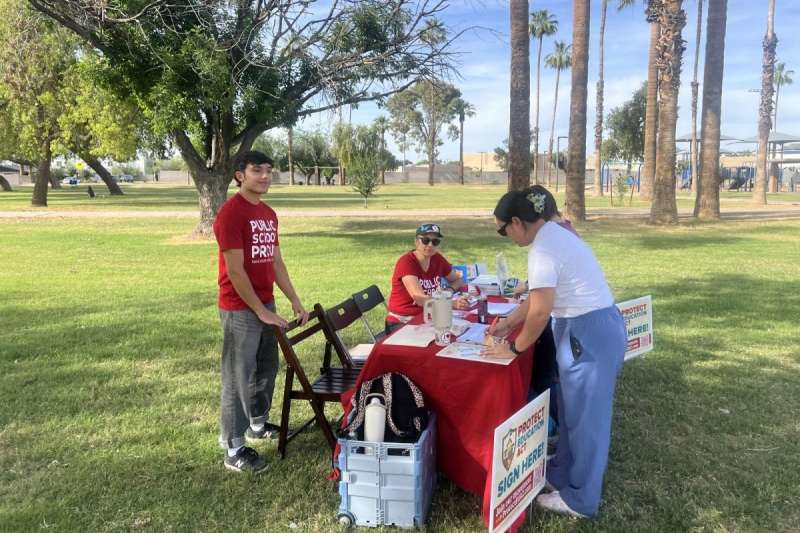
Maxwell Foster is a seventh-grade social studies teacher in Phoenix. He spent eight years in elementary school classrooms before moving to middle school. When he’s not in the classroom, he’s been out and about collecting signatures to fix what he perceives as a problem in Arizona education, calling it “policymakers who are neglecting public schools.”
“They know that this is happening and they’re apparently just shrugging their shoulders or saying ‘So what?’ that this money is being wasted. This is money that could be used for public schools in a positive way, and the waste is just being allowed to happen,” he said.
Foster is collecting signatures for the Protect Education, Accountability Now Act. It’s a citizen-led ballot initiative aimed at reining in Arizona’s Empowerment Scholarship Account program. In its fourth year as a universal program it’s grown to over 100,000 students and ballooned past $1 billion per year.
‘They are the families in need’
Foster said his district’s budget is worse than it was just five years ago, because pandemic-era federal funding has gone away and there isn’t money for support staff that used to be there.
“There are positions in our school district that we had to just let go of, or collapse [multiple jobs] into one,” Foster said. “Because we don’t have the funds for it anymore.”
He estimated that he, and most, teachers spend hundreds of dollars out of pocket every year on classroom supplies. Most recently he spent money on poster boards for a project that didn’t come with all the materials needed.
One of the things that stayed with Foster from this year was a food drive his school ran after the federal SNAP changes took effect over the summer.
“I had plenty of students that couldn’t bring in food to donate,” he said. “They are the families in need.”
In Arizona, the Trump administration’s SNAP cuts have already pushed hundreds of thousands of people off food assistance, including roughly 181,000 children, as families and schools absorb the fallout. Educators and advocates say that means more students are arriving hungry, while schools and food banks scramble to fill the gap left by reduced benefits.
Across the country, 47% of all SNAP recipients were removed from the rolls. That’s the fastest reduction in the history of the program—and points to the Trump administration kicking people off the rolls, not supporting them into better economic situations.
“The dramatic drop cannot be explained by a rapid improvement in people’s economic well-being or reduced need for help affording food,” according to a report from the Center on Budget and Policy Priorities.
Foster said most of his students who struggle with completing homework assignments aren’t purposely neglecting their studies. He said they complete everything in class and show a high aptitude for the curriculum.
“I know that it’s not a lack of work ethic. They’re too busy taking care of their family at home. They don’t have the luxury, really, of being able to continue being a student at home.”
How to get more money back into public schools
Arizona’s Empowerment Scholarship Account program, also known as universal vouchers or the ESA program, lets parents take 90% of the state funding their child would have generated by attending a public school and use that money for private schools, homeschooling, tutoring, or other educational expenses.
ESAs are available to every Arizona student, regardless of income. The Arizona Department of Education estimated in 2022 that around 75% of the ESA applicants didn’t have any record of public school enrollment, which means Arizona taxpayers were immediately on the hook for students who were already attending private schools or getting homeschooled before the state started to subsidize it.
The Protect Education Act that Foster’s been collecting signatures for would limit ESA voucher eligibility to families earning less than $150,000 a year starting in the 2027-28 school year, with an exception for students with disabilities. It would also ban the use of voucher money on luxury and non-educational items, and require schools that accept voucher dollars to follow basic safety rules, including background checks for staff. And it would require 90% of unused voucher funds to return to public schools.
To make the November 2026 ballot, organizers and volunteers need to gather around 250,000 signatures by July 2.
Public school budgets are squeezed from another direction too. When families lose SNAP, for example, their children automatically lose certification for free school meals, and the portion of the federal funding that follows those students into their schools.
Tara Lathrop, a longtime Save Our Schools Arizona volunteer and current board member whose son is a freshman at Arizona State University and was a K-12 public school student, has her own pitch to voters when they walk by.
“Typically I’ll just say ‘Hey, would you want to sign a petition to protect education?’” she said. “If they haven’t heard of it they’ll ask what that means? And I’ll usually start off by explaining the impact of the ESA program and that our public schools are losing a billion dollars a year as a result of this program.”
If the Protect Education Act makes the ballot, it won’t be the first time Arizonans will have been asked to make a decision on school vouchers. In 2018, voters rejected an expansion of the universal ESA program by a roughly two-to-one margin. Two years later, voters passed a ballot measure to increase income tax by 3.5% on Arizonans who made $250,000 or more.
Meanwhile, Arizona has been below the national average in both student testing proficiency and in funding.
How we got here
Arizona’s state revenue picture is front and center when it comes to what gets funded and when. Former Gov. Doug Ducey, a Republican, signed a flat tax into law in 2021. That law didn’t officially change the tax code until 2023, after Gov. Katie Hobbs, a Democrat, took office.
Ducey’s tax cut was essentially a deficit ticking time bomb. By reducing state revenue just as universal ESA spending was climbing, the flat tax left lawmakers with less room to fund public schools and other services—forcing them to reshuffle spending and make cuts to close an over $1 billion gap.
When the new federal SNAP rules hit last summer, the state had basically no fiscal cushion.
Arizona also faces a potential $195 million federal penalty in two years if it can’t bring its SNAP error rate down to the new federal target. The state’s options for absorbing that cost are limited by the same tight budget that’s funding the voucher program.
Error rate isn’t a fraud measure. It’s a federal accounting metric that captures how often caseworkers issue benefits in the wrong amount. That could mean too much or too little money, usually because of paperwork mistakes, miscalculated income, or processing errors. Error rates are a measure of mistakes, not fraud, yet it punishes the recipients.
Lathrop didn’t hesitate to say what she thinks about a billion dollars going to vouchers while families lose food assistance.
“I think that’s heartbreaking,” she said. “Arizona doesn’t collect enough revenue to properly fund our public services in the state.”
What now?
Foster said reform via the ballot measure wouldn’t just cut back on waste—it would actually help the responsible families who aren’t abusing the ESA program. He said he’s talked to ESA parents in his community who told him that they want the program tightened.
“This initiative also benefits people who have been using the ESA vouchers in a responsible manner,” Foster said. “This is not an initiative against school choice at a philosophical level.”
“Public schools are like the glue that really binds together communities, and communities are like the bedrock of our society. If we neglect them, we’re going to end up with a worse-off society.”
In the meantime, Lathrop and Foster will continue to collect signatures one at a time between now and July in the hopes that other Arizonans still care about public education. Though the food drive at Foster’s school ended, the need it tried to meet is not.