When Tucson passed an ordinance in March barring ICE from city-owned property, it set off a legal fight that’s now playing out at the state’s highest levels.
Immigration and Customs Enforcement (ICE) agents have ramped up operations across Arizona to meet President Donald Trump’s goal of deporting one million immigrants per year, arresting residents at courthouses, restaurants and stores despite protests from the local community.
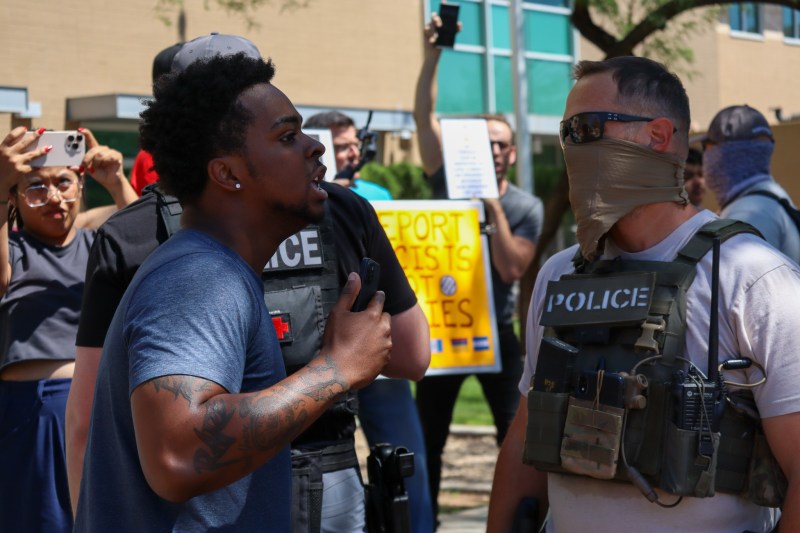
The mass deportation agenda has resulted in immigrants afraid to leave their homes, families being separated, and with it, a massive mobilization effort against ICE, with demonstrations across Arizona calling for an end to the immigration crackdown.
Now, local governments are pulling up their sleeves and getting involved in the fight to push back and defend Arizona’s immigrant communities.
Earlier this year, two major Arizona cities—Tucson and Phoenix–moved to block federal authorities from using city-owned property to conduct operations, including staging and processing, without city permission.
But, is that legal?
Arizona Attorney General Kris Mayes says yes. In back-to-back formal rulings, she rejected Republican-filed complaints against Phoenix’s policy on April 29 and a similar ordinance from the Pima County Board of Supervisors on May 6 — concluding both times that limiting access to government property doesn’t amount to restricting immigration enforcement. “Refusing to help is not the same as impeding,” she wrote. Her rulings give legal cover to any Arizona city or county that wants to pass a similar policy.
But Arizona Republicans aren’t backing down. In March, Rep. Quang Nguyen (R-Prescott) filed the first complaint with Mayes’ office, asking her to assess whether Phoenix’s ban on ICE violates state law. Arizona law forbids counties, cities and towns from limiting or restricting the enforcement of federal immigration laws to “less than the full extent permitted by federal law.”
In a news release, Nguyen said, “Phoenix has no authority to put the enforcement of federal immigration law behind a political gatekeeper. Phoenix crossed the line.”
Her office later rejected the complaint filed by Arizona Republicans, stating that the city limiting access to certain properties does not rise to the level of “limiting or restricting” immigration authorities’ ability to enforce immigration law. Mayes said the law prohibits local governments from taking actions against federal agents, but nothing in either state or federal law requires local officials to cooperate with the federal government.
Arizona State University law professor Khaled Beydoun agrees, arguing that “it’s nuanced,” but yes.
Under Article VI of the Constitution — the Supremacy Clause — federal law takes priority over state and local law. That means no state or local body can create laws that would conflict with the federal government’s authority as it could disrupt national unity.
That does not mean states and local bodies can’t create their own laws, it just means they must do so in a way that ensures local laws do not interfere with the federal government’s rule.
What makes these cases legally defensible, Beydoun said, is ICE’s conduct under the Trump administration. He said Trump’s “aggressive overreach” gives local officials the right to create their own policies pertaining to ICE, so long as they do not impede on immigration enforcement.
“The position cities are taking is that ‘this is not immigration policy, this is overreach in the federal government,’” Beydoun said. “Acting with impunity in ways that really tread on the governmental authority of local government.”
Beydoun said allegations of racial profiling also strengthen the cities’ legal case of federal overreach and why it must create such policies to ensure trust between the local government and its communities.
“It’s not only individuals who are undocumented that are being arrested and detained,” Beydoun said. “There’s also a lot of racial profiling going on, especially in Arizona, where there’s massive Latinx and Native communities being racially profiled.”
Last year, the Conservative-leaning Supreme Court cleared the way for ICE agents to racially profile, stopping anyone they suspect could be undocumented based on factors such as race, employment, or spoken language. Immigration officials have long used racial profiling as a means to make arrests. Arizona has its own history: Senate Bill 1070, the 2010 ‘Show Me Your Papers,’ law that allowed officers to ask for the legal documents of anyone they suspected could be undocumented.
Beydoun argued that the mass deportation agenda has flipped “a fundamental touchstone of the American system,” which is that individuals are innocent until proven guilty.
“In this instance, individuals are being demonized and treated as guilty before given an opportunity to engage in any process,” Beydoun said.
What the policies can’t do
The policies don’t give Phoenix or Tucson the power to stop ICE operations altogether. They make it harder — not impossible — for the agency to operate within city limits. A full ban on immigration enforcement would conflict with the Supremacy Clause, Beydoun said.
“They’d be wrong to say that they have no immigration charge, and they’re not doing that,” Beydoun said. “They’re basically saying that you can’t set up these permanent staging checkpoints. The cities are essentially saying that what you’re doing is disabling us from engaging in the kind of governance that is reserved to us— by not only the federal Constitution, but state constitutions.”
Arizona Republicans have pushed back hard, filing formal complaints and demanding Mayes intervene.
But for now, the law — and Arizona’s attorney general — appear to be on the cities’ side.
“The Constitution doesn’t extend complete, unfettered authoritarian control to the federal government to engage in aggressive policing, because states have rights as well,” Beydoun said. “Cities have rights as well, rights to govern residents and citizens within their bounds the way they see fit.”