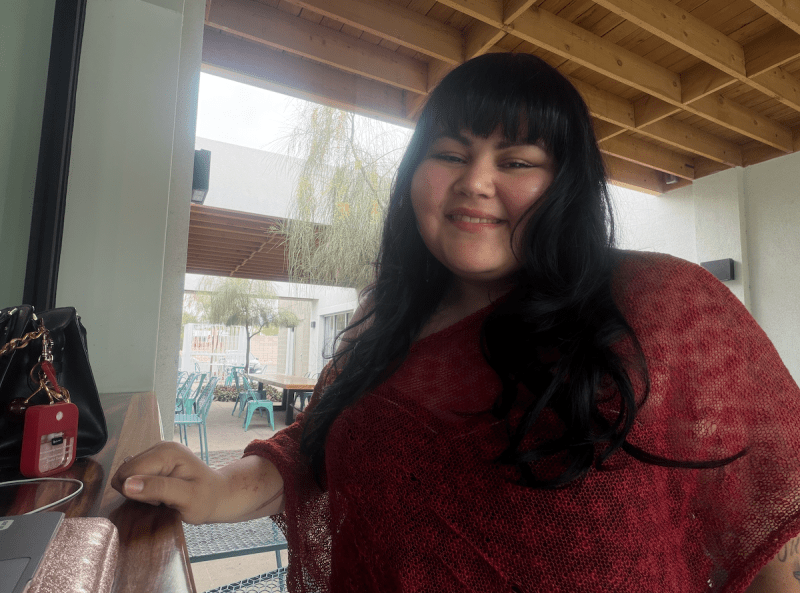
Karla Toledo’s Monday morning started like any other. She woke up, ate breakfast, and got dressed for work in her bright yellow dress.
But her life changed at around 8:40 a.m. May 18 when five Immigration and Customs Enforcement (ICE) agents showed up at her doorstep.
“It was terrifying. They tried to be intimidating, to humiliate–it’s just who they are,” Toledo said. “Their intent is to be deceiving.”
Toledo, 31, has lived in the US since she was 1 year old and has been enrolled in the Deferred Action for Childhood Arrivals (DACA) program since 2012 — the same year it was created. Her case is part of a broader pattern: immigration arrests in Arizona more than tripled in fiscal year 2025, and a federal appeals court has ruled that DACA recipients are no longer automatically protected from deportation.
As of April 4, more than 60,000 people were being held in ICE detention — the highest number in US history — as a result of President Donald Trump’s mass deportation agenda. The additional $170 billion from Trump’s One Big Beautiful Bill Act offered ICE more funding to expand operations, including an extra $45 billion for building new facilities.
Toledo knew her DACA status was intact, valid through July, and she’d renewed it months earlier.
After agents attempted to enter her home, she asked them to show her a warrant first. As a local leader who has educated herself on her rights, she knew they couldn’t just come in.
Despite her repeated requests, they failed to produce one, she said. The intentional deception from the agents made her question what she knew to be true, especially after one ICE agent said, “Now you want to play the game, ‘Oh now it needs to be signed by a judge,’ We know what we’re doing. We have a warrant, and it’s signed.”
After roughly 10 minutes, Toledo began to accept what was next. She was placed in handcuffs, still dressed in her bright yellow dress that she would’ve worn to her 9-5.
“I was hysterical. I didn’t know what to do,” Toledo said.
An ICE spokesperson disputed Toledo’s account of the incident, stating that Toledo assaulted an ICE agent at her doorstep, a claim Mo Goldman, Toledo’s attorney, called “pure fiction.”
“ICE arrested Karla Toledo, an illegal alien from Mexico, during a targeted immigration enforcement operation,” the statement read. “During the operation, Toledo assaulted a law enforcement officer—a felony offense—who was attempting to apprehend another individual.”
The spokesperson added that Toledo entered the US in 2024, and was released by the Biden administration, and that ICE had an active warrant for her arrest.
Goldman refuted ICE’s claim, stating that Toledo exited and re-entered the country using advance parole, a type of travel document which allows DACA recipients to legally leave the country.
The spokesperson confirmed that Toledo filed for DACA renewal in January, but that DACA “does not confer any form of legal status in this country.”
“While Toledo filed to renew her DACA status in January 2026, any illegal alien who is a DACA recipient may be subject to arrest and deportation for a number of reasons including criminal activity.”
Toledo also told The Arizona Daily Star that an ICE official threatened to charge her with assault unless she helped agents take her husband into custody — a conversation she said took place while she was still detained at the Tucson ICE field office.
In the back of an ICE van
The DACA program, created by then-President Barack Obama, provides temporary deportation relief, work permits, driver’s licenses, and Social Security numbers for some immigrants brought to the US as children.
But it didn’t seem to matter. She was in the back of an ICE van.
Alone in the back of an ICE van during the roughly 25-minute ride to the Tucson ICE Field Office, Toledo said she kept pressing the two agents for answers.
“I was feeling alone. I was very scared, but regardless, I kept talking, asking for a supervisor, because it wasn’t fair, because they were claiming one thing when it was another,” Toledo said.
Once at the facility, Toledo experienced what she described as prisonlike conditions — it was freezing cold, the bathrooms were exposed, and the atmosphere, chilling. She said she was unable to get in touch with her family members or even her lawyer.
On the other side of the wall, her community was fighting for her. Derechos Humanos, Party for Socialism and Liberation (PSL) and Scholarships A-Z organized an emergency rally outside the ICE field office.
Toledo said she could hear protesters shouting her name from inside her cell, which earned the attention of other detainees and even the ICE agents guarding her.
“A door was opened, I was in a cell, but I was able to hear my name in the protest,” Toledo said. “I had no idea that it was going on, and that’s when I realized that my community showed up.”
Toledo said the ICE agents appeared “freaked out” by the protests and avoided going outside to face off with them.
Aside from a brief call with her mother, Toledo’s only contact with the outside world was someone she didn’t really expect — US Rep. Adelita Grijalva (D-Tucson), who visited her at the facility and became one of the most vocal members of Congress calling for her release.
“I definitely did not expect to see her,” Toledo said.
Bouncing between facilities
Later that night, Toledo was transferred to the Florence Correctional Center. For three hours, Toledo said she was chained around her stomach and wrists with no seatbelt or anything to take hold of to stabilize herself. The ICE agent drove erratically, she said, which led to her hitting herself against the chains repeatedly.
Worse, once they arrived after about an hour’s drive, Toledo said she and the others in the van had to wait for hours before processing could begin — a problem she blamed on overcrowding.
Toledo tried to stay present rather than live in fear. But it was at this point when the fear really came alive, as she was all alone and far from the only home she’s ever known.
“I’m scared. I’m terrified. I’ve never gone to Florence. I was really anxious, just sitting there and waiting, not knowing what’s next,” Toledo said.
When she arrived, there wasn’t enough bed space for the women, which meant by the time she was finally processed by around 11 p.m. on May 18, she said she had to sleep on the floor with nothing but a blanket in an area designed to be an eating space. She hardly slept, instead talking through the night with a woman who arrived at 3 a.m.
Outside the facility, community groups continued demanding her release. The media, members of Congress, and even national news were all discussing Toledo’s case.
It wasn’t until an ICE agent connected her with a Mexican Consulate worker that Toledo began sensing how big her case had become. When the agent told her it looked like “big trouble,” she was afraid. She didn’t know the trouble he meant was for ICE.
On May 19, ICE facilitated her final transfer to the Eloy Detention Center, one of the deadliest detention facilities in the country. The drive wasn’t too bad, Toledo said. The wait was.
After arrival, Toledo said she had to wait 18 hours during intake—screenings and health assessments—before being sent into the detention facility. An agent told her she was being processed faster because of her high-profile case. Other inmates had to wait a grueling 26 hours, she said.
She was waiting with about 30 other women, she said, and recalled everybody sitting uncomfortably on the floor. The room was extremely hot at times, and ICE agents would sometimes refuse to open a window despite their requests, she said.
“It was horrible,” she said.
The conditions inside weren’t any better, she said. The food was “terrible,” and “suspicious,” Toledo said.
An ICE spokesperson disputed Toledo’s account, stating that all ICE facilities operate under performance-based national standards that are audited by external agencies
“All detainees receive three meals a day, clean water, clothing, bedding, showers, toiletries, and access to phones for communication with family members and lawyers,” the spokesperson said. “Meals are evaluated by certified dieticians, and comprehensive medical care—including medical, dental, and mental health services—is provided from the moment an individual enters ICE custody.”
For Toledo, unaware of what was going on outside the facility, and with no contact with her lawyer, it came as a surprise when she was told her bond had been paid–about $1,500.
By 3 p.m. on May 22, she was walking out of detention toward the people who had been fighting for her all week.
A new normal
She’s still afraid. The incident was traumatizing, having ICE agents pounding on her door, being treated so carelessly, and being shuffled between facilities despite having active DACA status.
“I’m still processing. Whenever I get to my car, I look around,” Toledo said. “If I hear a door slam close to my house, I look at cameras, I’m very overwhelmed, I feel very anxious, and I’m trying to get over it, but I just feel like I can’t.”
Toledo, who goes by ‘Karlangas’ on social media, is known for her outreach with immigrant and low-income families and serves on local boards. Multiple outlets describe her as a community influencer.
Now that she’s out, Toledo still has an uphill battle ahead of her. She’s preparing to fight deportation proceedings. She’s also channeling the experience into a desire to help the detainees she met during her time in detention.
To stay sane in detention, she focused on the present and avoided thinking about the possibility of a longer stay — far from her husband, parents, loved ones, and beloved home of Tucson. What helped her was conversing with the other detainees in Spanish, learning about their stories and their time in detention, she said.
“I was trying to accept what had happened, but I just couldn’t accept it,” Toledo said. “I was just trying to not think about it. I knew that if I kept thinking of my situation, I would just freak out and go into shock.”
She spoke to women who had signed up to self-deport but were still being held weeks later, immigrants who said ICE lost their passports and other necessary paperwork, and other women who had been stuck there much longer than her.
She can’t forget them. She’s organizing a a community bike ride and book drive to donate Spanish books to the facility for some of the inmates she left behind.
Toledo is vowing to fight for immigrants who might be living in fear, and is calling out the Trump administration for targeting law-abiding community members rather than the criminals they pledged to go after.
“They do treat us like criminals, but that rhetoric is not true. We’re human beings, we are just as normal as you are,” Toledo said. “We pay our taxes, we do everything that is necessary to be in this country. We deserve to be here.”